Watch the film
| Size in ft: | Width: 3'4" x Length: 5' |
| Size in Inch: | Width: 40" x Length: 60" |
| Size in meters: | Length: 1.52 x Width: 1.02 m |
| Colors: | Navy Blue, Antique Rust Red, Light Blue, Ivory, Sage Green, Apricot |
| Shape: | Rectangular |
| Woven: | 100% Hand-knotted | Handmade |
| Foundation: | Cotton |
| Pile: | |
| Age: | Circa 1940's | Antique |
| Design: | Feraghan | Floral Medallion | All Over Floral Field |
| Origin: | Persian Sarough | Made in Persia |
| Condition: | Excellent | Ready to use |
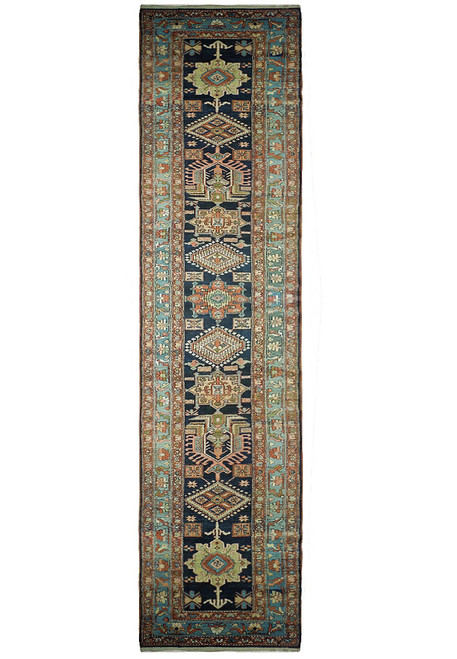
3'4" x 5' Persian Sarough Rug | Antique Feraghan Floral Medallion | 1940s Navy & Rust
A small piece with the drawing of a much larger one. This 3'4" x 5' rug is an antique Persian Sarough woven in the 1940's on a cotton foundation with a hand-spun wool pile, and the back shown in images 9 and 10 tells you immediately that this is village and workshop work of a good year: even rows, tight knotting and every flowerhead legible from behind. The ink navy field, the rust red medallion and the ivory guard bands have all softened the way only decades of real wool and madder dyes do. At 40" x 60" it sits comfortably among our 3x5 Persian rugs, and it ships with a certificate of authenticity confirming origin, age, materials and hand-knotted construction.
Design and Motifs
The layout is the classic Feraghan formula worked in miniature. A rust red diamond medallion sits dead center, stepped and toothed along its outline, carrying an inner cartouche of light blue that frames an 8 petal rosette in cream, gold and crimson. Slender finials run off the medallion top and bottom into the field, each ending in a small cypress and vase motif. Around it the navy ground is filled edge to edge with an all over floral lattice: small rosettes, carnations, serrated leaves and curling tendrils, drawn loosely enough to breathe but packed so there is no empty ground anywhere. The 4 corners are solid rust red spandrels filled with gold scrolling vine, apricot palmette heads and hooked returns that answer the medallion exactly. The border system runs 5 bands: a narrow reciprocal edge, an ivory and gold guard with a running vine, a wide navy main border of alternating red palmettes and sage green rosettes linked by a meandering stem, then a matching guard and a final reciprocal band at the selvage. Both ends finish in the original hand-knotted ivory fringe.
The Navy, Rust and Light Blue Palette
The field is a deep ink navy, nearly black in low light and clearly blue where the raking light in images 7 and 11 catches the pile. Against it the medallion and spandrels read as antique rust red, a warm madder tone that has aged toward brick and terracotta rather than fading, with flecks of true crimson still showing in the newer-looking knots at the base of the pile. The quiet surprise is the light blue inside the medallion, a dusty robin's egg shade that cools the center and is picked up again in dozens of tiny flowerheads scattered across the field. Sage and olive green carry the leaves and several of the border rosettes, apricot and gold run through the spandrel vinework and the guard bands, and soft rose pink appears in the smaller blossoms. The ivory and butter gold guard stripes keep the navy and rust from running together and give the whole rug its outline. It is a dark, saturated, library-toned palette that sits beautifully on walnut or wide-plank wood floors, as image 2 shows.
Sarough Weaving and the Feraghan Tradition
Sarough is a village in the Arak district of central Persia, and the Feraghan plain just north of it gave the region its most enduring pattern language: the dense all over floral field, the toothed medallion and the palmette border seen here. Sarough weavers built a reputation on heavy, tightly packed wool that wears for generations, and the weight of this piece in hand is the proof of it. The knotting is fine for village work, close enough that the medallion outline stays crisp and the small rosettes keep their petals rather than blurring into dots, which is exactly what separates a good 1940's Sarough from the looser commercial output of the same decade. Wool from the Zagros flocks takes madder and indigo deeply, which is why these colors have mellowed without going pale. If you want to understand how the dyes, drawing and back structure place a piece in a decade, our guide on how to date an Oriental rug walks through the same clues we used on this one.
3'4" x 5' Persian Sarough Rug | Antique Feraghan Floral Medallion | 1940s Navy & Rust
Ask about this rug
This piece is the only one of it, so the things worth knowing about it are particular to it. If you want to talk through the size, the colour in your own light, or the weave, speak to someone here first.