| Size in ft: | Width: 10'5" x Length: 13'4" |
| Size in Inch: | Width: 125" x Length: 160" |
| Size in meters: | Length: 4.06 x Width: 3.18 m |
| Colors: | Taup, Blue, Brown |
| Shape: | Rectangular |
| Woven: | Hand-Knotted |
| Pile: | Wool |
| Origin: | Persia |
| Design: | Kermanshah |
| Age: | 1940's |
| Condition: | Very Good- Low Pile, Stable Would Take Heavy Traffic |
10'5" x 13'4" Persian Kermanshah Rug | Antique Taupe & Blue Floral Medallion | Circa 1940s
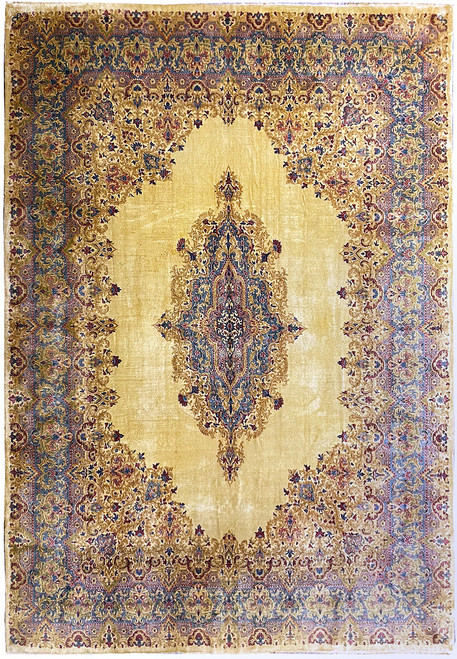
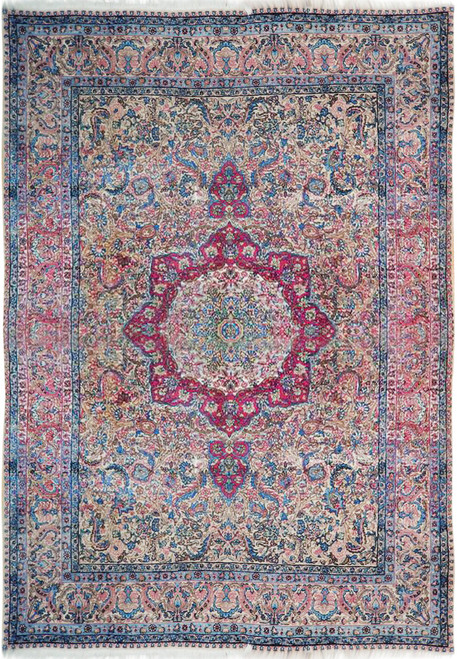
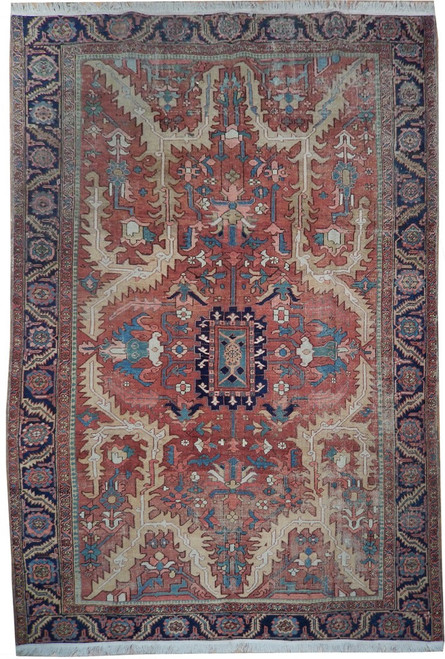
This is an antique room size piece from the 1940s, hand-knotted in wool on a cotton foundation and drawn in the classic Kermanshah manner: one large radiating medallion floating on an open taupe field, framed by an indigo palmette border and a stack of narrow ivory guard stripes. Decades of light have pulled the palette down into something quiet and powdery, the kind of surface decorators pay a premium for and cannot fake. At 10'5" x 13'4" it covers a full seating group with the furniture on the rug, and it sits comfortably in the band of 10x13 Persian rugs that suit large living rooms and formal dining rooms. Every rug we ship carries a certificate of authenticity confirming it as a genuine hand-knotted piece made in Persia.
Please Note About the Photographs:
This rug is roughly 80 years old and wears its age honestly. The pile is low and even across the field, which is exactly what produces the soft, washed look you see in the close-up photos. It is not a defect and it is not fading in patches: the foundation is sound, the selvedges and ends are intact, and the rug will take heavy traffic. Every piece is professionally cleaned, steamed and pressed before it leaves our Freeport warehouse.
Design and Motifs
The center holds a wide sunburst medallion built in concentric rings: a tiny blue eye at the core, a corona of ivory lancet leaves, then two full rounds of deep navy petals, each one filled with its own miniature palmette and rosette. The drawing is entirely curvilinear, with not a straight line in the field, and the weaver kept the two halves in near perfect mirror across both axes. Out of the medallion run thin arabesque vines that spiral into large cloud-band scrolls in the 4 corners, each scroll cradling serrated leaves and small cypress-like sprays. The spandrels are filled rather than left blank, carrying dense floral sprigs that dissolve into the ground. The main border is a procession of alternating boteh-shaped palmettes and lobed ivory blossoms on indigo, bracketed by 3 narrow guard bands of running vine and 4 petal flowerheads that step the eye down from the border to the field.
A Palette of Taupe, Indigo and Faded Sky Blue
The ground reads as a warm greyed taupe with a faint blush cast, closer to old plaster than to beige, and it shifts noticeably as you walk around the rug because the low pile catches light differently from each end. Against it, the medallion and border work in two very distinct blues: a dense inky indigo that still holds full saturation in the petals and the main border, and a much lighter powder and sky blue that pools through the field around the medallion and in the corner scrolls, the result of a natural indigo that has softened unevenly over 8 decades. Ivory and pale cream carry the drawing, outlining every leaf and blossom so the pattern stays legible even where the pile is lowest. Threads of soft brown and a muted teal green appear in the leaf work, with occasional apricot and rose touches inside the petal cartouches. The overall effect is cool, pale and low contrast, which is why this coloring works so easily with grey, white and natural oak interiors.
Kermanshah Weaving and the Kerman Tradition
In the rug trade, Kermanshah has long been used as a grade name rather than a strict map reference: it marks the finer, more finely drawn end of the Kerman school of weaving in southeastern Persia, the workshops that specialized in curvilinear medallions, cartoon-drawn florals and soft local wool. That heritage shows here in the accuracy of the medallion, the confident spiral of the corner scrolls and the way the border repeat lands cleanly at every corner, which only happens when a proper cartoon and an experienced master weaver are behind the loom. The wool is the giveaway on age: it is glossy, slightly silky underfoot and has taken the years without going brittle. If you want to understand the physical clues that place a piece like this in the 1940s, our guide on how to date an oriental rug walks through the same markers we used, from the hand-spun foundation and the dye behavior to the way the ends were finished.
10'5" x 13'4" Persian Kermanshah Rug | Antique Taupe & Blue Floral Medallion | Circa 1940s
Ask about this rug
This piece is the only one of it, so the things worth knowing about it are particular to it. If you want to talk through the size, the colour in your own light, or the weave, speak to someone here first.