| Size in ft: | Width: 11'8" x Length: 15'8" |
| Size in Inch: | Width: 140" x Length: 188" |
| Size in meters: | Length: 4.78 x Width: 3.56 m |
| Colors: | Butter, Green, Blue, Peach, Brown |
| Shape: | Rectangular |
| Woven: | Hand-Knotted |
| Pile: | Wool |
| Origin: | Persia |
| Design: | Kerman |
| Age: | 1940's |
| Condition: | Excellent |
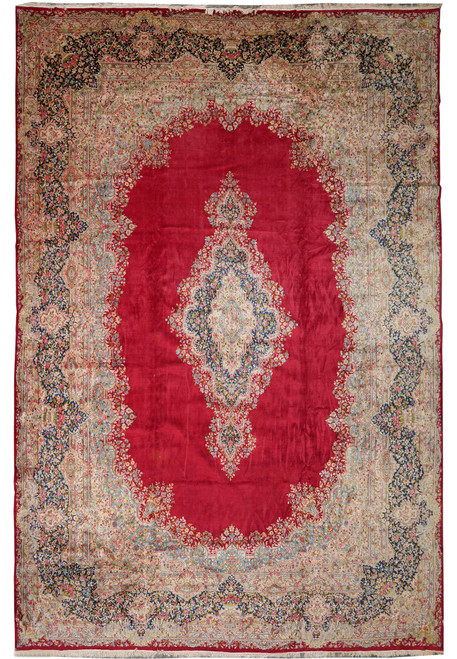
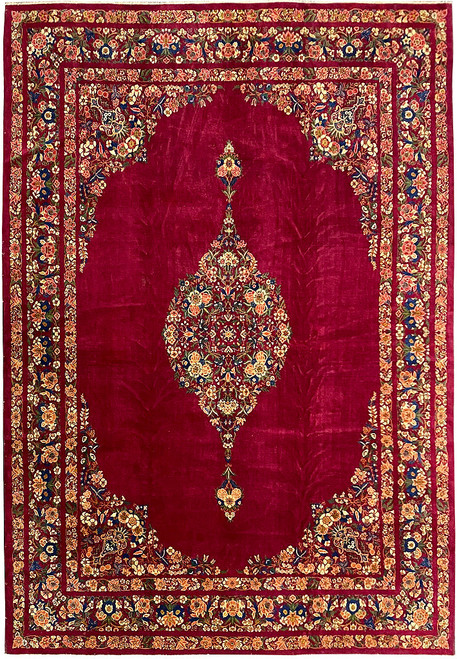
11'8" x 15'8" Persian Kerman Rug | Open Butter Field, Blue Floral Medallion | Circa 1940s
Kerman built its reputation on open ground and fine drawing, and this 11'8" x 15'8" piece from the 1940s makes the argument plainly. A soft butter gold field is left almost bare through the center, so the lobed blue medallion and the deep floral border each get room to read from the far side of a room. The wool is long, glossy and still standing full after roughly 80 years, the selvages are intact, and the pile is even across all 140 inches of width, with no thin areas or repairs. It is one of the more genuinely liveable oversize Persian rugs in the warehouse, and it ships with our certificate of authenticity.
Please Note About the Photographs:
These images were shot on different days under different light. The butter field photographs warmer and slightly pinker in the first studio view and cooler and creamier in the close-ups, and the long wool pile changes tone as it catches light from either direction. That shift is the natural sheen of the wool, not fading, wear or damage. Every rug is professionally steamed and pressed before it leaves us.
Design and Motifs
The center holds a wide, horizontally set medallion: a rose and blue cartouche wrapped around an ivory heart of interlocking arabesques and small cream rosettes, ringed by a blue ground crowded with tiny blossoms, and finished top and bottom with slender pendants that taper to a point. From the medallion, feathery scrolling leaves and curling vine tips spill out onto the empty field and dissolve into single stemmed flowers, so the eye travels outward rather than stopping at an edge. The 4 corners carry dense ivory spandrels packed with palmettes, carnations and lacy leafwork, their outlines drawn in brown and wine. The main border runs on blue, filled with alternating palmettes and blossom sprays joined by pale vines, with narrow guard stripes on ivory holding a repeating flower and leaf chain on each side. Drawing this curvilinear at this scale is exactly the skill the Kerman looms were known for.
The Butter Gold Field and Its Blue, Peach and Green Palette
The field is butter: a warm golden ivory that leans toward soft cream in daylight and glows amber where the pile lies against the light. Against it the medallion reads as a clear mid blue, closer to French blue than navy, cooled further by the same blue in the main border. The secondary colors are the pastel range Kerman is loved for, peach and dusty rose in the medallion cartouche and in the border palmettes, a muted sage green in the leaves and calyxes, and cream picked out in the rosettes. Deeper accents of wine red and a few notes of dark indigo punctuate the corners and the small field flowers, while a soft brown carries most of the outlining and keeps the pastels from floating. Brown also tints the scrollwork closest to the medallion, giving the open ground its faint antique warmth. It is a light rug overall, which is why it settles so easily into rooms with pale walls, wood floors and older furniture.
Kerman Weaving in Southeast Persia
Kerman sits in the high desert of southeast Persia and has been a workshop town, not a village tradition, for centuries. Its weavers worked from full cartoons drawn by professional designers, which is what allows a curved medallion and a continuous vine border to hold their line across nearly 16 feet of length. This piece is built the classic way, a fine cotton foundation carrying a wool pile left relatively long, so the surface has weight and a silky luster rather than the dry handle of a coarser weave. The 1940s output from these looms went largely to American houses, and the pastel and open field formula seen here is the signature of that period; if you want to understand how weavers, wear patterns and back structure are read, our guide on how to date an oriental rug walks through the same evidence we used. What makes this one worth attention is not just the age but the state of it: full pile, sound sides and ends, and colors that have mellowed without going flat.
11'8" x 15'8" Persian Kerman Rug | Open Butter Field, Blue Floral Medallion | Circa 1940s
Ask about this rug
This piece is the only one of it, so the things worth knowing about it are particular to it. If you want to talk through the size, the colour in your own light, or the weave, speak to someone here first.