| Size in ft: | Width: 10'4" x Length: 14'1" |
| Size in Inch: | Width: 124" x Length: 169" |
| Size in meters: | Length: 4.29 x Width: 3.15 m |
| Colors: | Burgundy Pomegranate, Green, Blue |
| Shape: | Rectangular |
| Woven: | 100% Hand-knotted | Handmade |
| Foundation: | 100% Cotton |
| Pile: | |
| Age: | Circa 1940s |
| Design: | Kerman Floral | Pendant Medallion | Open Field |
| Origin: | Persian Kerman | Made in Persia |
| Condition: | Excellent |
10'4" x 14'1" Persian Kerman Rug | Burgundy Pomegranate Open Field with Floral Medallion | 1940s, Excellent Condition
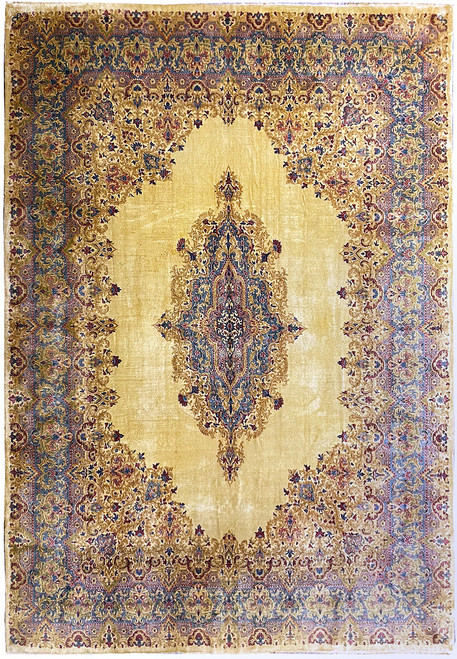
Woven in Kerman in the 1940s, this rug has spent roughly eight decades doing exactly what a good Persian floor piece is supposed to do, and it still reads clean and full. The pile stands high, the fringe on both ends is intact, and the wool has that faint sheen you only get from long, slow use on a well drawn ground. The layout is confident and restrained: a wide open pomegranate burgundy field, one lobed floral medallion set dead center with a small pendant above and below, and floral spandrels closing the 4 corners into a quiet arch. At 10'4" x 14'1" it belongs in the 10x14 Persian rug range that formal dining rooms and long living rooms actually need, and genuine mid-century room-size Kermans in this condition do not surface often. It ships with a certificate of authenticity.
Please Note About the Photographs:
Under studio and daylight the field photographs brighter and pinker than it looks in a room. In person the ground is a deep burgundy pomegranate with a cool undertone, not the hot magenta the close-up shots suggest. The soft diagonal bands visible across the open field in a few images are light play and shadow from pallet storage, not wear, not fade and not damage. They relax once the rug is laid flat, and every rug is professionally steamed and pressed before it leaves us.
Design and Motifs
The drawing is pure curvilinear Kerman floralwork, all naturalistic garden flowers rather than stylized palmettes. The center medallion is built from concentric rings of full blown roses, cream daisies and blue iris buds radiating out from a single 8 petal rosette, with feathery green leaves and thin ochre vines tying every bloom into the next. Above and below it, slender stems carry small pendant bouquets out toward the ends, which is what keeps such a large open field from reading empty. The corner spandrels repeat the same vocabulary at a larger scale and add a small footed vase at each apex, a signature Kerman touch. Three borders frame the whole thing: a narrow inner guard of running vine, a wide main border of rose bouquets and morning glory trumpets set on the same burgundy ground, and an outer stripe of paired blossoms. Nothing in the design is mechanical, and the flowers change slightly as they travel around the border, which is the mark of hand drawn cartoon work rather than a repeated stamp.
The Burgundy Pomegranate Field, with Green and Blue
The field is a saturated burgundy pomegranate, the color of ripe fruit skin, and it shifts gently between a cooler wine tone and a warmer raspberry as the light moves across the pile. That natural variation is abrash, the honest signature of small dye lots, and it gives the open ground depth that a flat machine color never has. Against it the palette is deliberately cool: deep indigo and cobalt in the iris petals and leaf tips, two greens in the foliage, a soft forest and a lighter sage, and a full range of pinks running from pale blush through salmon to a strong coral in the border roses. Cream and ivory blossoms do the heavy lifting, lifting the medallion off the field and outlining the spandrels, while touches of ochre and mustard warm the vinework. If you are shopping burgundy and red Persian rugs, this one leans jewel-toned and floral rather than dark and heavy, and it sits very comfortably with walnut, mahogany, brass and cream upholstery.
Kerman: Weaving Town and Quality
Kerman sits in the southeast of Persia, a high desert city with a weaving tradition that reaches back to the Safavid period and a reputation built on two things: naturalistic garden drawing and unusually soft, long-staple wool. Kerman weavers worked from detailed painted cartoons, which is why their roses look like roses and their borders read like a garden rather than a geometry lesson, and the local wool takes dye beautifully while staying supple underfoot. This piece is classic 1940s workshop production from that town: a cotton foundation, a single-weft curvilinear weave fine enough to carry the delicate stems and petals cleanly, and a pile clipped at medium height so the flowers stay crisp. The wear pattern, the fringe treatment and the dye behavior all line up with that period, and if you want to understand how those clues are read, our guide on how to date an oriental rug walks through the same evidence. What you are buying is a mid-century room-size Kerman that has been cared for rather than restored, still whole on all 4 sides and still full of color.
10'4" x 14'1" Persian Kerman Rug | Burgundy Pomegranate Open Field with Floral Medallion | 1940s, Excellent Condition
Ask about this rug
This piece is the only one of it, so the things worth knowing about it are particular to it. If you want to talk through the size, the colour in your own light, or the weave, speak to someone here first.