| Size in ft: | Width: 10' x Length: 13'3" |
| Size in Inch: | Width: 120" x Length: 159" |
| Size in meters: | Length: 4.04 x Width: 3.05 m |
| Colors: | Champagne, Green, Blue, Rust |
| Shape: | Rectangular |
| Woven: | 100% Hand-knotted | Handmade |
| Foundation: | Cotton |
| Pile: | |
| Age: | 1900's | Antique |
| Design: | Kermanshah | Star medallion | All-over floral field |
| Origin: | Persian Kermanshah | Made in Persia |
| Condition: | Excellent |
10' x 13'3" Persian Kermanshah Rug | Antique Floral Star Medallion | 1900s Champagne Field
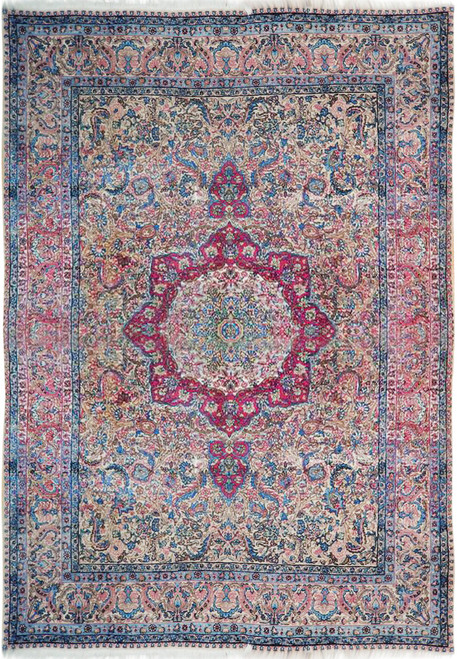
Woven in Persia in the 1900s, this antique Kermanshah has come through more than a century with its drawing fully legible and its low 1/4" wool pile still even from end to end. The ground is a pale champagne, and across it sits a very large 16 point star medallion in ink navy, drawn so wide that it reaches most of the way to the side borders. What separates a piece like this from later floral weaving is that nothing is left empty: the champagne field behind the medallion is packed with small roses, buds, leaf sprays and thin stems, all drawn at the scale of a fingernail. It is one of the better preserved examples of the type we have handled at this size, and it makes a genuinely usable floor piece rather than a wall-only antique. Among 10x13 antique Persian rugs it is an unusually complete survivor, and it ships with a certificate of authenticity documenting origin, age, materials and hand-knotted construction.
Please Note About the Photographs:
The first full overhead photograph was taken under warmer light and reads more olive and gold than the rug does in person. The close-up and angled photographs are the accurate ones: the ground is a pale champagne with rose and raspberry tones through the medallion and borders. This is a lighting difference only, not fading, wear or two different areas of color.
Design and Motifs
The composition is a classic court-style layout built in three layers. At the center is a raspberry rosette on a champagne cartouche, ringed by curling ivory leaf scrolls and small vase and blossom motifs, and that center sits inside a broad 16 point navy star whose points end in lobed floral cartouches. Around the star, a second ring of navy trefoils and shield shapes steps outward into the field, each one filled with its own miniature rose garden. The field itself is an all-over floral: single stemmed roses, carnation heads, five petal blossoms and fine tendrils, drawn small and repeated with a light hand so the eye reads texture rather than repetition. The 4 corners carry deep burgundy spandrels filled with pale arabesque vinery and cusped outlines, and these frame the field without closing it in. The border system runs five bands deep: a wide navy main border of rose vines, flanked by champagne guard stripes carrying the flowering shrub and blossoming tree motif that Kerman weaving is known for, then narrow rose and gold minor stripes at the outer edge. Read the border on its own and it is essentially a garden panel repeated all the way around the rug.
Color Palette
The base note is champagne, a soft straw ivory that shifts toward warm gold where the light catches the low pile and toward cool cream in the shaded areas. Against it the medallion and main border are an almost black indigo navy, which is what gives the rug its structure from across a room. The third color, and the one that decides the character of the piece, is rose: it runs from a clear raspberry at the medallion core through mid pink blossoms across the field to pale blush in the border flowers, with true burgundy holding the corner spandrels. Green appears as olive and sage in the leaves and stems, never as a block of color, so it reads as foliage rather than as a field tone. Rust and old gold sit in the small vase forms, the outer guard stripes and the stems of the shrub border, and there are pinpoints of clear blue in a few rosettes that lift the whole palette. The overall effect is light, a champagne and rose rug with navy weight, and it suits a room with pale walls, warm woods and antique gilt far better than the heavy red and navy palette most people picture when they think of a Persian antique.
Origin and Weaving Quality
Kermanshah is the name the trade has used since the late 19th century for the top grade of this southeastern Persian floral weaving, the pieces drawn on paper by a master designer and executed at a knot count fine enough to hold a curved line. You can see the whole case for it in the close-up photographs: the outlines of the medallion points are smooth curves, not stepped stair lines, and the individual rose heads are only a few knots across. The thin 1/4" pile is original to how the type was woven, clipped low from the loom so the drawing stays crisp, and the cotton foundation keeps a rug this size flat and stable on the floor. The back photograph shows a tight, regular weave with no repairs interrupting the grid, and the pile is even across the field rather than low at one end, which is unusual in a piece of this age. If you want to understand how the palette, drawing and weave together place a piece in the 1900s, our guide on how to date an Oriental rug walks through the same evidence a dealer uses in the hand.
10' x 13'3" Persian Kermanshah Rug | Antique Floral Star Medallion | 1900s Champagne Field
Ask about this rug
This piece is the only one of it, so the things worth knowing about it are particular to it. If you want to talk through the size, the colour in your own light, or the weave, speak to someone here first.