Watch the film
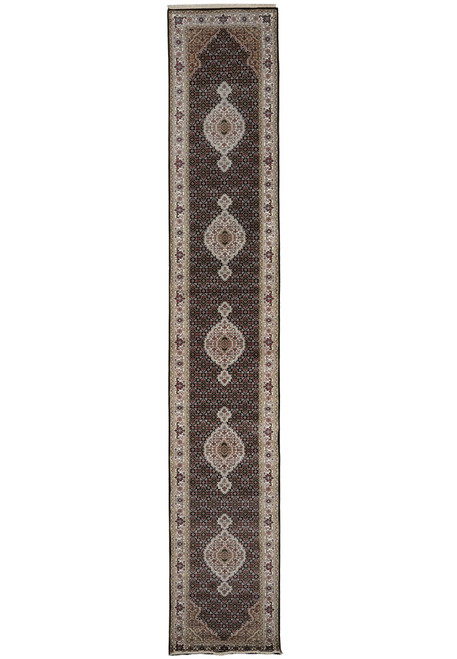
| Size in ft: | Width: 4'3" x Length: 16'3" |
| Size in Inch: | Width: 51" x Length: 195" |
| Size in meters: | Length: 4.95 x Width: 1.30 m |
| Colors: | The Main Color Of This Rug Is Dark Brown, With Black, Beige, Tan, Rust, Gold, And Olive Green. |
| Shape: | Runner |
| Woven: | Hand-Knotted |
| Pile: | Wool And Silk |
| Origin: | Persia |
| Design: | Tabriz |
| Age: | 1980's |
| Condition: | Perfect |
4'3" x 16'3" Persian Tabriz Mahi Runner Rug | Signed Cartouche | 1980s Wool & Silk
This 4'3" x 16'3" Persian Tabriz was woven in the 1980s on a cotton foundation with a wool and silk pile, and it is signed with a small woven cartouche at one end, the mark of a named workshop rather than an anonymous bazaar piece. The drawing is the classic Mahi formula: a near black ground carrying a fine Herati lattice, a layered scalloped medallion stacked in rust, gold and olive, and a deep floral border that frames the whole field. The silk is used sparingly, along the scallop outlines and the cream tracery, so it catches light as you walk the length of the piece. Condition is perfect, with full pile, straight sides and hand-tied ivory fringe at both ends. Every rug we sell ships with a certificate of authenticity recording origin, materials and measurements.
Design and Motifs
Mahi means fish, and the name comes from the Herati unit repeated across the ground: a small rosette inside a diamond, flanked by 4 curved lanceolate leaves that old weavers read as fish circling a pool. Here that unit is drawn very small and repeated thousands of times, which is the real test of a Tabriz weaver, because any drift in the lattice shows immediately on a field this long. The centre holds a medallion built in concentric scalloped rings, each ring outlined in cream and filled with its own miniature Herati field, stepping from a burgundy and ivory core out through gold, rust and olive tiers. Pendants finish the medallion at top and bottom, and the corner spandrels repeat the same scalloped edge so the composition reads as one continuous drawing. The main border runs turtle palmettes and 8 petal rosettes on black, linked by curling vine, and is contained by a set of narrow guard stripes in turquoise, gold and burgundy that give the edges their crispness.
A Dark Brown Ground Lit by Rust, Gold and Olive
The main color is a dark brown so deep it reads black in most light, and under lamplight it warms toward espresso with brown undertones visible in the Herati knots. Against that ground the lattice is picked out in ivory, beige and tan, with small rust and gold rosettes and thin olive green stems that keep the field from going flat. The medallion is where the palette opens up: a salmon and rust tier, a soft gold tier, a sage and olive tier, all separated by cream scallop lines, with touches of burgundy and pale turquoise in the innermost cartouche. The border carries the same family of colors on black, adding apricot vine work and small pink and green florals. It is a quiet, masculine palette that sits well on dark hardwood and next to brown, camel or bronze upholstery, and the silk highlights shift from matte to luminous depending on which direction you view the pile.
Tabriz Weaving in Northwest Persia
Tabriz sits in the northwest of Persia and has been the country's most organised weaving city for centuries, working to the Raj system, where the count of knots across a gereh of about 2.75 inches tells you exactly how fine a workshop is willing to go. Mahi is the pattern Tabriz is best known for, and it is unforgiving work: the fish lattice has to stay square over a very long field, the scallop rings have to close cleanly, and the silk accents have to be placed knot by knot. The signed cartouche at one end ties this piece to a specific atelier, and the 1980s date places it in a strong period for Tabriz production, when good kork wool and fine cotton warps were still readily available. If you want to understand how a signature, a pattern and a foundation together place a piece in time, our guide on how to date an Oriental rug walks through the same evidence we used here.
4'3" x 16'3" Persian Tabriz Mahi Runner Rug | Signed Cartouche | 1980s Wool & Silk
Ask about this rug
This piece is the only one of it, so the things worth knowing about it are particular to it. If you want to talk through the size, the colour in your own light, or the weave, speak to someone here first.