Watch the film
| Size in ft: | Width: 13' x Length: 16'8" |
| Size in Inch: | Width: 156" x Length: 200" |
| Size in meters: | Length: 5.08 x Width: 3.96 m |
| Colors: | Ivory, Green, Brown, Rust |
| Shape: | Rectangular |
| Woven: | 100% Hand-knotted | Handmade |
| Foundation: | Cotton |
| Pile: | Wool and Silk |
| Age: | 1980's |
| Design: | Mahi Tabriz | Herati Fish Pattern |
| Origin: | Persian Tabriz | Made in Persia |
| Condition: | Excellent |
13' x 16'8" Persian Tabriz Mahi Rug | Wool and Silk Herati Fish Design | 1980s
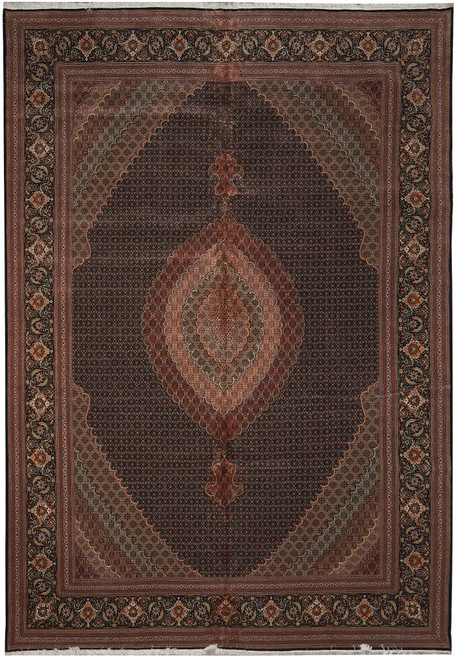
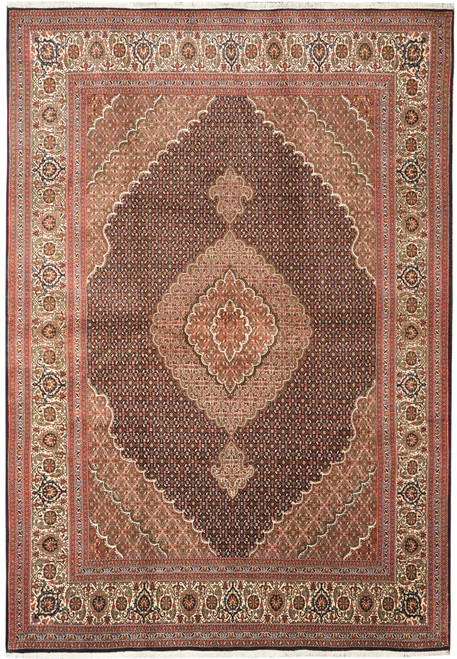
This 13' x 16'8" Persian Tabriz was woven in the 1980s in the mahi, or fish, pattern that the city is best known for, and it is the kind of piece that people buy once and keep for a lifetime. The pile is wool with silk used through the outlines and highlights, knotted on a cotton foundation, and the surface still carries the light sheen of a rug that has never been walked on hard. At 13 feet by nearly 17 feet it belongs in the oversize Persian rugs group, wide enough to carry a full seating arrangement or a long dining table with all chairs pulled back and still show border. Condition is excellent, the ends and cream selvedges are original and sound, and the rug ships with our certificate of authenticity.
Please Note About the Photographs:
Several of the full length photos show soft light and dark banding across the field. That is pile direction and fold shadow from pallet storage, not wear, not fading and not damage. The lines relax once the rug is laid flat, and every rug leaves us professionally steamed and pressed before shipping.
Design and Motifs
The whole field is filled with the herati repeat: a small rosette inside a diamond, flanked by 4 curved lanceolate leaves that read as fish circling the flower, which is where the mahi name comes from. The repeat runs corner to corner without a break, and over a field this large the discipline required to keep the lattice true is the real test of the weaver. Sitting on top of that ground is an elongated diamond medallion built from ring after ring of scalloped outline, with a small floral core at the center and slender pendants running to the top and bottom of the field. Four scalloped arcs sweep out from the medallion to the corners, creating a second ghost diamond that frames the center without interrupting the herati underneath. The main border is an ivory band of palmettes, rosettes and curling vine, punctuated at intervals by dark cartouche style rosettes, and it is flanked by a stack of narrow guard stripes carrying meander, boteh and small flower heads, each one separated by a fine blue and white barber pole line.
A Closer Look at the Colors
The ground is ivory, but almost nowhere does it read as flat white, because the density of the drawing over it pulls the whole field toward a warm greyed brown at viewing distance. Come close and the palette opens up: soft sage green rosettes, rust and terracotta leaves, deep brown outlines, navy blue flower heads and small touches of rose pink scattered through the lattice. The medallion is worked in rust and dusty salmon with a green and ivory core, and the scalloped corner arcs pick up the same rust so the composition holds together across the full 13 feet of width. The main border is the brightest part of the rug, a clean ivory that lifts the whole piece, with the palmettes drawn in salmon, olive green, rust and black. Outside the guard stripes runs a plain camel band and then the ivory fringe, a quiet finish that keeps the eye inside the design. The silk highlights sit mainly in the outlines and catch the light as you cross the room, so the rug changes tone depending on where you stand.
Tabriz Weaving and This Rug's Origin
Tabriz sits in the northwest corner of Persia and has been a commercial weaving capital for centuries, with workshop looms that measure fineness in Raj, the number of knots counted across a gereh of about 2.75 inches. Mahi is the house pattern of those workshops, and it is unforgiving: the repeat has to stay square over the entire length, the medallion has to land dead center, and the scalloped outlines have to keep their curve, none of which is possible at a loose knot count. On this piece the rosettes stay crisp and individually readable in the close photos, the curved lines in the border do not break into steps, and the back shows tight, even rows with no slack. A 1980s weaving date puts it in a good period for Tabriz workshop production, when handspun wool and silk accents were still standard on better commissions, and if you want to understand how weavers, dealers and collectors read age in a piece like this, our guide on how to date an Oriental rug walks through the same clues we used here.
13' x 16'8" Persian Tabriz Mahi Rug | Wool and Silk Herati Fish Design | 1980s
Ask about this rug
This piece is the only one of it, so the things worth knowing about it are particular to it. If you want to talk through the size, the colour in your own light, or the weave, speak to someone here first.