Watch the film
| Size in ft: | Width: 7' x Length: 9'7" |
| Size in Inch: | Width: 84" x Length: 115" |
| Size in meters: | Length: 2.92 x Width: 2.13 m |
| Colors: | Blue, Red, Ivory |
| Shape: | Rectangular |
| Woven: | 100% Hand-knotted | Handmade |
| Foundation: | Cotton |
| Pile: | |
| Age: | 1980's | Approx. 40 years old |
| Design: | Mahi Tabriz | Herati Fish | All Over Field with Center Medallion |
| Origin: | Persian Tabriz | Made in Persia |
| Condition: | Excellent | Perfect |
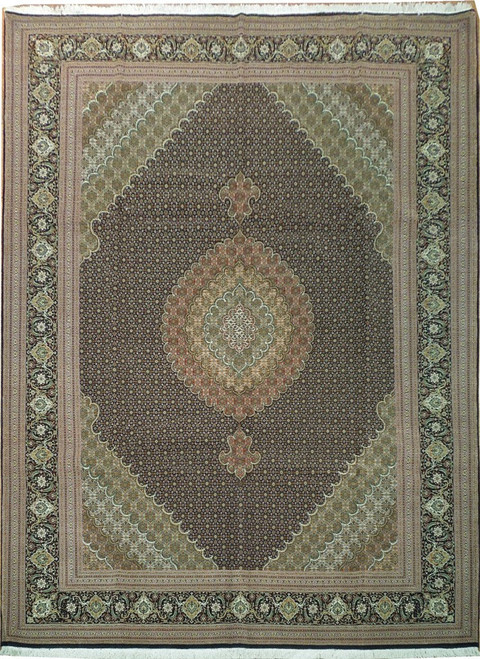
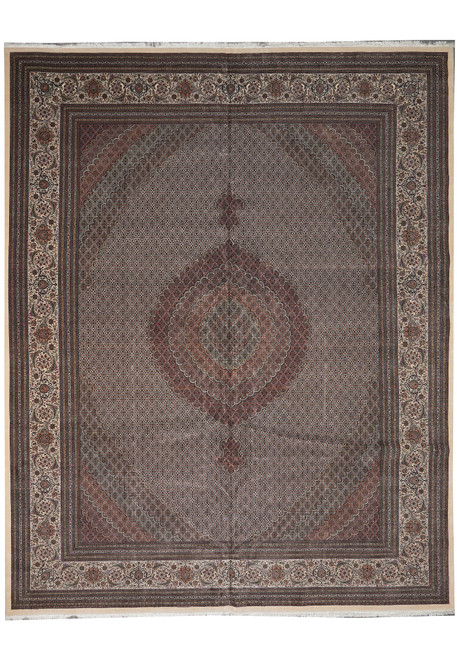
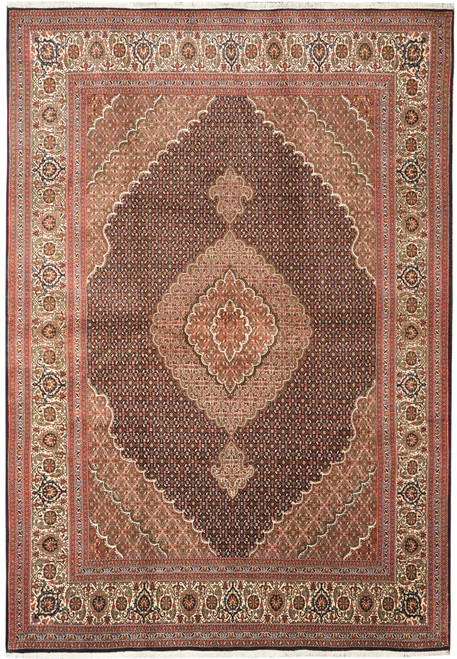
7' x 9'7" Persian Tabriz Rug | Mahi Fish Herati Design | 1980s Wool Pile
This 7' x 9'7" Persian Tabriz was knotted in the 1980s in the design the Tabriz weavers themselves simply call Mahi, the fish pattern, and it is a textbook example of the type: a dark navy field packed edge to edge with tiny diamond compartments, a small ivory medallion holding the center, and a madder red border carrying the whole thing. The pile is fine wool on a cotton foundation, clipped low so the drawing stays crisp, and after roughly 40 years the rug remains in excellent, essentially perfect condition with even pile, straight sides and complete original ends. It falls squarely in the 7 x 10 Persian rug range, the most useful room size there is, and like every rug we sell it ships with a certificate of authenticity identifying origin, materials and weave.
Design and Motifs
The field is an all over Herati design, a repeating diamond lattice with a rosette at each intersection and 4 lanceolate leaves curving around it. Those leaves are the fish that give the pattern its name, and in this piece they are drawn small and repeated hundreds of times, which is exactly what separates a good Mahi from a coarse one. At the center sits an 8 lobed ivory medallion filled with a symmetrical vase and palmette group, ringed by a red halo and finished top and bottom with slender hooked pendants outlined in a single ivory line that traces out across the field. The 4 corners are quartered spandrels in ivory, carrying the same lattice at a lighter value so the field reads as a framed panel rather than an endless repeat. The main border is a red ground of alternating palmettes and curled boteh forms, flanked by narrow ivory guard stripes of running vine and pink rosettes, with a fine dark reciprocal edge and a navy selvage closing the design.
A Navy, Madder Red and Ivory Palette
Seen from across a room the rug reads as deep indigo navy with a warm red frame, but the close work is far busier than that. The navy ground is broken up by knot by knot accents of soft turquoise, salmon pink, madder red, olive green and small flecks of gold, so the field shifts between blue and a plum tone depending on where the light falls, visible in the photograph taken at an angle. The medallion and the corner spandrels are worked in undyed ivory wool that has mellowed to a creamy oyster, giving the dark field a bright center of gravity. The main border sits at a slightly brick, terracotta side of red rather than a hot crimson, with its palmettes picked out in sky blue, teal and rose. If you are shopping the navy blue Persian rugs for a room with cream walls, dark wood or a red accent already in play, this palette is the classic answer and hides traffic better than any light ground rug will.
Tabriz Origin and Weaving Quality
Tabriz sits in the northwest corner of Persia and is the oldest continuously working rug city in the country, the place where the commercial workshop weave was effectively invented. Tabriz weavers knot with a small hook rather than the fingers alone, and they measure fineness in Raj, the number of knots counted across a gereh of about 2.75 inches, where 40 Raj is commercial work, 50 is fine and 60 or more is collector ground. A Mahi field like this one cannot be drawn at all without a reasonably high count, since each fish leaf and rosette occupies only a handful of knots, and the clean repeat here with no wandering lattice lines tells you the loom was well dressed and the weaver disciplined. The cotton warp and weft give the rug a flat, stable handle that lies dead straight on a floor, while the tightly packed wool pile is the reason a 1980s Tabriz can still look this fresh after decades of use.
7' x 9'7" Persian Tabriz Rug | Mahi Fish Herati Design | 1980s Wool Pile
Ask about this rug
This piece is the only one of it, so the things worth knowing about it are particular to it. If you want to talk through the size, the colour in your own light, or the weave, speak to someone here first.