| Size in ft: | Width: 6'7" x Length: 9'10" |
| Size in Inch: | Width: 79" x Length: 118" |
| Size in meters: | Length: 3.00 x Width: 2.01 m |
| Colors: | Brown, Cream, Red, Green, Black, Beige |
| Shape: | Rectangular |
| Woven: | 100% Hand-knotted | Handmade |
| Foundation: | Cotton |
| Pile: | Wool and Silk |
| Age: | Recent | Modern production |
| Design: | Tabriz Mahi | Herati Fish Pattern | Central Medallion |
| Origin: | Persian Tabriz | Made in Persia |
| Condition: | Perfect | Never used |
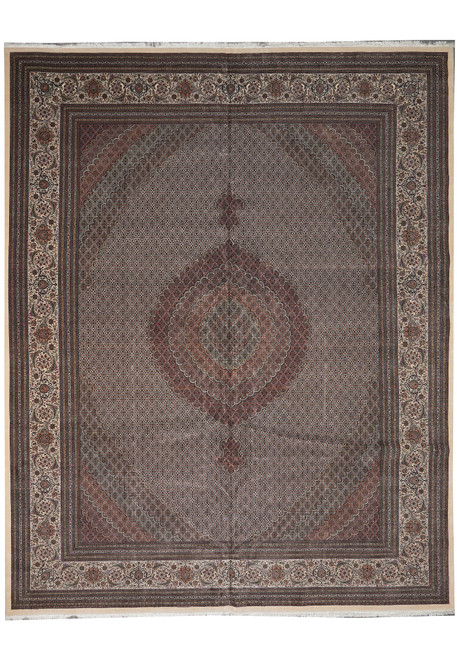
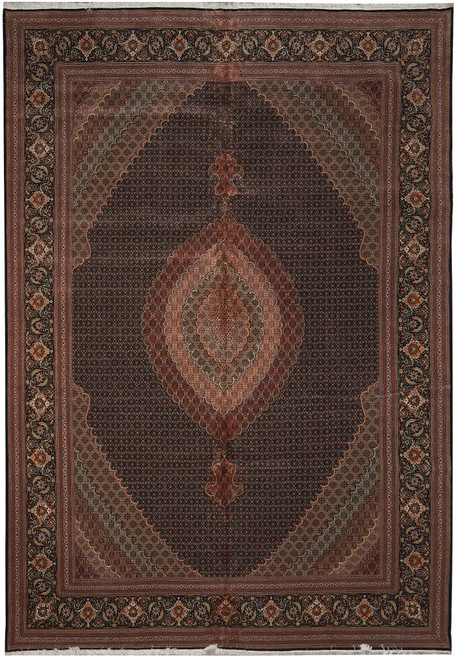
6'7" x 9'10" Persian Tabriz Mahi Rug | Brown Herati Fish Design | Wool and Silk Pile
This is the Mahi drawing that made Tabriz famous, worked here at 6'7" x 9'10" in wool with silk on a cotton foundation. The field is a deep brown that reads almost black under strong light, filled edge to edge with the small herati lattice, and a stepped diamond medallion in soft salmon and cream floats at the center with matching pendants above and below. The silk shows itself where the light changes: the outlines of the medallion, the little leaf forms in the lattice and the white highlight dots all catch and hold a sheen that plain wool cannot produce. The piece has never been on a floor, the pile stands even from selvage to selvage, and the fringes and ends are untouched. Every rug we ship carries a certificate of authenticity recording origin, materials, size and knot construction.
Design and Motifs
Mahi means fish, and the name comes from the pair of curved lanceolate leaves that flank each small rosette inside the diamond lattice. Repeated thousands of times, that single unit builds the all over herati design that covers the entire field. At the center sits a many-lobed medallion drawn in three rings, a cream scalloped outline around a salmon ground, then a second cream cartouche, then a small inner rosette, with a pair of hooked pendants extending along the long axis and cusped spandrels closing the four corners. The main border is an ivory band of alternating green and rust rosettes linked by dark scrolling vine and yellow-hearted palmettes, framed by narrow guard stripes of red, brick and pale blue meander. The corner photographs show how cleanly the border pattern turns, which is one of the first things an experienced buyer checks on a Tabriz.
A Brown Field Lit with Cream, Red and Green
The ground color is a warm dark brown, deepening toward black in the outer field and warming to cocoa and taupe where the medallion halo spreads outward. Against it, the lattice is picked out in beige, brick red, ivory and small flashes of leaf green, with tiny white dots that behave like pin lights. The medallion itself is the warmest passage in the rug, a rust and salmon interior over which the cream outlines read almost like piping. The ivory main border is the brightest element and gives the whole piece a clean frame, while the burgundy and brick guard stripes tie back to the reds in the field. In daylight the rug leans warm and coppery; under lamplight the brown deepens and the cream border carries the room. It is an easy palette to live with, sitting comfortably beside walnut, leather, brass and warm neutral walls.
Woven in Tabriz, Northwest Persia
Tabriz sits in the northwest of Persia and has been the country's most organized weaving city for centuries, working from drawn cartoons on vertical looms with fineness measured in Raj, the number of knots across a gereh of width. The Mahi pattern belongs to that city's core repertoire, and it is unforgiving: the lattice repeat has to stay square over almost 10 feet of length or the eye catches the drift immediately. On the back of this piece the knot rows are straight and tightly packed, the pile is clipped low so the small motifs stay legible, and the selvages are firmly overcast. Sized at 6'7" x 9'10", it falls into the range of 7 x 10 Persian rugs that anchor a seating group or fill a mid-size dining space without crowding it.
6'7" x 9'10" Persian Tabriz Mahi Rug | Brown Herati Fish Design | Wool and Silk Pile
Ask about this rug
This piece is the only one of it, so the things worth knowing about it are particular to it. If you want to talk through the size, the colour in your own light, or the weave, speak to someone here first.