| Size in ft: | Width: 9'8" x Length: 9'10" |
| Size in Inch: | Width: 116" x Length: 118" |
| Size in meters: | Length: 3.00 x Width: 2.95 m |
| Colors: | Ivory, Brown, Green, Coral |
| Shape: | Square |
| Woven: | Hand-Knotted |
| Pile: | Wool And Silk |
| Origin: | Persia |
| Design: | Mahi Tabriz |
| Age: | 1980's |
| Condition: | Very Good |
9'8" x 9'10" Persian Tabriz Mahi Rug | Square Wool & Silk | 400 KPSI, 1980s
Square rugs in this weave are uncommon, and at 9'8" x 9'10" this one is only 2 inches off a perfect square, which is why it sits so calmly under a square coffee table or a round dining table. It was knotted in the 1980s in the Mahi drawing that Tabriz is known for worldwide, with a wool and silk pile on a cotton foundation and roughly 400 knots per square inch, about 50 Raj by the local counting system. The silk is used sparingly, in the outlines and the highlight colors, so the design catches light as you walk around it. The pile is pre-owned and evenly settled rather than worn thin, the ends and sides are intact, and the rug ships with a certificate of authenticity.
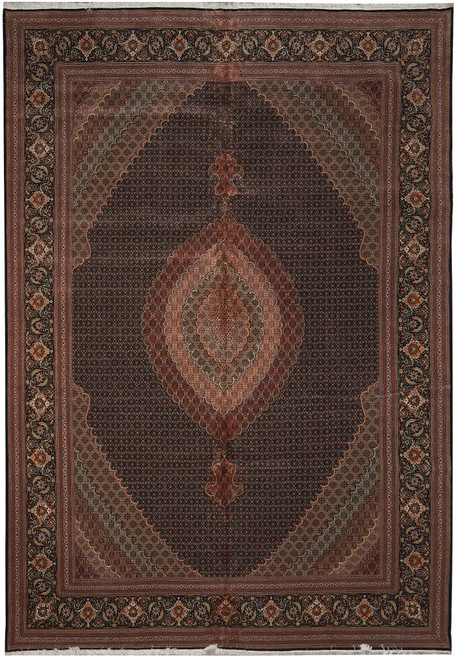
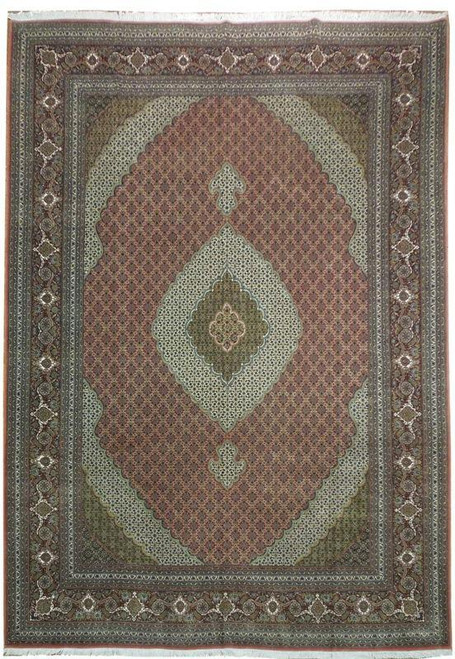
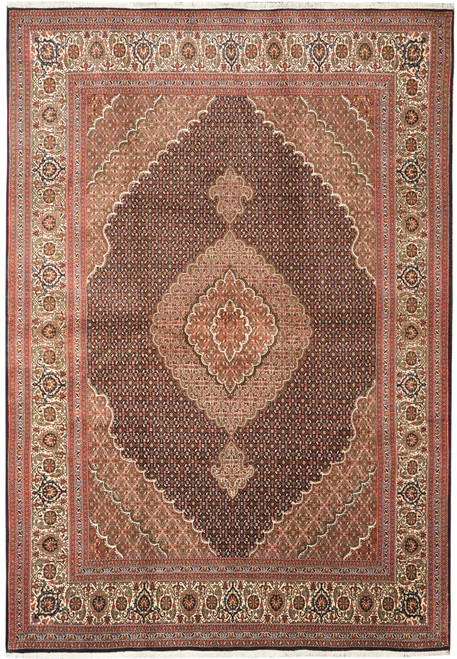
Please Note About the Photographs:
The full-length overhead shots read warmer and browner than the rug is in person, because low-angle light and the direction of the silk pile darken the field. The close-up photographs show the true palette: a cream to ivory ground, a coral medallion and sage green outlines. Nothing in those tonal shifts is fade or wear.
Design and Motifs
Mahi means fish, and the field is a strict lattice of the herati motif: a small diamond holding a rosette, flanked on 4 sides by curved lanceolate leaves that the weavers read as fish circling a pool. The repeat runs edge to edge without a break, which in a square format is far harder to balance than in a long room size. At the center sits a stepped star medallion with 16 points, drawn in coral and outlined in pale sage, with a pendant finial reaching top and bottom and a matching pair of lobed cartouches to either side. Scrolling cloudband tendrils float free over the field and gather again in the 4 corner spandrels. The border system is deep, with a wide main band of paired palmettes, boteh forms and 8 petal rosettes on a soft rose taupe ground, framed by narrow reciprocal guard stripes in wine, ivory and blue.
Ivory, Coral and Sage Green Coloring
The ground is ivory to light cream, warmed to a soft biscuit tone where the herati lattice is drawn in brown, olive and dark navy. The medallion breaks the field with coral and salmon, shading toward terracotta at the center and cooled by sage green outlining that repeats in the cloudbands and the corner spandrels. Accents are scattered rather than massed: small points of wine red, powder blue flowerheads, mustard gold centers and touches of dark chocolate that give the drawing its edge. The main border shifts to a dusty rose taupe with ivory palmettes, blue rosette centers and deep green vine work, so the frame reads softer than the field it surrounds. The overall effect is neutral from across a room and detailed up close, which suits a space where the furniture rather than the floor carries the color.
Tabriz Weaving and the Mahi Tradition
Tabriz sits in northwestern Persia and has been the commercial and technical center of Persian weaving for centuries. Fineness there is counted in Raj, the number of knots across a gereh of about 2.75 inches: 40 Raj is commercial work, 50 Raj is fine, and 60 Raj and above is collector territory. At roughly 50 Raj and about 400 knots per square inch, this piece has the resolution the Mahi pattern needs, since the fish leaves and rosettes collapse into mush at a coarser count. The weaver worked on a cotton warp and weft with a clipped low pile, and the highlight yarns carry the quiet luster you find in Persian silk rugs, used here as accent rather than as the whole pile. That combination, tough Tabriz wool for the body and silk for the outlines, is why a 1980s piece like this still lies flat, holds its drawing and takes daily traffic.
9'8" x 9'10" Persian Tabriz Mahi Rug | Square Wool & Silk | 400 KPSI, 1980s
Ask about this rug
This piece is the only one of it, so the things worth knowing about it are particular to it. If you want to talk through the size, the colour in your own light, or the weave, speak to someone here first.