Watch the film
| Size in ft: | Width: 6'2" x Length: 13'10" |
| Size in Inch: | Width: 74" x Length: 166" |
| Size in meters: | Length: 4.22 x Width: 1.88 m |
| Colors: | Multi Color, Rust Red, Terracotta, Ivory, Cream, Teal Blue, Sage Green, Gold |
| Shape: | Rectangular |
| Woven: | 100% Hand-knotted | Handmade |
| Foundation: | 100% Cotton |
| Pile: | |
| Design: | Agra | Mamluk Medallion | Compartment Field |
| Origin: | Made in India |
| Condition: | Excellent | Never used |
6'2" x 13'10" Agra Oriental Rug | Mamluk Medallion | Fine Wool Pile, Made in India
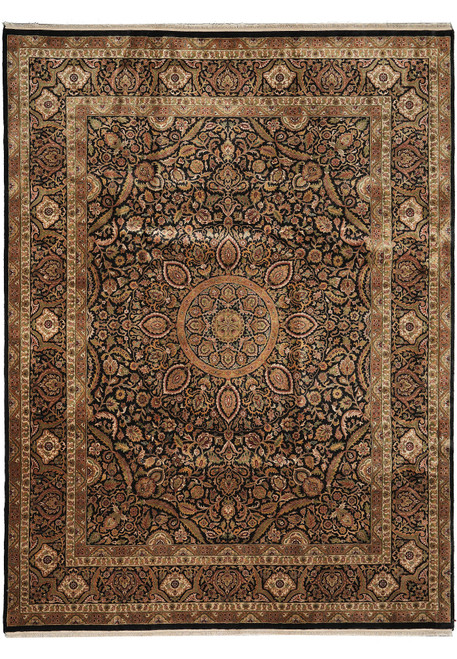
This is a gallery format piece, 6'2" x 13'10", hand-knotted in India in the Agra tradition and drawn from the classic Mamluk medallion cartoons that 16th century workshops made famous. The original tags were still attached when it came in, marked handknotted, handmade in India, 100% wool pile, and the rug has never been on a floor. At nearly 14 feet long and just over 6 feet wide it suits a room where a standard 9x12 sits short at one end, and it reads as a serious decorative object rather than a filler. It is a genuine hand-knotted Oriental rug, not a machine product, and it ships with a certificate of authenticity from Rugs.net. Buyers working through our large hand-knotted rugs will notice how few pieces come in this long, narrow proportion.
Design and Motifs
The center of the field carries a large rust red rosette medallion built on a many sided outline, filled with rows of ivory lancet leaves and small arched devices that repeat with the discipline of tile work. Inside it sits a soft blue octagon holding an 8 point star, and inside that star a further small floral rosette, so the eye steps down through 3 layers before it reaches the middle. Above and below the medallion the field breaks into compartments: small squares and hexagons of scrolling vine, teal rosettes, pendant cartouches shaped like water drops, and 4 pointed star flowers scattered across the open ground. Each end closes with a wide arched panel of cypress-like sprays and interlaced blossoms, a device borrowed straight from period Mamluk drawing. The main border runs an unbroken vine of ivory palmettes and curling leaves over a rust ground, framed by narrow sage and ivory guard stripes that keep the whole composition tight.
A Multi Color Palette Built on Rust, Ivory and Teal
The dominant color is a warm rust red that shifts between brick and terracotta depending on where the light falls, and it carries both the border and the great central medallion. Against it the field is a pale oatmeal ivory with a faint wheat gold cast, soft enough that the small motifs sitting on it never look busy. The third voice is a dusty teal blue, used for the octagon at the center, for scattered rosettes in the compartments and for the guard band that separates field from border. A muted sage green appears along the inner frame and in the arched end panels, and small touches of ochre and cream pick out individual star flowers. The tonal movement across the rust ground, visible in the close photographs, is the natural variation of wool taking dye by hand, and it gives the surface depth that flat modern color never achieves.
Agra Weaving and the Quality of the Knot
Agra has been a weaving center since the Mughal court set up workshops there, and the city gave its name to a whole family of designs that combine dense curvilinear drawing with a heavy, hard wearing handle. India is now where most of the world's good contemporary hand-knotted work is made, and this rug shows why: the knotting is even from selvage to selvage, the outlines of the small compartment motifs stay crisp at a scale where a coarser weave would smudge them, and the wool pile has the slight sheen of well washed, properly spun fleece. The wool is knotted onto a cotton foundation, which is what holds a piece this long straight and flat over time, and the ends are finished with a plain woven skirt and hand-secured fringe. Handled in person it is heavy and firm, the sign of a rug built for decades of use rather than a season of display.
6'2" x 13'10" Agra Oriental Rug | Mamluk Medallion | Fine Wool Pile, Made in India
Ask about this rug
This piece is the only one of it, so the things worth knowing about it are particular to it. If you want to talk through the size, the colour in your own light, or the weave, speak to someone here first.