Watch the film
| Size in ft: | Width: 6'5" x Length: 10'4" |
| Size in Inch: | Width: 77" x Length: 124" |
| Size in meters: | Length: 3.15 x Width: 1.96 m |
| Colors: | Red, Ivory, Taupe, Gold, Brown, Navy accents |
| Shape: | Rectangular |
| Woven: | 100% Hand-knotted | Handmade |
| Foundation: | Cotton |
| Pile: | Wool with Silk Highlights |
| Design: | Tabriz Mahi | Herati Fish Pattern | Lobed Medallion |
| Origin: | Persian Tabriz | Made in Persia |
| Condition: | Excellent |
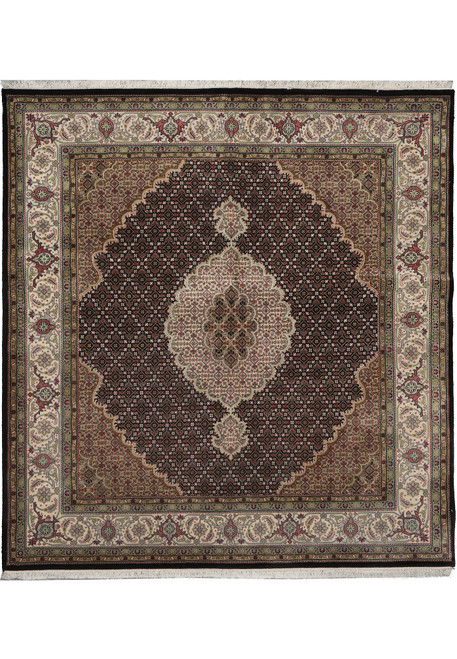
6'5" x 10'4" Persian Tabriz Mahi Rug | Fish Pattern Medallion | Wool with Silk Highlights
This is the Mahi design that made Tabriz famous, woven here at a scale that suits a real room rather than a gallery wall. The 6'5" x 10'4" field is packed with the tiny Herati fish repeat, a lobed ivory medallion sits dead center with matching pendants above and below, and silk highlights run through the medallion and the scalloped spandrels so the drawing lifts as you walk past it. The wool pile is short and tightly beaten on a cotton foundation, the handle is firm, and the condition is excellent with the full original pile and clean, even selvages. Photograph 6 shows the fringe and the back with a ruler laid across it, which is the honest way to see how fine the weave actually is. Every rug we sell ships with a certificate of authenticity, and this one sits comfortably in the 7 x 10 size class for seating groups and dining tables.
Design and Motifs
Mahi means fish, and the name comes from the Herati unit that fills this entire field: a small rosette ringed by 4 curved leaves that read like fish circling a pond, repeated in a diagonal lattice so tight that the field looks textured rather than patterned. At the center is a lobed medallion with a scalloped ivory outline and a gold cartouche core, built up in concentric rings of fine vine work around a small central rosette. Slim arrowhead pendants extend from the top and bottom of the medallion, and 4 large scalloped spandrels cut the corners, each one carrying the same fish repeat on a lighter ground so the field reads in two tones. The main border is an ivory band of palmettes and shield rosettes joined by a thin arabesque vine, flanked by narrow reciprocal guard stripes and an outer brown band of stacked floret boxes. Nothing in the drawing is improvised: this is workshop cartoon work, and the medallion halves mirror each other cleanly across the long axis.
The Color Palette: Red Field, Ivory Medallion, Taupe Corners
The dominant color is a deep raspberry red, cooler and more muted than a Kashan red, and because the Herati repeat is drawn in ivory, black and soft gold over that ground, the field reads as a dusty rose-red at a distance and resolves into individual flowers up close. The 4 spandrels shift to a pale greige and taupe, almost a warm mushroom brown, which is where the silk highlights show most clearly under angled light. The medallion moves from ivory at its scalloped edge into caramel and antique gold at the core, with fine outlines of charcoal and a trace of slate blue. The main border is a clean ivory, its palmettes filled with terracotta, sage green, soft blue and dark navy, and the guard stripes pick up brown and cream. Small navy accents scattered through the field and the border give the palette its depth. Overall it is a warm, slightly faded, formal red and ivory scheme that works against oak floors, walnut furniture and cream walls without shouting.
Woven in Tabriz, Northwest Persia
Tabriz, in the far northwest of Persia, has been a commercial and court weaving center for centuries, and it is the town that turned the Mahi design into a signature. Tabriz weavers work with a hook-ended knife on vertical looms and count fineness in Raj, the number of knots across roughly 2.75 inches of width, which is why a Tabriz weave is so consistent from end to end: the cartoon is followed knot by knot rather than improvised. A Mahi field like this one cannot be faked at a coarse count, since the fish rosette needs enough knots to keep its curved leaves legible, and here the repeat stays crisp right into the spandrel scallops and the border vine. The tight beat-down over a cotton foundation gives the rug a flat, dense back and a pile that resists crushing under furniture legs, which is exactly why Persian Tabriz rugs in this format tend to be handed down rather than replaced.
6'5" x 10'4" Persian Tabriz Mahi Rug | Fish Pattern Medallion | Wool with Silk Highlights
Ask about this rug
This piece is the only one of it, so the things worth knowing about it are particular to it. If you want to talk through the size, the colour in your own light, or the weave, speak to someone here first.