| Size in ft: | Width: 6'5" x Length: 10' |
| Size in Inch: | Width: 77" x Length: 120" |
| Size in meters: | Length: 3.05 x Width: 1.96 m |
| Colors: | Black, Ivory, Rust Red, Green, Brown, Camel, Soft Blue |
| Shape: | Rectangular |
| Woven: | 100% Hand-knotted | Handmade |
| Foundation: | Cotton |
| Pile: | Wool and Silk |
| Age: | Recent |
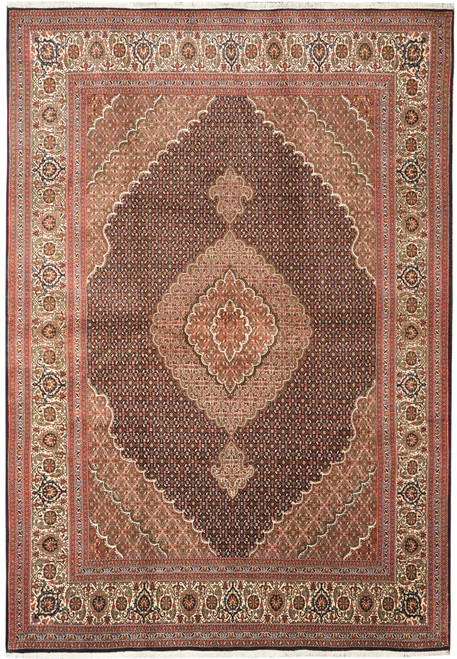
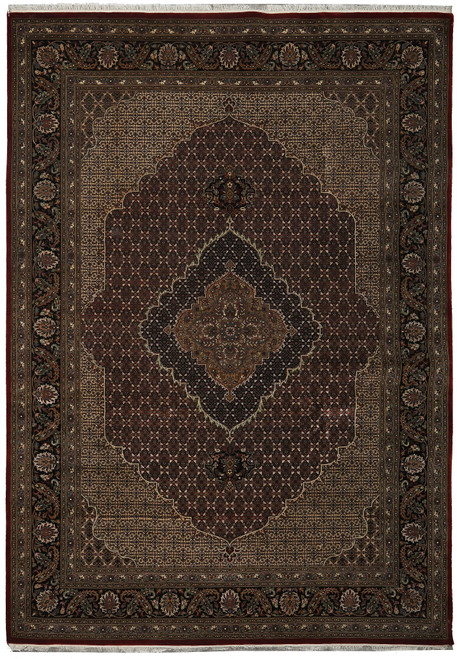
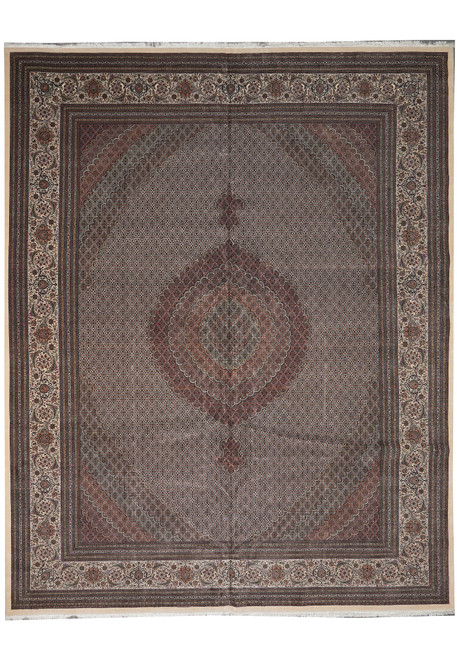
| Design: | Mahi Tabriz | Herati fish pattern | Central medallion |
| Origin: | Persian Tabriz | Made in Persia |
| Condition: | Perfect |
6'5" x 10' Persian Tabriz Mahi Rug | Black Herati Fish Field | Wool and Silk Pile
This is the Mahi drawing that made the modern workshops of Tabriz famous, worked here at a size that fits a real room rather than a gallery. The black field carries a tight herati lattice, an ivory scalloped medallion floats dead center, and silk is used exactly where it should be, in the outlines and small flower heads, so the pattern lifts and changes as you walk past it. The pile is short and firm, the back is even, and the rug has never been on a floor. Every rug we ship, including this Persian Tabriz rug, leaves Freeport with a certificate of authenticity recording origin, materials and size.
Design and Motifs
Mahi means fish, and the name comes from the herati unit repeated across the field: a small rosette inside a diamond, flanked by 4 curved lanceolate leaves that old dealers read as fish circling a pond. Here those units run edge to edge in a disciplined grid, interrupted only by the scalloped ivory medallion, its small inner rosette, and the 2 matching pendants above and below. The corner spandrels repeat the same lattice on a lighter ground and end in a cloud-edge outline, so the eye reads 2 layers of the same idea at once. The main border is an ivory band of 8 petal rosettes and shield-shaped cartouches linked by a dark vine, framed on both sides by narrow guard stripes of rose, saffron and soft blue flower heads over red. The corners are resolved cleanly, with the border turning square rather than being cut off, which is a good sign of a drawn cartoon and a careful weaver.
A Black Field Lit by Ivory, Rust and Green
The ground is a true black, deep enough that in low light it reads almost as a shadow, and this is what gives the rug its drama: the ivory medallion and spandrels appear to hover above it. Inside the lattice sit tiny points of rust red, saffron, moss green, powder blue and cream, each no bigger than a fingernail, which keep the dark field alive instead of flat. The spandrels and the field just outside the medallion are a warm camel to beige, shading softly where the silk catches light. The border ivory is a creamy, slightly buttery tone rather than a bleached white, and its rosettes are drawn in sage and olive green with burgundy and copper orange centers. Rose pink appears only in the guard stripes, a small counterweight to all the red. The result is a rug that works with dark walnut and black metal as easily as it does with cream upholstery.
Woven in Tabriz, Northwest Persia
Tabriz sits in the northwest of Persia and has been the country's most organized weaving center for centuries, the place where cartoons are drawn, apprentices are trained and fineness is measured in Raj, the count of knots across a gereh of about 2.75 inches. The city's workshops use a Turkish knot on a cotton warp and weft and beat the weave down hard, which is why a Tabriz Mahi holds its crisp outlines even where the drawing shrinks to a few knots. That density is visible on the back of this piece, where the knot rows are regular and the pattern reads clearly from the reverse. The wool is tightly spun and clipped low, the silk is reserved for highlights, and the selvages and fringe are finished in the conventional Tabriz manner, dark overcast sides and plain cotton warp ends.
6'5" x 10' Persian Tabriz Mahi Rug | Black Herati Fish Field | Wool and Silk Pile
Ask about this rug
This piece is the only one of it, so the things worth knowing about it are particular to it. If you want to talk through the size, the colour in your own light, or the weave, speak to someone here first.