Watch the film
| Size in ft: | Width: 10' x Length: 13'2" |
| Size in Inch: | Width: 120" x Length: 158" |
| Size in meters: | Length: 4.01 x Width: 3.05 m |
| Colors: | Black, Brown, Copper, Sage Green, Ivory, Gold |
| Shape: | Rectangular |
| Woven: | 100% Hand-knotted | Handmade |
| Foundation: | Cotton |
| Pile: | Wool & Silk | 1/4" pile height |
| Design: | Tabriz Mahi | Herati fish pattern | Scalloped medallion with corner spandrels |
| Origin: | Persian Tabriz | Made in Persia |
| Condition: | Brand New | Never used |
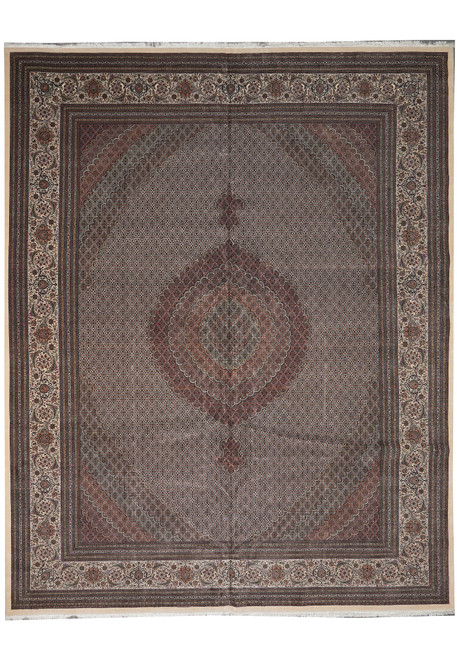
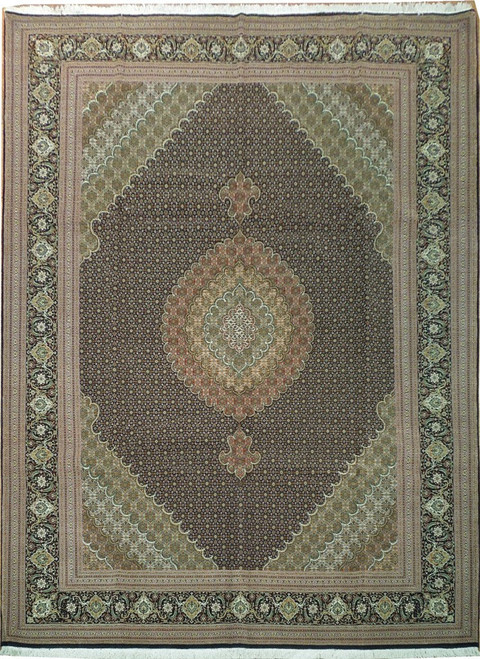
10' x 13'2" Persian Tabriz Mahi Rug | Wool & Silk Herati Fish Design | Black Field, Never Used
This 10' x 13'2" Tabriz is a Mahi, the fish pattern that Tabriz workshops have drawn tighter and finer than anyone else in Persia. The field is a deep black carrying thousands of small diamond compartments, each holding a rosette and a pair of curved leaves, and floating over that dense ground is a copper medallion with a scalloped, petalled outline and two matching pendants. The pile is wool with silk worked into the outlines and highlights, which is why the medallion and the spandrels shift in brightness as you walk around the rug and the black ground stays matte and quiet by comparison. It is knotted on a cotton foundation with a low 1/4" pile, exactly what this kind of small-scale drawing requires, and it has never been on a floor. Ships with a certificate of authenticity, and as a room-filling piece it sits squarely in the most-asked-for format among 10x13 Persian rugs.
Please Note About the Photographs:
The two full-length studio photographs were taken under strong overhead lighting, which lifts the black ground toward olive and flattens the copper of the medallion. The daylight close-ups are the truer reading of the rug: a genuinely deep black field, a warm copper and apricot medallion, and sage green outlining. Nothing in those lighter frames is fading or wear.
Design and Motifs
Mahi means fish, and the name comes from the 4 slim leaves that curve around each small rosette like fish circling a pond. Here the motif repeats across the entire field on a fine diamond lattice, so the eye reads texture first and individual flowers only when you look closely. The central medallion is built in rings: an ivory and indigo core, a gold cusped frame, then two bands of scalloped petals in copper and soft brown, all edged in sage green and cream so the outline stays crisp against the dark ground. Slender pendants run north and south, and each of the 4 corners carries a large scalloped spandrel filled with the same herati drawing in lighter tones, giving the classic medallion and corner layout its balance. The border system is deep and unusually well resolved: a black main band of palmettes, curling vines and ivory cartouches, flanked by multiple narrow guard stripes in rust, ivory, blue and olive that step the design down to the selvedge without a single crowded corner.
A Black Field Lit by Copper and Sage
The ground is black, close to charcoal where the light catches it, and it is worked with so many tiny ivory rosettes and copper-brown leaves that from a standing height it reads as a dark, warm, softly speckled surface rather than a flat block of color. Against that, the medallion is copper moving into apricot and salmon, with a pale gold and ivory center and touches of cornflower blue inside the innermost lozenge. Sage and celadon green trace the scalloped outlines, the only cool notes in the palette, and they keep the copper from bleeding into the black. The corner spandrels graduate from mushroom brown through pale olive to a soft silvery blue-green, so the outer thirds of the field feel lighter than the middle. Brown, rust and ivory carry through the guard stripes, with small pink and red flower heads appearing in the border cartouches. This is a dark rug that stays warm, which suits walnut, brass and oxblood leather rather than cool grey schemes.
Tabriz Weaving and the Quality of This Piece
Tabriz sits in the northwest of Persia and has been the country's commercial weaving capital for centuries, the city where cartoons are drawn, where the Raj system of counting fineness is used, and where the Mahi pattern became a house specialty. Fineness there is measured in Raj, the number of knots across a gereh of roughly 2.75 inches, and a design of this scale simply cannot be executed on a coarse loom: the leaves around each rosette would lose their curve. You can see the resolution best in the close-ups, where the outlines stay unbroken and the medallion petals hold clean arcs, which is the practical meaning of a high knots per square inch count. The silk is used sparingly and intelligently, reserved for outlines and highlight passes so it lifts the drawing without turning the rug shiny. The handle is firm, the pile low and even, the selvedges tight, and the ends are straight, all signs of a workshop piece that came off the loom and went straight into storage rather than onto a floor.
10' x 13'2" Persian Tabriz Mahi Rug | Wool & Silk Herati Fish Design | Black Field, Never Used
Ask about this rug
This piece is the only one of it, so the things worth knowing about it are particular to it. If you want to talk through the size, the colour in your own light, or the weave, speak to someone here first.