Watch the film
| Size in ft: | Width: 6'5" x Length: 6'8" |
| Size in Inch: | Width: 77" x Length: 80" |
| Size in meters: | Length: 2.03 x Width: 1.96 m |
| Colors: | Black, Ivory, Brown |
| Shape: | Square |
| Woven: | 100% Hand-knotted | Handmade |
| Foundation: | 100% Cotton |
| Pile: | Wool with Touch of Silk |
| Age: | New | Never used |
| Design: | Mahi Tabriz | Fish Herati Lattice | Lobed Medallion |
| Origin: | Made in India |
| Condition: | Perfect | Never used |
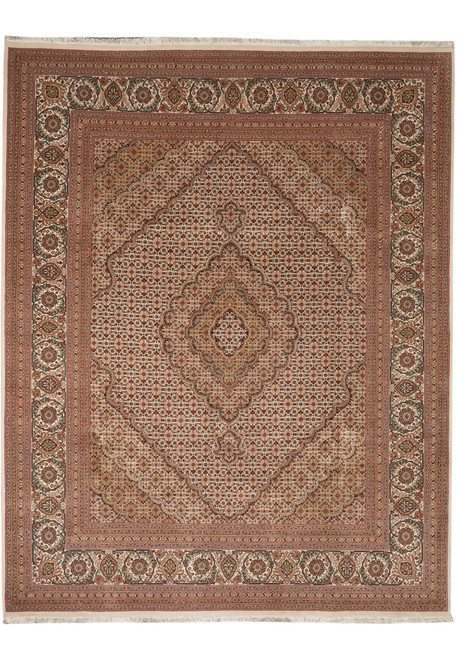
6'5" x 6'8" Square Oriental Rug | Mahi Tabriz Fish Design | Wool with Silk Highlights | Brand New
A true square is one of the hardest formats to fill well, and this 6'5" x 6'8" piece solves it without compromise. It is a hand-knotted Oriental rug made in India, woven in fine wool with a touch of silk over a cotton foundation, drawn in the Mahi Tabriz layout that weavers have long treated as the test of a steady hand. The field reads almost black and is covered edge to edge with a small herati lattice, with a lobed ivory medallion set dead center and a matching pendant at the head and the foot. The pile is full, the selvages and the ivory fringe are untouched, and the rug has never been on a floor. Because the proportions are nearly even on both axes, it sits beautifully under a round dining table or a square coffee table, and it belongs with the better square rugs we stock. Every rug ships with a certificate of authenticity listing the size, materials, design and origin.
Design and Motifs
The field is a continuous herati lattice: a grid of small diamonds, each one holding a rosette with 4 curved leaves turning around it like fish circling a pond, which is exactly where the name mahi, meaning fish, comes from. Each diamond is only a few knots across, so the lattice stays crisp and the repeat never blurs into a haze. At the center sits a lobed medallion outlined in pale sage, filled with its own miniature lattice of diamonds and florets over a camel ground, flanked by 2 small side lobes and anchored by a slender pendant palmette above and below. The 4 corner spandrels carry the same herati drawing in a lighter brown tonality, so the eye reads the medallion shape as a scalloped cartouche floating over the dark ground. The main border is an ivory band of alternating rosettes and rust palmettes joined by a thin vine, framed by a camel guard stripe with a running vine, 2 narrow black outlines and a fine ivory outer stripe. Corner resolution in the border is clean on all 4 corners, which is the first place a hurried weaver gives themselves away.
Black Field, Ivory Medallion and Warm Brown Lights
The ground is a deep black that warms toward brown under daylight, so the rug never looks flat or cold the way a printed black does. Against it, the herati knots fire off in brick red, soft rose, rust, cream and small touches of powder blue and sage green, and ivory sprigs scatter across the lattice like points of light. The medallion is the brightest passage in the rug: an ivory to bone field, a camel and olive core, and tiny accents of wine red, slate blue and green at the floret centers, with the silk content in the pile catching the light so the medallion shifts tone as you walk around it. The wide border is a creamy ivory, calmed by sage green and camel in the guard stripes, with rust palmettes repeating at a steady interval to tie the border back to the field. The ivory fringe and the black outer edge finish the frame. In a room with cream walls, warm wood floors and mid-tone upholstery, the black ground grounds the furniture while the ivory border keeps the whole square from feeling heavy.
Made in India, Woven to the Mahi Standard
This rug was hand-knotted in India, which is where most of the world's best contemporary hand-knotted work is now produced, and we say that with no hedging. The Mahi layout takes its name and its discipline from the weaving city of Tabriz, where the fish lattice was refined into a strict, repeatable system, and the Indian ateliers that specialize in it work from the same cartoons at the same density. On the back you can see the knotting line by line: a tight cotton warp, even rows, no slack and no patching, with the pile clipped low so the small motifs stay legible instead of being swallowed by wool. The yarn is a good hand-spun wool with silk worked into the highlight areas, which is why the medallion and the ivory sprigs read brighter than the surrounding field. A low, dense pile on a cotton foundation is also the practical choice for a square room that sees chairs, feet and a table, since it lies flat, resists crushing and cleans easily for decades.
6'5" x 6'8" Square Oriental Rug | Mahi Tabriz Fish Design | Wool with Silk Highlights | Brand New
Ask about this rug
This piece is the only one of it, so the things worth knowing about it are particular to it. If you want to talk through the size, the colour in your own light, or the weave, speak to someone here first.