Watch the film
| Size in ft: | Width: 6'8" x Length: 9'10" |
| Size in Inch: | Width: 80" x Length: 118" |
| Size in meters: | Length: 3.00 x Width: 2.03 m |
| Colors: | Pom Red, Beige, Olive Green |
| Shape: | Rectangular |
| Woven: | 100% Hand-knotted | Handmade |
| Foundation: | 100% Cotton |
| Pile: | Wool and Silk |
| Age: | New |
| Design: | Traditional Mahi Tabriz | Herati Fish Pattern | Central Medallion |
| Origin: | Made in India |
| Condition: | Perfect | Brand new | Never used |
6'8" x 9'10" Oriental Rug | Mahi Tabriz Fish Design | Wool and Silk, Brand New
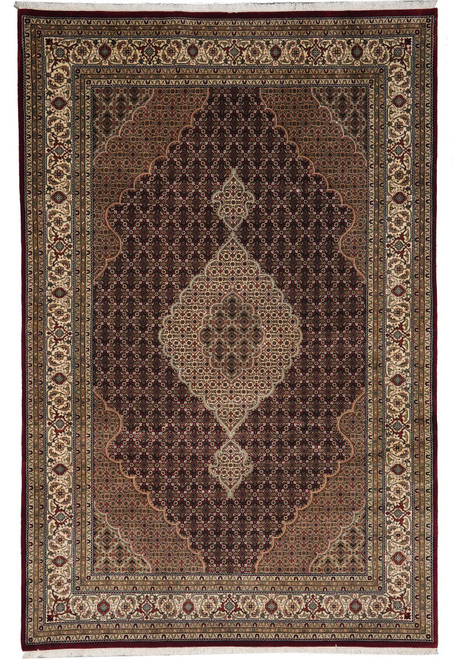
This is a brand new, never used hand-knotted Oriental rug woven in the classic Mahi Tabriz manner, measuring 6'8" x 9'10" on a cotton foundation with a wool and silk pile. Laid flat, the first thing you notice is density: the pile is short, tightly packed and slightly waxy to the hand, with the silk catching light along the ivory medallion and the beige main border. The drawing is disciplined all the way to the corners, the selvedges are firm, and the cream cotton fringe is clean and even at both ends. It is a rug built for real rooms rather than a display piece, and it arrives with our certificate of authenticity confirming that it is 100% hand-knotted.
Design and Motifs
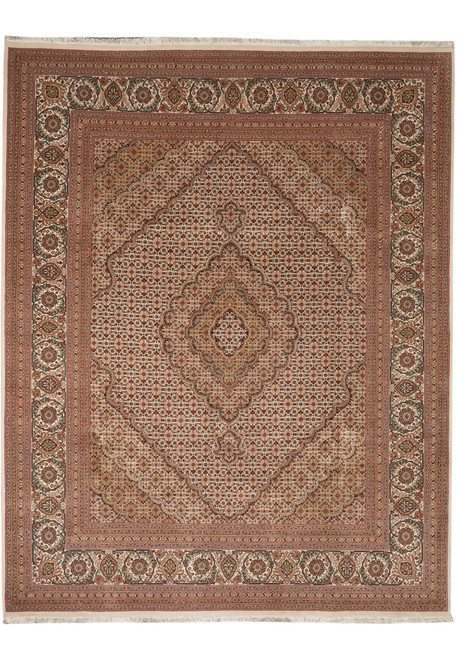
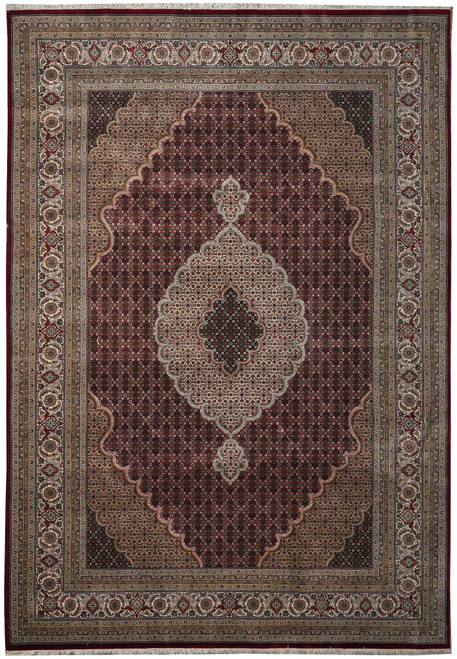
The field carries the Mahi, or fish, version of the Herati pattern: a repeating diamond lattice, each cell holding a small rosette flanked by 4 curved lanceolate leaves that give the design its fish name. It runs edge to edge without a break in rhythm, which is the hardest part of this pattern to weave well. At center sits a scalloped ivory medallion with a slate blue core, outlined in dark navy and finished top and bottom with small stepped pendants, plus 2 matching floating cartouches to left and right. The corner spandrels reverse the color logic, dropping the same lattice onto a near black ground so the 4 corners read as quiet anchors. The border system is layered: a wide beige main band of rosettes, palmettes and scrolling vine, framed by olive and slate guard stripes and a fine outer meander, all contained by a plain red outer edge. This 7x10 proportion places the medallion squarely under a coffee table while the border stays fully visible around the furniture, and it slots neatly into the 7x10 rug size most sitting rooms are cut for.
Pom Red, Beige and Olive Green Color Work
The ground color is a deep pom red, closer to a ripe garnet than a bright scarlet, and it shifts noticeably with the nap: warm and glowing from one end, darker and more wine toned from the other. Against it the lattice is picked out in charcoal navy outline with tiny highlights of cream, soft peach, camel and a muted powder blue, so from standing height the field reads as a rich textured red rather than a flat block of color. Beige does the heavy structural work, carrying the main border and the medallion ground in a warm sand to ivory range, and the silk content makes those pale areas the brightest thing in the rug. Olive green appears in the guard stripes, in the leaf work of the border vine and scattered through the field rosettes, and it is what keeps the red and beige from feeling too warm on their own. Small touches of brick red, black and off white sharpen every outline. The overall palette is traditional and forgiving, sitting comfortably with dark walnut floors, charcoal upholstery and brass, as the interior photograph shows.
Origin and Weaving Quality
This rug is made in India, where the majority of the world's best contemporary hand-knotted work is now produced, by weavers working from the Tabriz Mahi cartoon. The back of the rug tells the story: an even, fine grid of knots on a cotton warp and weft, crisp motif definition with no blurring of the lattice, and straight side cords with no pull or waviness. The wool is spun for strength and clipped low, which is why the Herati detail stays legible, and the silk is used as highlight rather than filler, threaded through the medallion, the pale border ground and the smaller blossoms where it earns its sheen. Weight, handle and knot density all sit well above what the price of a workshop Indian piece would suggest, and among hand-knotted Oriental rugs in this size and design this is the level of finish worth holding out for. It has never been on a floor.
6'8" x 9'10" Oriental Rug | Mahi Tabriz Fish Design | Wool and Silk, Brand New
Ask about this rug
This piece is the only one of it, so the things worth knowing about it are particular to it. If you want to talk through the size, the colour in your own light, or the weave, speak to someone here first.