Watch the film
| Size in ft: | Width: 6'7" x Length: 10'3" |
| Size in Inch: | Width: 79" x Length: 123" |
| Size in meters: | Length: 3.12 x Width: 2.01 m |
| Colors: | Red, Navy Blue, Ivory, Olive Gold, Sage Green, Rose Pink |
| Shape: | Rectangular |
| Woven: | 100% Hand-knotted | Handmade |
| Foundation: | 100% Cotton |
| Pile: | |
| Design: | Tabriz Medallion | Floral Spandrels | Palmette Border |
| Origin: | Persian Tabriz | Made in Persia |
| Condition: | Excellent | Even pile throughout |
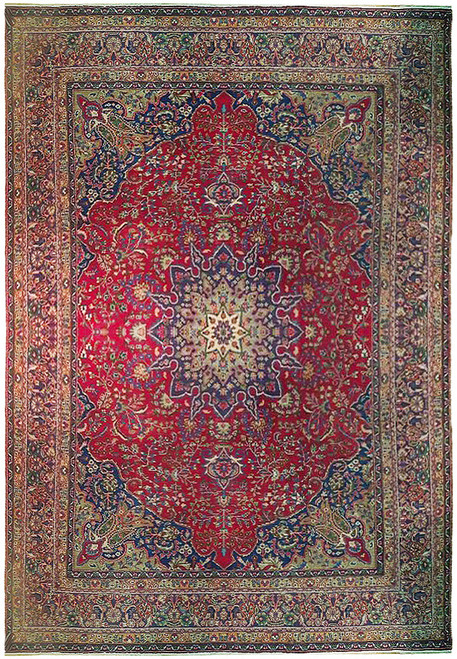
6'7" x 10'3" Persian Tabriz Rug | Raspberry Red Field, Ivory Star Medallion | Semi-Antique, Excellent Condition
This is a classic city-woven Tabriz in the proportion most American rooms actually want, a touch longer than it is square and roomy enough to float a sofa and two chairs. The raspberry red field carries a single ivory and olive gold star medallion, framed by inky navy spandrels that pull the eye straight to the center. The wool has the slightly waxy handle that comes with age and use, the pile is even from end to end, and the cotton foundation is tight and flat, which is why the rug lies without ripple on a bare floor. If you are shopping 7x10 Persian rugs and want real decorative color rather than a washed-out neutral, this is that rug. Every piece we sell ships with a certificate of authenticity stating origin, materials and hand-knotted construction.
Design and Motifs
The drawing follows the Tabriz medallion-and-corner formula, worked with a village directness that keeps it lively. At the center sits a small ivory panel holding an 8 petal rosette, wrapped in an olive gold stepped cartouche and then in a lobed navy medallion built from curling split leaves and little rosettes. A navy pendant palmette drops from the medallion at each end, with a second pair of palmettes beyond them, so the long axis reads as a vertical stem rather than a single isolated motif. The 4 corners are filled with deep navy spandrels packed with serrated leaves, flowering sprays and tiny vases of blossoms, and the red field between them is scattered with small stems, berry clusters and detached rosettes rather than left bare. The main border is navy with a repeating palmette and leaf scroll in rose, gold and sage, flanked by ivory guard bands carrying the crossed-bar and rosette motif that Tabriz weavers use so often. Fringe is present at both ends and the selvages are intact.
A Raspberry Red Field Against Inky Navy
The field is a cool raspberry red, closer to cherry and cranberry than to brick or rust, and it shifts gently lighter and darker across the width where the dye lots changed, the natural abrash that tells you the yarn was dyed in small batches. Against it the borders and spandrels read almost blue-black, a dense navy that only shows its blue in direct light, which is what gives the rug its depth in photographs 2 through 4. Inside that frame the palette is surprisingly varied for a red rug: ivory and cream in the guard stripes and medallion center, olive and antique gold in the cartouche and leaves, soft sage and teal green in the blossoms, rose pink in the border scroll, and warm cocoa brown in a few of the vines. The close-up of the medallion shows how the cream, gold and teal stack up in a few rows of knots. Buyers browsing red and burgundy Persian rugs will find this one on the brighter, cooler side of red, which sits well with navy upholstery, walnut furniture and warm white walls.
Tabriz: Northwest Persia and the Weave
Tabriz sits in the far northwest of Persia and has been the country's most organized commercial weaving center for well over a century, the city where cartoon-driven workshop production, the Raj fineness system and the long export trade all took hold. Tabriz weavers use a hook-ended knife and work to a drawn design, which is why their medallions hold their geometry and their borders stay in register corner to corner, and you can see that discipline here in the way the palmette scroll turns each corner cleanly. The rug is hand-knotted with a wool pile on a cotton foundation, clipped to a medium-low height that keeps the small berry and leaf details legible, and the back photograph shows tight, regular rows of knots with the ruler laid across them for scale. Nothing about the weave is fussy or over-refined; it is a solid decorative Tabriz, built to be walked on, and the pile depth still left in it says it has plenty of service ahead.
6'7" x 10'3" Persian Tabriz Rug | Raspberry Red Field, Ivory Star Medallion | Semi-Antique, Excellent Condition
Ask about this rug
This piece is the only one of it, so the things worth knowing about it are particular to it. If you want to talk through the size, the colour in your own light, or the weave, speak to someone here first.