Watch the film
| Size in ft: | Width: 9'7" x Length: 12'7" |
| Size in Inch: | Width: 115" x Length: 151" |
| Size in meters: | Length: 3.84 x Width: 2.92 m |
| Colors: | Red, Ivory, Eggplant Purple |
| Shape: | Rectangular |
| Woven: | 100% Hand-knotted | Handmade |
| Foundation: | Cotton |
| Pile: | 3/8" Wool |
| Age: | Semi Antique |
| Design: | Tabriz Star Medallion | Floral Field | Navy Main Border |
| Origin: | Persian Tabriz | Made in Persia |
| Condition: | Excellent | Even pile throughout |
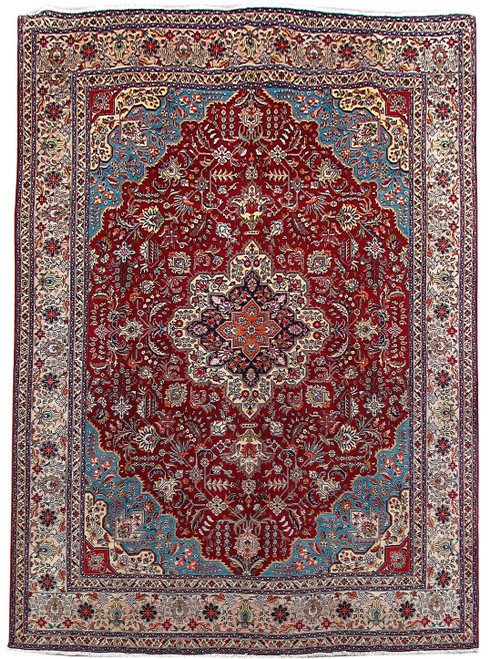
9'7" x 12'7" Persian Tabriz Rug | Red Field, Ivory Star Medallion | Semi Antique, Excellent Condition
This is a semi antique room size piece from the northwest of Persia, hand-knotted in wool on a cotton foundation and still carrying a full, even 3/8" pile after decades of life. The drawing is the classic town formula: a red field packed with flowering vine, a layered star medallion at the center, olive-green spandrels at the 4 corners and a navy main border framing the whole thing. At 9'7" x 12'7" it sits squarely in the most useful of all 10x13 Persian rugs, large enough to carry a full seating group or a dining table with chairs pulled out. It ships with a certificate of authenticity confirming origin, materials and hand-knotted construction.
Please Note About the Photographs:
The first overhead image was shot under brighter, flatter light and reads lighter and pinker than the rug actually is. The showroom floor photographs and the close-ups are the truer record of the color: a deep, saturated red field with a genuinely dark navy border.
Design and Motifs
The center holds an 8 point star medallion, drawn in ivory and pale olive with a small rosette at its heart, sitting inside a broad eggplant purple ring that throws out serrated leaf points and long curling tendrils in every direction. Around that, a second lobed halo of pale green and ivory steps outward into the field, so the medallion reads as 3 nested layers rather than one flat shape. The red ground between the medallion and the border is not left empty: it is filled edge to edge with thin flowering vine, small palmettes, rosettes and lanceolate leaves, all drawn on a curved line rather than a village-style angular one. The 4 corner spandrels repeat the olive and navy palette in miniature, each one anchored by a large paisley-shaped boteh cradling a red flower head. The main border runs a navy ground with alternating palmettes and flowering sprays, flanked by narrow guard stripes in ivory, camel and red that keep the whole composition tightly framed.
The Red, Ivory and Eggplant Purple Palette
Red carries the rug. It is a true madder-toned red, warm and slightly brick rather than fire engine bright, and in the angled photographs you can see it shift a shade lighter or deeper as the pile leans one way or the other. Against it, the eggplant purple of the medallion ring is the surprise: a muted aubergine that sits between violet and deep plum and gives the center far more depth than the usual navy would. The star itself is ivory, worked with pale olive and soft rose, and that same ivory travels out through the vine work so the field never goes heavy. Navy anchors the main border and the outer edge of the medallion, olive green fills the spandrels and the guard stripes, and small touches of sky blue, moss and old rose appear in the individual flower heads. The ends finish in natural ivory fringe. Taken together it is a palette that reads rich and traditional from across the room and surprisingly varied up close.
Tabriz Weaving in Northwest Persia
Tabriz sits in the far northwest of Persia and has been one of the country's great commercial weaving centers for centuries, working on vertical looms with the Raj system, where knot count is measured across a gereh of roughly 2.75 inches. What separates town weaving from village weaving is the cartoon: a Tabriz workshop weaves from a drawn design, which is why the vine on this rug curves cleanly, the medallion is symmetrical on both axes and the border pattern turns the corner properly instead of running out of room. The wool is tightly packed on a cotton warp and weft, the pile is clipped low and level, and the back shows a regular, disciplined knot line, as the ruler photograph makes clear. Age here is judged the way it always is with a town piece, by wool handle, dye behavior and the way the pile has settled, the same evidence covered in our guide on how to date an Oriental rug. This one has softened and mellowed without losing pile, which is exactly what you want in a semi antique.
9'7" x 12'7" Persian Tabriz Rug | Red Field, Ivory Star Medallion | Semi Antique, Excellent Condition
Ask about this rug
This piece is the only one of it, so the things worth knowing about it are particular to it. If you want to talk through the size, the colour in your own light, or the weave, speak to someone here first.