Watch the film
| Size in ft: | Width: 6'7" x Length: 10' |
| Size in Inch: | Width: 79" x Length: 120" |
| Size in meters: | Length: 3.05 x Width: 2.01 m |
| Colors: | Black, Ivory, Brown, Rust, Sage |
| Shape: | Rectangular |
| Woven: | Hand-Knotted |
| Pile: | Wool And Silk |
| Origin: | India |
| Design: | Mahi Tabriz |
| Age: | New |
| Condition: | Perfect |
6'7" x 10' Mahi Design Oriental Rug | Black Herati Fish Lattice Field | Wool and Silk, Never Used
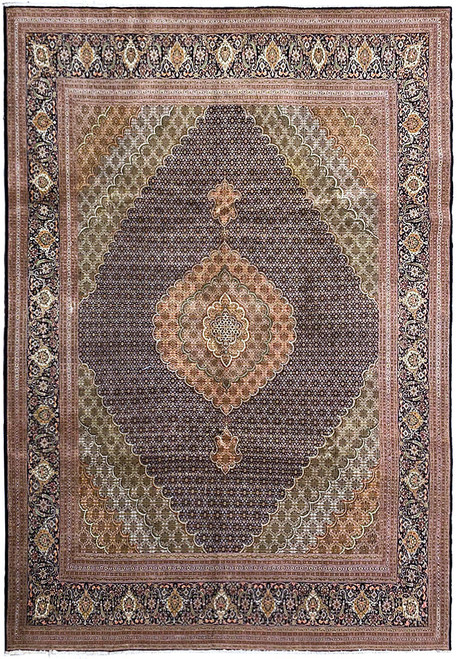
At 6'7" x 10' this is a true room-size piece, and it sits in the most useful part of the 7x10 rugs range: long enough to carry a sofa and two chairs, narrow enough to leave a clean margin of floor on either side. It was knotted entirely by hand in India in fine wool with silk highlights over a cotton foundation, and the pattern is the classic Mahi, or fish, design: a dense diagonal lattice across a black field with one ivory lobed medallion at the center. The pile is clipped low and even, which is the only way this pattern works, because every rosette and leaf in the lattice is tiny and has to stay readable. The rug is brand new, has never been on a floor, and ships with our certificate of authenticity documenting the materials, the hand-knotted construction and the origin of this Oriental rug.
Design and Motifs
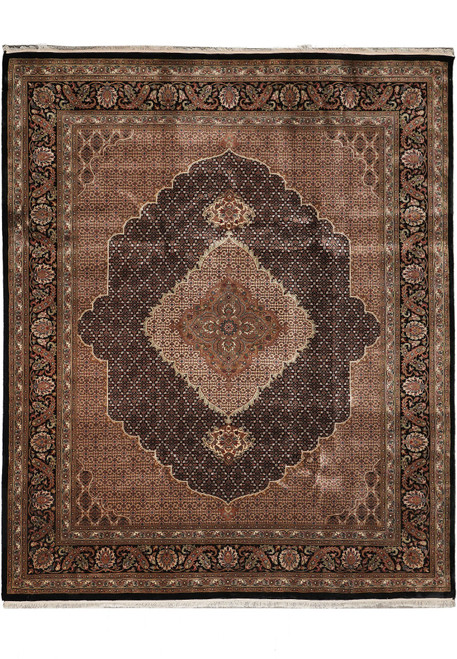
The field is a full herati lattice: small diamond frames set in diagonal rows, each one holding a rust rosette flanked by 4 curling leaves, the fish shapes that give the Mahi design its name. Between them sit ivory 4 petal crosses and slate blue leaf pairs, so the ground never reads as a flat repeat. The center medallion is an ivory lobed form outlined in sage and plum, filled with the same lattice drawn at a smaller scale, with an olive and slate core at its heart. A small matching pendant rises above and below the medallion, and 2 narrow ivory finials break out to the left and right. The 4 corner spandrels are quarter medallions in camel gold, each carrying its own lattice and finishing in a stepped, scalloped outline against the black. Around all of it runs a wide ivory main border of red palmettes, sage rosettes and curling arabesque leaves, framed by a camel gold floral vine stripe, a grey rosette stripe and fine ivory zigzag guards. The corners of the border resolve cleanly on all 4 sides, which tells you the drawing was followed rather than improvised.
A Black Field Lit by Ivory, Rust and Sage
The field is a deep, saturated black, closer to ink than charcoal, and it does the work of making every other color look brighter than it is. Against it the lattice motifs come forward in brick rust, soft sage green, pale slate blue, cream ivory and small touches of plum and aubergine. The medallion is a warm ivory, not a cold white, graded with sage and dusty rose outlines so the shape has depth rather than sitting on the surface like a sticker. The corner spandrels and the inner vine stripe shift into camel gold and honey brown, which keeps the overall effect warm and traditional instead of stark. The main border is ivory with red and sage, so the rug reads as a light frame holding a dark center, a contrast that photographs well and reads well in a room with pale walls or wood floors. Where the silk highlights fall in the medallion and the small leaves, the surface catches light and the tone lifts as you walk around the rug. The ends finish in natural ivory cotton fringe and the sides in a black selvedge.
Made in India: Weave Quality and the Mahi Drawing Tradition
This rug was woven in India, and that is worth saying with confidence: India is where most of the world's good contemporary hand-knotted Oriental rugs are made today, by weavers working on the same upright looms, with the same hand-tied knots and the same cotton warps used for generations. The Mahi lattice they are following here comes out of the Tabriz drawing tradition, where the pattern is built from a cartoon square by square, and it is an unforgiving design to copy: miss a count and the diagonal rows drift. On this piece the lattice holds true from border to border, the medallion is symmetrical, and the back shows small tight knots with clear definition, which is what allows the motifs to be this fine at this scale. The wool is well washed and has a quiet sheen, the silk is used sparingly as accent rather than filler, and the handle is firm with a short pile that will take traffic in a living room, dining room or office for decades.
6'7" x 10' Mahi Design Oriental Rug | Black Herati Fish Lattice Field | Wool and Silk, Never Used
Ask about this rug
This piece is the only one of it, so the things worth knowing about it are particular to it. If you want to talk through the size, the colour in your own light, or the weave, speak to someone here first.