Watch the film
| Size in ft: | Width: 10' x Length: 13'1" |
| Size in Inch: | Width: 120" x Length: 157" |
| Size in meters: | Length: 3.99 x Width: 3.05 m |
| Colors: | Maroon, Beige, Camel Brown, Ivory, Olive Green |
| Shape: | Rectangular |
| Woven: | 100% Hand-knotted | Handmade |
| Foundation: | Cotton |
| Pile: | Wool and Silk |
| Age: | New | Never used |
| Design: | Mahi Tabriz | Herati Fish Pattern | Scalloped Medallion |
| Origin: | Made in India |
| Condition: | Brand New | Never used |
10' x 13'1" Oriental Mahi Tabriz Rug | Wool and Silk Herati Fish Design | New, Never Used
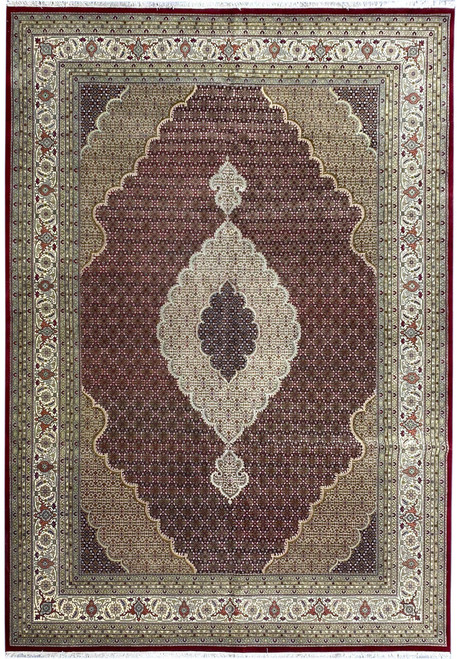
This 10' x 13'1" rug is knotted entirely by hand in wool with silk drawn through the highlights, and it follows the Mahi Tabriz layout: a deep maroon field packed edge to edge with the herati fish pattern, a layered scalloped medallion in ivory and camel floating at the centre, and a wide ivory border of palmettes and rosettes holding the whole composition together. The pile is full and untouched, the ends are clean and evenly fringed, and the piece has never been on a floor. It ships with a certificate of authenticity confirming that it is 100% hand-knotted. At just over 13 feet long it will carry a full seating group without crowding the walls, which is why this proportion stays the most requested of our 10x13 area rugs.
Please Note About the Photographs:
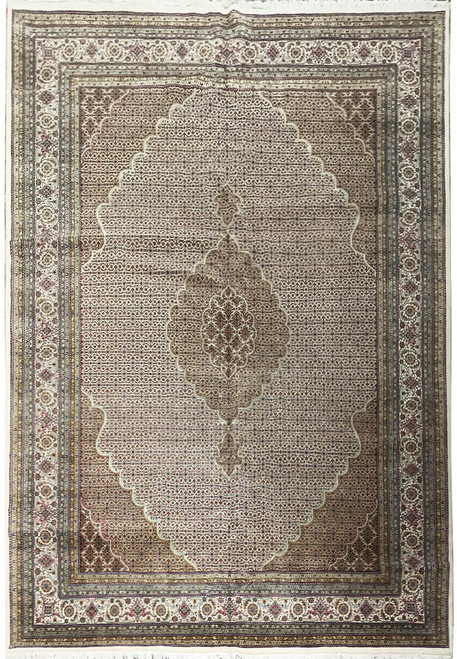
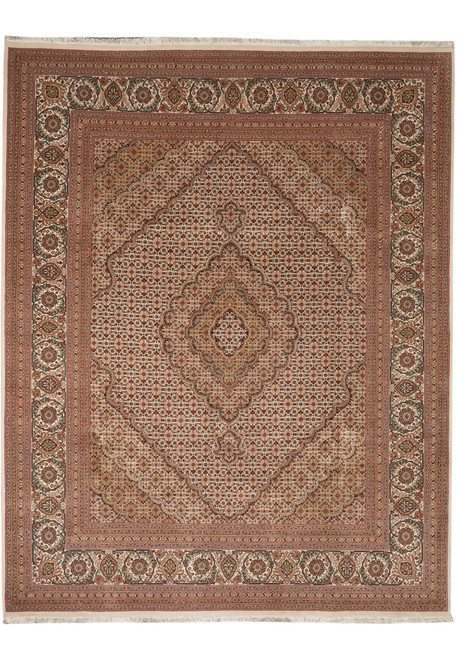
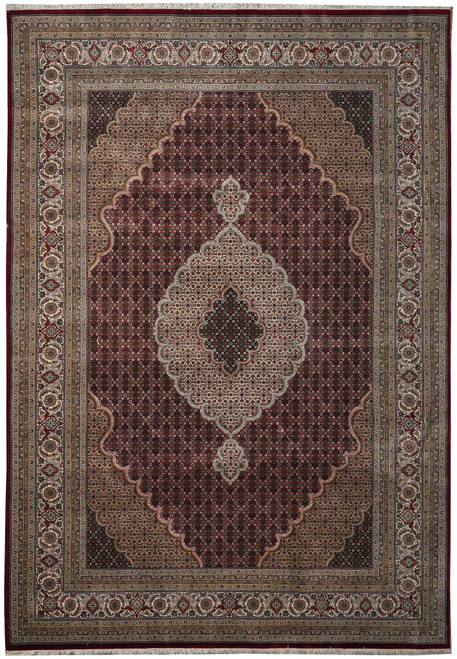
The flat overhead photograph was shot under even studio light, which pushes the field toward a dull plum. The close-up images of the pile, the folded back and the medallion show the true colour: a clear maroon red with warm camel and ivory around it. Nothing is faded and there is no discoloration in the rug itself.
Design and Motifs
Mahi means fish, and the name describes the small lozenge cells of the herati repeat, each one framed by 4 curved leaves that read like fish circling a rosette. Here that repeat runs unbroken across the entire field and continues inside the medallion and the corner spandrels, so the eye never finds a blank inch. The centre medallion is built in concentric scalloped rings, roughly 40 cusped lobes deep, each ring outlined in camel and pale slate, with a small lobed cartouche at the very core and matching pendants reaching out along the long axis toward the ends. The spandrels answer the medallion with the same scalloped edge, drawn in beige and camel so the field reads as a red oval set into a lighter ground. The main border is ivory, alternating pointed medallions with open palmettes and eight petal rosettes joined by a leafy vine, and it is flanked by 4 narrow guard stripes of running flowerheads before the plain maroon outer band and the cotton fringe.
Color: Maroon, Camel and Ivory
The field is a deep maroon, closer to claret than to bright scarlet, and because every herati cell is outlined in black brown the red reads dark and dense rather than loud. Inside those cells sit tiny cream flowerheads, olive green leaves and occasional dots of powder blue and dusty rose, which is what keeps a field this large from going flat. The medallion and spandrels shift the palette to ivory, camel and soft beige, with silk highlights catching the light along the scalloped outlines so the centre appears lit from within as you walk around it. The border is a warm ivory ground carrying terracotta vinework, slate grey palmettes, olive green foliage and mauve rosettes, all closed by the plain maroon selvage band that frames the rug. Against pale oak, walnut or a cream wall the maroon holds the room, while the beige and camel keep it from feeling heavy.
Woven in India to Mahi Tabriz Standards
This rug is made in India, and that is a mark in its favor. India is where most of the world's good contemporary hand-knotted work is now produced, and the best ateliers there weave the classic Mahi Tabriz cartoon at a knot count fine enough to hold the tiny herati cells and the cusped medallion outlines without blurring them. The folded back photograph shows the proof: a tight, regular knot on a cotton foundation, crisp pattern definition from the reverse, and straight sides with a hand-finished selvage. The pile is a good quality wool with silk worked into the highlights, which gives the medallion and border a sheen the wool alone would not produce, and a surface that will burnish rather than wear as it is used. If you are weighing this against older workshop pieces, our guide to what separates a Oriental rug from other hand-knotted traditions explains where the value sits.
10' x 13'1" Oriental Mahi Tabriz Rug | Wool and Silk Herati Fish Design | New, Never Used
Ask about this rug
This piece is the only one of it, so the things worth knowing about it are particular to it. If you want to talk through the size, the colour in your own light, or the weave, speak to someone here first.