Watch the film
| Size in ft: | Width: 6'8" x Length: 10' |
| Size in Inch: | Width: 80" x Length: 120" |
| Size in meters: | Length: 3.05 x Width: 2.03 m |
| Colors: | Ivory, Brown, Black, Rust, Green |
| Shape: | Rectangular |
| Woven: | 100% Hand-knotted | Handmade |
| Foundation: | 100% Cotton |
| Pile: | Wool and Silk |
| Age: | New |
| Design: | Mahi Tabriz | Herati fish pattern | Lobed medallion |
| Origin: | Made in India |
| Condition: | Perfect | New |
6'8" x 10' Mahi Tabriz Rug | Wool & Silk Ivory Fish Pattern Field | Made in India, New
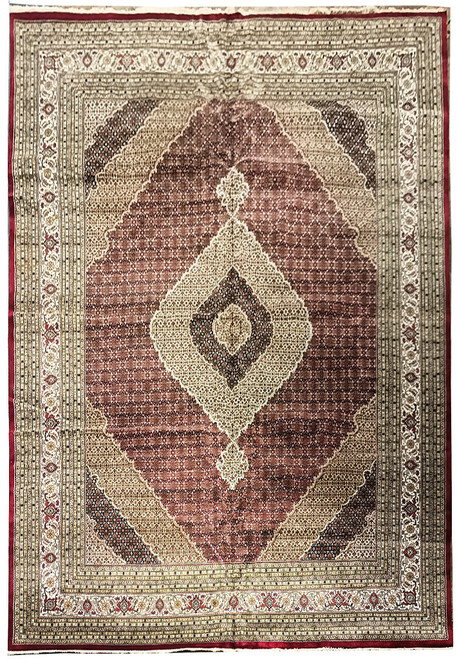
This 6'8" x 10' rug is a hand-knotted Mahi Tabriz design woven in India in fine wool with silk highlights over a cotton foundation, and it is brand new with the back tag still attached (see the final photograph). The Mahi, or fish, layout is one of the most quietly addictive patterns in the Oriental rug repertoire: thousands of tiny diamond and rosette units marching across an ivory ground, pulled into order by a single scalloped medallion. At 80 inches by 120 inches it sits comfortably in the 7x10 rug size range, large enough to carry a sofa and two chairs or a six-seat table with chairs pulled back. Every rug we ship leaves with a certificate of authenticity recording its size, materials, weave and origin.
Please Note About the Photographs:
The first overhead photograph was taken under warmer light, so the field reads deeper and rustier there than it does in person. The angled studio shots and the close-up details are the truer reading: a light ivory ground with rust, brown and green drawing. This is a lighting difference only, not fading, shading or wear.
Design and Motifs
The field is a true herati, the pattern Persian weavers call mahi dar ham, built from a diamond lattice with a rosette at each center and four curved lancet leaves set around it, the leaves that give the fish pattern its name. That tiny repeat covers the whole ground without a break, and the weaver has kept the units in perfect register line after line, which is where this kind of drawing is won or lost. Over it sits a scalloped lobed medallion with an inner cartouche of its own, finished top and bottom with slender pendants, and the field is bracketed by large lobed corner forms that echo the medallion outline rather than cutting it with a hard spandrel. The main border runs an ivory ground with palmettes and open rosettes joined by a brown arabesque vine, with small leaf sprigs filling the gaps, and it is framed by several narrow guard stripes of reciprocal sawtooth and running floral meander. Flat woven ends and plain ivory fringe close both ends.
A Detailed Look at the Colors
The ground is ivory, closer to warm cream than stark white, and because the herati units are so small the field reads from a distance as a soft oatmeal tone rather than as pattern. Step closer and the individual colors separate out: rust and brick red in the rosettes, chocolate and tobacco brown in the vines and leaves, near black in the fine outlines and lattice diamonds, sage to olive green in the small star flowers, with occasional slate blue and a rose beige that warms the medallion ground. The medallion itself is a dusty rose and camel field with ivory outlining and darker brown and black accents in the center cartouche, so it sits half a shade deeper than the surrounding field instead of shouting against it. The border reverses that balance, an ivory ground carrying pink-rose palmettes, green leaves and small red buds, which lifts the whole rug at the edges. The silk highlights do their work in the rosette hearts and leaf tips, catching light as the rug is walked around, visible in the rolled pile photographs.
Origin and Weaving Quality
This rug was made in India, where the best contemporary hand-knotted work in the world is now produced, and the workshops that weave the Mahi Tabriz layout do so on fine looms with a tight knot count because the pattern simply cannot be drawn at a coarse gauge. The folded corner photograph shows what that means in the hand: a dense, even back with small regular knots, straight selvedges, and no slack or wobble in the lattice rows. Wool carries the structure and the silk is used sparingly as highlight, which is the right way around for a floor rug, since the wool takes the traffic while the silk supplies the sheen. The pile is clipped low and uniform, so the drawing stays crisp and the rug lies flat without buckling. It has never been used, it has no restoration, repair or wear of any kind, and it is ready to put straight into a room.
6'8" x 10' Mahi Tabriz Rug | Wool & Silk Ivory Fish Pattern Field | Made in India, New
Ask about this rug
This piece is the only one of it, so the things worth knowing about it are particular to it. If you want to talk through the size, the colour in your own light, or the weave, speak to someone here first.