Watch the film
| Size in ft: | Width: 9'9" x Length: 13'4" |
| Size in Inch: | Width: 117" x Length: 160" |
| Size in meters: | Length: 4.06 x Width: 2.97 m |
| Colors: | Black, Ivory, Brown, Rust, Green |
| Shape: | Rectangular |
| Woven: | 100% Hand-knotted | Handmade |
| Foundation: | Cotton |
| Pile: | Wool and Silk |
| Age: | New | Current production |
| Design: | Mahi Tabriz | Herati Fish Pattern | Medallion and Corners |
| Origin: | Made in India |
| Condition: | Perfect | Never used |
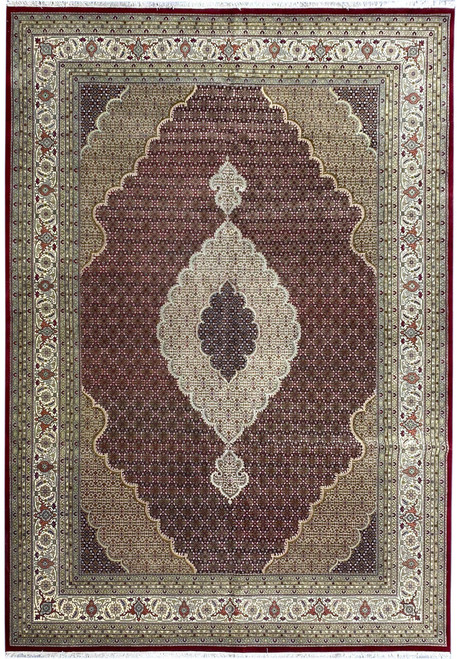
9'9" x 13'4" Wool & Silk Mahi Tabriz Design Rug | Herati Fish Pattern | Brand New, Made in India
This 9'9" x 13'4" rug is a brand new, never used hand-knotted piece in the Mahi Tabriz drawing, worked in wool with silk highlights over a cotton foundation. The weave is tight and even, the pile is low and crisp, and the silk catches light exactly where the design needs it: in the medallion petals, the pendants and the small floral heads scattered through the field. At just under 10 by 13 it sits squarely in the most useful large room size, and buyers shopping 10x13 area rugs will find this one unusually detailed for its scale. Every rug we sell ships with a certificate of authenticity confirming that it is hand-knotted, along with its exact measurements and materials.
Please Note About the Photographs:
A few of the overhead shots show soft shading across the field where the studio light falls off and where the rug was recently unrolled. That shading is camera shadow and pile direction, not wear, fading or damage. The pile lies uniformly once the rug is flat, and every rug is professionally steamed and pressed before it leaves our warehouse.
Design and Motifs
Mahi means fish, and the whole field is built from the herati lattice: a small diamond enclosing a rosette, flanked by 4 curved lanceolate leaves that early weavers read as fish circling a pool. Here the lattice repeats thousands of times at a very small scale, which is what makes the pattern shimmer rather than read as a grid. At the center sits a lobed black medallion filled with palmettes, curling leaves and a starburst rosette, finished with an elongated pendant at each end and a small ivory cartouche beyond it. Two scalloped ovals of ivory and dark ground frame the medallion and push it forward, while deep corner spandrels with stepped outlines anchor the 4 corners. The main border runs an ivory ground with a continuous vine of serrated saz leaves and palmettes, set between camel colored minor borders of small rosettes and a fine reciprocal zigzag guard. Look at the close-up photographs and you can see the outlining knot by knot: every leaf has a dark contour line, which is the detail that separates a well drawn Mahi from a flat one.
Color Palette and How It Reads in a Room
The field ground is a deep near black that warms into aubergine brown where the light strikes it, and the herati lattice is drawn over it in ivory, camel and soft sage green so the surface reads as a warm dark brown from a standing distance rather than a hard black. Inside the scalloped oval the ground lifts to ivory and pale sand, giving the medallion room to breathe. The medallion itself is black outlined in ivory with a dusty rose and tan center, filled with rust, brick red, olive green, slate blue and cream florals. The main border is a clean ivory that frames the whole composition, carrying burgundy, moss green, gray green and terracotta leafwork, and the outer edge and selvage finish in a rich burgundy red that gives the rug a defined perimeter. The green notes are quiet, the rust notes are earthy, and the silk highlights add a low sheen that changes as you walk around the rug. Against wood floors, cream walls, or a room already using brown leather and brass, this palette settles in immediately.
Origin and Weaving Quality
This rug was made in India, in the workshops that now produce most of the world's best contemporary hand-knotted work. The Mahi design belongs to the Tabriz weaving tradition of northwest Persia, and Indian master weavers have adopted it because it demands exactly what they do well: a very fine, very consistent knot count over a large surface, with disciplined outlining and clean symmetry across a 13 foot length. Nothing about that origin is a compromise. The wool is spun tight, the silk accents are real silk rather than mercerized cotton, the cotton warp and weft keep the rug flat and square, and the fringe and selvage are finished by hand. If you are weighing how a piece like this compares with a Persian workshop rug, our guide to the difference between a Persian rug and an Oriental rug lays out what actually changes and what does not. What you get here is a large, formal, never used floor piece with a decorative vocabulary that has held its value for a century.
9'9" x 13'4" Wool & Silk Mahi Tabriz Design Rug | Herati Fish Pattern | Brand New, Made in India
Ask about this rug
This piece is the only one of it, so the things worth knowing about it are particular to it. If you want to talk through the size, the colour in your own light, or the weave, speak to someone here first.