Watch the film
| Size in ft: | Width: 6'8" x Length: 10' |
| Size in Inch: | Width: 80" x Length: 120" |
| Size in meters: | Length: 3.05 x Width: 2.03 m |
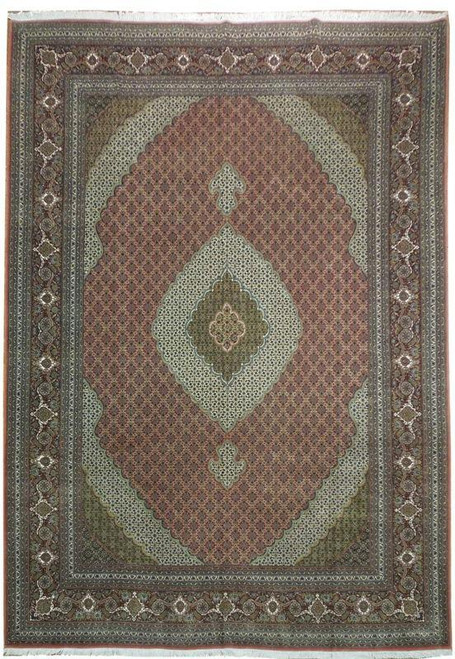
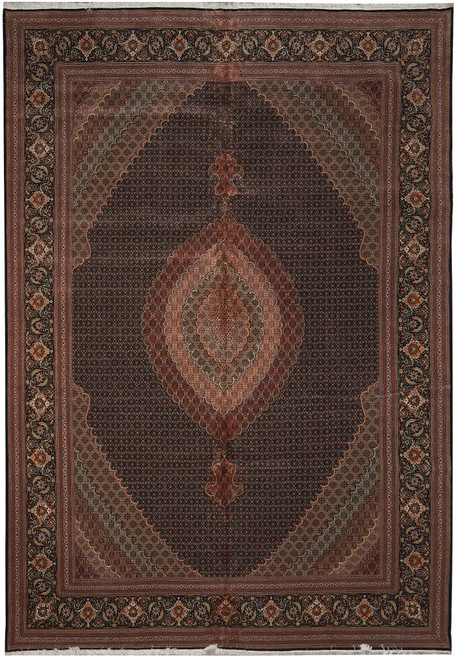
| Colors: | Black, Ivory |
| Shape: | Rectangular |
| Woven: | 100% Hand-knotted | Handmade |
| Foundation: | Cotton |
| Pile: | 1/4" Wool and Silk |
| KPSI: | 60 Raj | Approx. 400 |
| Design: | Tabriz Mahi | Herati Fish Lattice | Central Medallion |
| Origin: | Persian Tabriz | Made in Persia |
| Condition: | Brand New | Never used |
6'8" x 10' Persian Tabriz Mahi Rug | Fine Wool & Silk Black Fish Design | Approx. 400 KPSI, Never Used
This 6'8" x 10' Persian Tabriz is a Mahi, the fish pattern that the best Tabriz workshops treat as their test piece, and it has never been on a floor. The pile is fine wool carrying silk in the medallion, spandrels and outlines, knotted at roughly 60 Raj over a cotton foundation, which is why the tiny Herati rosettes stay crisp instead of blurring into one another. At close range you can read every element of the lattice; from standing height the black ground reads almost like a dark textile with a soft glow moving through it. The pile is a low 1/4", the way a fine Tabriz should be cut, so the drawing stays sharp and the rug lies flat under furniture. It ships with a certificate of authenticity. Buyers working in this footprint can also compare our other 7x10 Persian rugs.
Design and Motifs
The whole field is filled with the Herati, or Mahi, lattice: a repeating diamond frame holding a small rosette, with curved fish leaves turned in along each side. It runs edge to edge in a strict grid, and the weaver held that grid through the medallion area as well, which is the hard part. At center sits a scalloped lobed medallion built in rings, an ivory core carrying a fine 8 petal rosette and arabesque tracery, then a gold band, then a broad salmon and rust field of concentric scallops outlined in ivory. Slender pendants reach out of the top and bottom of the medallion toward the ends of the field. Four corner spandrels in olive-gold carry the same scalloped edge and their own miniature lattice, and two small cloud bracket motifs float in the open field between medallion and corners. The main border is black, set with alternating ivory rosettes and shield shaped palmettes joined by a gold vine, and it is framed by narrow guard stripes of reciprocal vine work and a pearl band that keeps the whole composition contained.
A Black Ground Lit by Ivory, Salmon and Olive
The field is a deep, near ink black, and because the Herati rosettes inside it are worked in ivory, warm gold and terracotta, the ground never turns flat or heavy. The medallion moves through salmon, soft rose and brick rust, each scallop separated by a thin ivory line, and finishes in a bright ivory center that pulls the eye straight to the middle of the rug. The spandrels are a muted olive-gold with green shading, the single warmest passage on the rug, and they balance the dark field at the four corners. Green appears again in the black border, in leaf work around the ivory rosettes, alongside touches of apricot and pale blue. The silk sits in the outlines, the medallion rings and parts of the spandrels, so those areas change tone as you walk past while the wool ground stays constant. Ivory fringe and ivory guard stripes give the piece a clean, finished edge.
Tabriz Weaving and the Mahi Tradition
Tabriz sits in the northwest corner of Persia and has been the commercial and technical center of Persian weaving for centuries. Tabriz measures fineness in Raj, the number of knots across a gereh of about 2.75 in: 40 Raj is commercial work, 50 Raj is fine, and 60 Raj, roughly 400 knots per square inch, is where collector grade begins. This rug is woven at that level, and the Mahi design is the reason it matters. A Herati lattice at low knot count gets muddy within a few rows; at this density the fish leaves keep their curve and the rosette centers stay legible across the full 10' length. The back, shown against a ruler in the photographs, is tight and evenly beaten with no slack rows, and the selvedges and ends are finished the way a workshop piece should be. This is production from a Tabriz atelier working in wool with silk, not a village weave, and it is offered brand new and unused.
6'8" x 10' Persian Tabriz Mahi Rug | Fine Wool & Silk Black Fish Design | Approx. 400 KPSI, Never Used
Ask about this rug
This piece is the only one of it, so the things worth knowing about it are particular to it. If you want to talk through the size, the colour in your own light, or the weave, speak to someone here first.