| Size in ft: | Width: 11'6" x Length: 16'6" |
| Size in Inch: | Width: 138" x Length: 198" |
| Size in meters: | Length: 5.03 x Width: 3.51 m |
| Colors: | Black, Beige, Brown, Olive, Rust |
| Shape: | Rectangular |
| Woven: | 100% Hand-knotted | Handmade |
| Foundation: | Cotton |
| Pile: | Wool and Silk |
| KPSI: | Approx. 400 |
| Age: | 2000's |
| Design: | Tabriz Mahi | Herati fish pattern | Central medallion |
| Origin: | Persian Tabriz | Made in Persia |
| Condition: | Excellent |
11'6" x 16'6" Persian Tabriz Rug | Mahi Herati Fish Design | Wool & Silk 400 KPSI
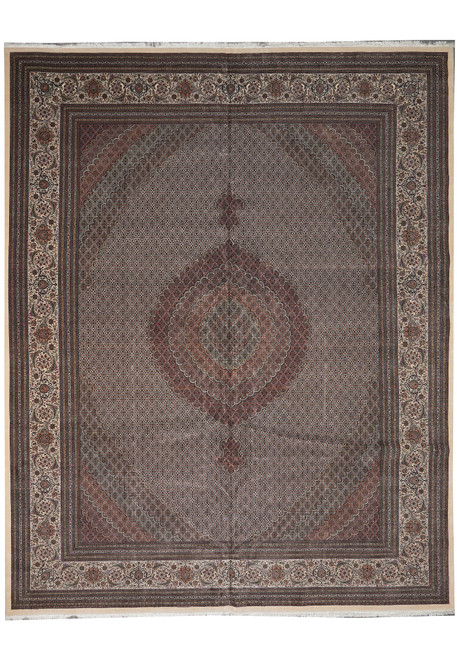
This 11'6" x 16'6" Persian Tabriz is a workshop piece in the Mahi tradition, hand-knotted in wool with silk worked through the highlights at approximately 400 knots per square inch. At nearly 17 feet long it belongs with the genuinely oversize Persian rugs, yet the drawing never coarsens: the Herati lattice holds its scale across the full field, and the medallion resolves cleanly at every ring. The handle is firm and even, the pile still crisp, and the condition is excellent throughout. Every rug we ship travels with a certificate of authenticity recording origin, materials and knot count.
Design and Motifs
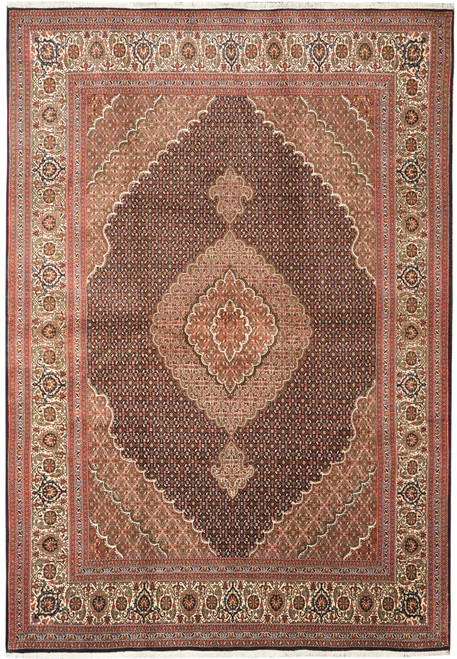
The field is a full Herati, known as Mahi or fish pattern: a continuous diamond lattice with a rosette at each center and 4 curved lanceolate leaves, the so-called fish, turning around it. Thousands of those repeats cover the ground at a tiny scale, which is only possible at this knot count. A layered oval medallion sits dead center, built from ring after ring of scalloped cartouche work with a small floral rosette at its heart, and it sends out slender stems to cusped pendants at top and bottom. Matching quarter medallions fill the 4 corners with the same scalloped edging, and the remaining spandrel ground carries an ivory-toned Herati of its own. The main border runs palmettes and star rosettes linked by curling vine, framed by narrow guard stripes of boteh paisley, running vine and a fine herringbone band.
Color Palette
The ground is a deep black that reads almost charcoal under lamplight, and it does the heavy work here: against it the tiny Herati rosettes come forward in ivory, apricot, rust and small points of soft blue and olive green. The medallion shifts through copper and rust into salmon and then a pale beige core, so it appears lit from the middle outward, with the silk highlights catching light as you walk past and changing tone from one end of the room to the other. Spandrels and outer field edges soften into beige, sand and warm brown, and the main border returns to black with palmettes in apricot, ivory, wine red and moss green. Guard stripes add thin lines of terracotta, gold and pale blue, and the rug finishes with black selvage and natural ivory cotton fringe.
Tabriz Origin and Weaving Quality
Tabriz sits in the northwest of Persia and has been the country's most organized weaving city for centuries, working from cartoons drawn by professional designers and measuring fineness in Raj, the number of knots counted across a gereh of about 2.75 inches. Roughly 400 knots per square inch puts this piece around 60 Raj, the level where Tabriz workshops stop producing commercial goods and start producing collector work. The Mahi is the design Tabriz is judged on, precisely because a loose weave turns the fish leaves into mush, and here they stay legible at the smallest scale. The back shows a tight, regular knot grid on a cotton foundation, the wool is dense and springy with silk reserved for the accents, and the piece dates to the 2000's with no restoration and no wear of note.
11'6" x 16'6" Persian Tabriz Rug | Mahi Herati Fish Design | Wool & Silk 400 KPSI
Ask about this rug
This piece is the only one of it, so the things worth knowing about it are particular to it. If you want to talk through the size, the colour in your own light, or the weave, speak to someone here first.