| Size in ft: | Width: 6'8" x Length: 10' |
| Size in Inch: | Width: 80" x Length: 120" |
| Size in meters: | Length: 3.05 x Width: 2.03 m |
| Colors: | Cream, Salmon Pink, Beige, Brown, Red, Green, Blue, Gray |
| Shape: | Rectangular |
| Woven: | 100% Hand-knotted | Handmade |
| Foundation: | Cotton |
| Pile: | Wool and Silk |
| KPSI: | 60 Raj | Approx. 400 |
| Age: | 2000's | Never used |
| Design: | Tabriz Floral Medallion | Corner Spandrels | Multi-band Border |
| Origin: | Persian Tabriz | Made in Persia |
| Condition: | Perfect | Never used |
6'8" x 10' Persian Tabriz Rug | Cream Wool and Silk Floral Medallion | Approx. 400 KPSI, Never Used
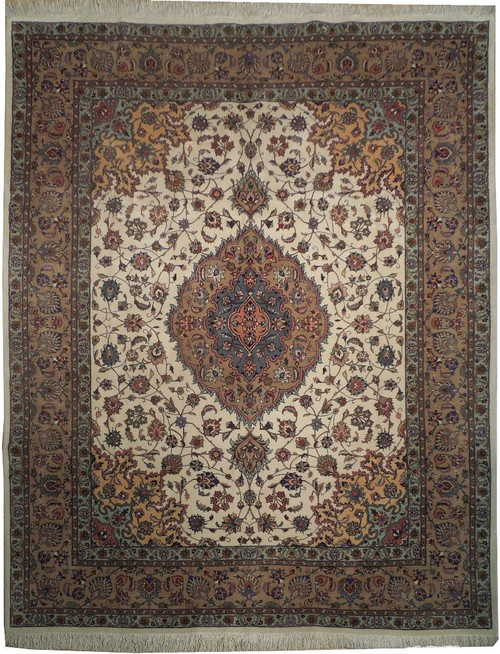
This 6'8" x 10' piece is a workshop Tabriz woven in the 2000's and never put on a floor, and the pile still has the full, unflattened stand you only see on an unused rug. The ground is cream, almost the shade of raw silk, and the silk knots used in the flower heads and vine tips catch the light at a different angle from the wool around them, so the field shifts as you walk past it. At roughly 400 knots per square inch the drawing stays crisp at the smallest scale: the curl of a single leaf tip is still a curve, not a staircase. It is a size that reads as formal without being heavy, and it works for buyers shopping 7x10 Persian rugs who want fineness rather than bulk. Every rug we sell ships with a certificate of authenticity.
Design and Motifs
The layout is the classic Tabriz medallion and corner, drawn with unusual restraint. A pointed lobed medallion sits at center, finished top and bottom with slender pendants that taper into small palmette finials. Inside it a second, smaller cartouche holds a rosette ringed by curling acanthus leaves. The cream field around it is filled with a continuous arabesque of thin vines that split, loop back and reconnect, carrying rosettes, buds, serrated saz leaves and small feathery boteh-like sprays. Nothing repeats mechanically: the left and right halves mirror each other but the individual blossoms change color as they go. The 4 corner spandrels are drawn large and filled with big curled palmettes and split-leaf scrollwork, so the ivory field reads as a distinct central panel. The border system runs 5 bands deep, a wide main band of alternating palmettes and vase-like flower clusters flanked by narrow floral guard stripes and fine reciprocal edging.
The Cream, Sage and Salmon Palette
Cream is the dominant color and it is a warm cream, closer to ivory and old parchment than to white, which keeps the whole rug soft rather than stark. The main border is a muted sage green that leans olive and taupe depending on the light, and it frames the field without competing with it. The spandrels are salmon pink over beige, warming the 4 corners and giving the field its boundary. The medallion is the coolest note in the rug: slate blue at its heart, ringed in sage and gray-green, outlined in a fine brown and beige tracery. Scattered through the vinework are touches of rust red, deep brown, forest green, sky blue and a pale gray, all used in small quantities as accents on individual flower heads. The silk highlights sit mostly in the lighter tones, so the cream and pale blue passages carry a sheen that the wool grounds do not.
Tabriz Weaving and Quality
Tabriz sits in the northwest of Persia and has been the country's most organized weaving center for centuries, the place where the medallion and corner layout was codified and exported to every other Persian workshop town. Fineness there is counted in Raj, the number of knots across a gereh of about 2.75 inches: 40 Raj is ordinary commercial work, 50 is fine, and 60 Raj, roughly 400 knots per square inch, is where a rug moves into collector territory. This one is at that 60 Raj level, woven on a cotton foundation with a clipped wool and silk pile, and the back photograph shows the tight, even knot grid that makes the curved arabesque drawing possible in the first place. Short pile, dense knotting and a mineral-hard local wool are what let a Tabriz of this grade hold its detail for generations rather than blurring after a decade of use.
6'8" x 10' Persian Tabriz Rug | Cream Wool and Silk Floral Medallion | Approx. 400 KPSI, Never Used
Ask about this rug
This piece is the only one of it, so the things worth knowing about it are particular to it. If you want to talk through the size, the colour in your own light, or the weave, speak to someone here first.