| Size in ft: | Width: 8' x Length: 10' |
| Size in Inch: | Width: 96" x Length: 120" |
| Size in meters: | Length: 3.05 x Width: 2.44 m |
| Colors: | Ivory, Taupe, Rust, Blue, Green |
| Shape: | Rectangular |
| Woven: | 100% Hand-knotted | Handmade |
| Foundation: | Cotton |
| Pile: | Wool and Silk |
| KPSI: | 60 Raj | Approx. 400 |
| Age: | Recent | Unused |
| Design: | Curvilinear Floral Medallion | All-over Vine Field | Woven Cartouche |
| Origin: | Persian Tabriz | Made in Persia |
| Condition: | Perfect | Never used |
8' x 10' Persian Tabriz Rug | Ivory Floral Medallion | Wool & Silk, Approx. 400 KPSI, Never Used
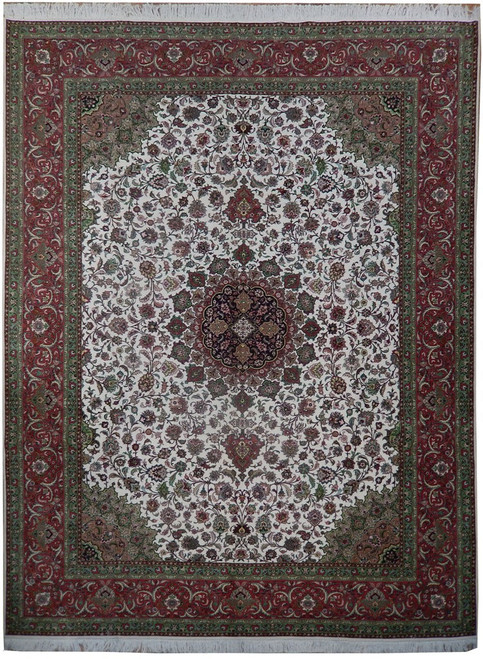
A recent workshop piece that has never been laid in a home, this Tabriz keeps the crisp pile height and unbruised fringe of a rug straight off the loom. The wool and silk pile is knotted at roughly 400 knots per square inch, or 60 Raj by the Tabriz counting system, which is the level at which curved drawing stops being approximate and starts being exact. You can see it in the medallion outlines and in the tiny paired leaves scattered across the ivory field. A woven cartouche sits in the upper guard border, the mark of a named workshop rather than an anonymous commercial loom. Among 8' x 10' Persian rugs this is a formal, light-ground piece rather than a dark one, and it reads as bright and open even in a room with limited daylight. Every rug we ship carries a certificate of authenticity, and this one is one of the more genuinely collectible 8x10 Persian rugs we stock in this fineness.
Design and Motifs
The layout is the classic curvilinear Tabriz formula, drawn with unusual care. A lobed central medallion anchors the field, built in concentric rings: a small rosette at the core, a salmon cartouche around it, then a slate blue ground carrying palmettes and leaf sprays, then a camel outer lobe finished with a scalloped, cusped edge. Slender pendants rise and fall from the medallion at top and bottom, each tipped with a palmette. The ivory field around it is not empty for a single inch. Thin vines curl across the whole ground, carrying rosettes, cypress-like leaflets, split palmettes and small serrated leaves, all mirrored across both axes. The 4 corner spandrels break the ivory with a warm peach ground and a heavier, more architectural arabesque, giving the field a defined frame within the frame. The main border runs a camel ground with alternating fan palmettes and boteh-like blossoms linked by a fine vine, and it is fenced on both sides by soft green guard stripes filled with rosettes and a barber-pole minor stripe. The signature cartouche breaks the rhythm of the upper guard border, woven in dark script on the green ground.
A Palette of Ivory, Taupe, Rust, Blue and Green
The field is a warm ivory, closer to unbleached cream than to stark white, and the silk in the pile catches light so the ground shifts between pale gold and near white depending on where you stand. Against it the drawing works in a muted, slightly dusty range: brick rust and terracotta in the rosettes, deep forest green in the leaves, indigo and mid blue in the smaller blossoms, and a chalky rose that softens everything. The medallion supplies the strongest contrast in the rug, a slate blue that leans grey-blue rather than navy, ringed by camel and salmon. The main border is a taupe camel, warm and neutral, which lets the sage green guard stripes read as the cool note framing the whole piece. There is no harsh color anywhere in this rug and no synthetic brightness. It sits comfortably with oak or walnut floors, with cream and grey upholstery, and with brass or aged bronze, and it will not fight existing artwork.
Tabriz Weaving and Workshop Quality
Tabriz sits in the northwest of Persia and has been the commercial and artistic center of Persian weaving for centuries, the city where the great court designs were revived and where the trade standard for fineness is still set. Tabriz measures quality in Raj, the number of knots counted across a gereh of about 2.75 inches of width: 40 Raj is commercial work, 50 is fine, and 60 Raj, roughly 400 knots per square inch, is where a rug crosses into collector territory. This piece is woven at that 60 Raj level on a cotton foundation, with silk worked into the wool pile to lift the outlines and the medallion. The back, visible in the final photograph, shows the knot nodes small, square and even from selvage to selvage, with the design as legible from behind as it is from the front. That evenness over 80 square feet is the real tell of a workshop loom and experienced weavers rather than a village production, and it is why a rug like this holds its drawing for generations.
8' x 10' Persian Tabriz Rug | Ivory Floral Medallion | Wool & Silk, Approx. 400 KPSI, Never Used
Ask about this rug
This piece is the only one of it, so the things worth knowing about it are particular to it. If you want to talk through the size, the colour in your own light, or the weave, speak to someone here first.