| Size in ft: | Width: 9'5" x Length: 13'2" |
| Size in Inch: | Width: 113" x Length: 158" |
| Size in meters: | Length: 4.01 x Width: 2.87 m |
| Colors: | Ivory, Mauve Coral, Wine, Blue, Green |
| Shape: | Rectangular |
| Woven: | 100% Hand-knotted | Handmade |
| Foundation: | Silk |
| Pile: | Wool and Silk |
| KPSI: | Approx. 500 |
| Age: | 2000's | Unused |
| Design: | Tabriz Floral Medallion | All-over Vine Field | 4 Corner Spandrels |
| Origin: | Persian Tabriz | Made in Persia |
| Condition: | Perfect | Never used |
9'5" x 13'2" Persian Tabriz Rug | Ivory Floral Medallion, Wool & Silk on Silk | Approx. 500 KPSI | Never Used
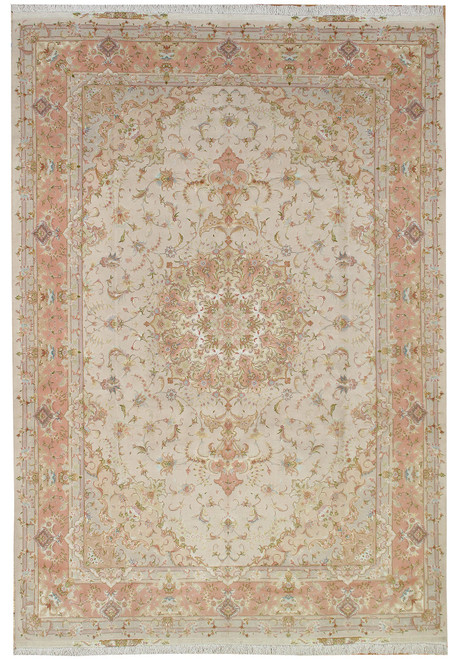
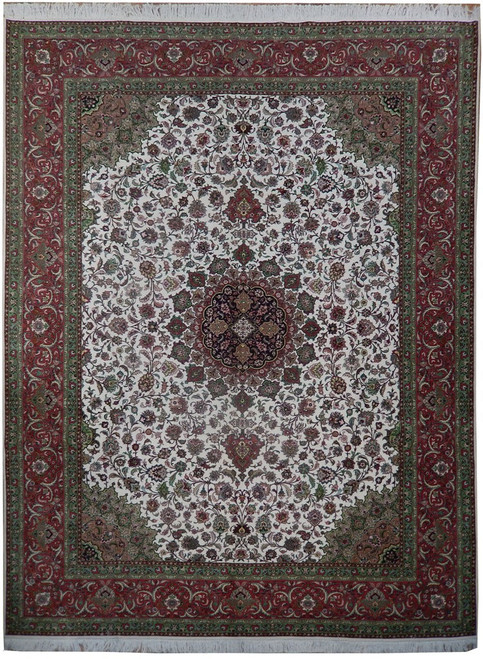
This 9'5" x 13'2" Persian Tabriz was woven in the 2000s and has never been laid in a room. The pile is wool with silk accents, knotted onto a silk foundation at roughly 500 knots per square inch, and that combination is what lets the drawing stay this precise: the vine scroll across the ivory field curves without a single stepped line, and the medallion holds its circle cleanly from edge to edge. Silk warps take tension harder than cotton, so the weaver could pack the rows tighter and pull the design finer, and the silk highlights in the flowers catch light at a different angle than the surrounding wool, which is why the field shifts as you walk around it. Photographs 4 and 5 show the knot scale honestly. In the 13 foot length this piece sits with the 10x13 Persian rugs most formal rooms are built around. Every rug we sell ships with a certificate of authenticity documenting origin, materials and knot count.
Design and Motifs
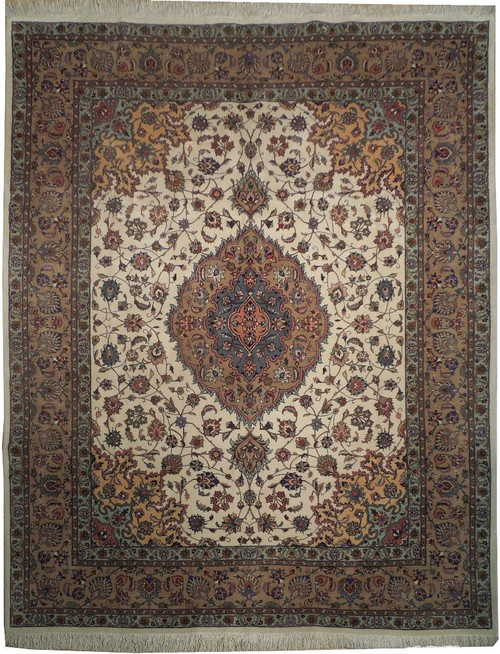
The composition is the full classical Tabriz formula rather than a simplified version of it. At the center sits a round medallion built in layers: a small 8 petal rosette at the core, a pale celadon lattice panel around it, a coral ground carrying paisley and heart shaped palmette forms, and an outer mauve ring closed off with curling cloud band brackets. Slender pendants run off the top and bottom of the medallion into the field. The 4 corners carry quarter repeats of the same medallion drawn on taupe and black grounds, so the corners answer the center exactly. Between them the ivory ground is covered edge to edge with a fine lattice of thin vine scroll, Shah Abbasi palmettes, small rosettes, budding sprays and serrated leaves, mirrored across both axes with no drift. The main border runs alternating large palmettes and rose clusters, framed on both sides by a celadon guard stripe of trailing flowers and by narrow navy outlining bands that sharpen the whole frame.
A Field of Ivory Against Mauve, Coral and Wine
The field is a warm ivory, closer to unbleached cream than white, and it is doing the hardest job here: it holds thousands of small motifs without the pattern reading as busy. The medallion moves from a salmon coral interior through rose and dusty mauve to a deeper wine outline, and that same wine carries the main border, where the flowers are drawn in blush pink, peach, tan, ivory and soft olive green. Celadon green appears twice, once in the guard borders and once inside the medallion panel, and it is the color that keeps the reds from turning heavy. Navy and deep indigo run as thin outlines around the palmettes and along the border edges, giving every motif a hard edge instead of a blur. The corner spandrels drop into taupe, charcoal and near black, which anchors the 4 corners of an otherwise pale rug. Overall the palette is soft and slightly faded in tone by design, so it works with warm woods, creams and greys rather than fighting them.
Woven in Tabriz, Northwest Persia
Tabriz in northwest Persia measures fineness by Raj, the number of knots counted across a gereh of about 2.75 inches of width. 40 Raj is ordinary commercial work, 50 Raj is fine, 60 Raj lands near 400 knots per square inch and is where collector grade begins, and 70 Raj at roughly 700 is the ceiling the best ateliers attempt. At approximately 500 knots per square inch this piece sits above 60 Raj, in the range only a workshop with a proper cartoon, a silk warped loom and experienced weavers can hold consistently over a rug of this length. The silk foundation is the tell: it is expensive, it is unforgiving to weave on, and no workshop uses it on a rug it does not intend to be its best work. If you are comparing this against pure silk pieces, our guide to Persian silk rugs explains how wool and silk pile behaves differently underfoot. Unused since the loom, this one still has its full pile height and sharp, unworn ends.
9'5" x 13'2" Persian Tabriz Rug | Ivory Floral Medallion, Wool & Silk on Silk | Approx. 500 KPSI | Never Used
Ask about this rug
This piece is the only one of it, so the things worth knowing about it are particular to it. If you want to talk through the size, the colour in your own light, or the weave, speak to someone here first.