| Size in ft: | Width: 8' x Length: 11'10" |
| Size in Inch: | Width: 96" x Length: 142" |
| Size in meters: | Length: 3.61 x Width: 2.44 m |
| Colors: | Ivory, Coral, Peach, Green, Blue |
| Shape: | Rectangular |
| Woven: | 100% Hand-knotted | Handmade |
| Foundation: | Silk warp and weft |
| Pile: | Wool and Silk |
| KPSI: | Approx. 500 |
| Age: | 1980's | Never used |
| Signature: | Signed | Woven cartouche at one end |
| Design: | Tabriz Floral Medallion | All over vine field |
| Origin: | Persian Tabriz | Made in Persia |
| Condition: | Perfect | Never used |
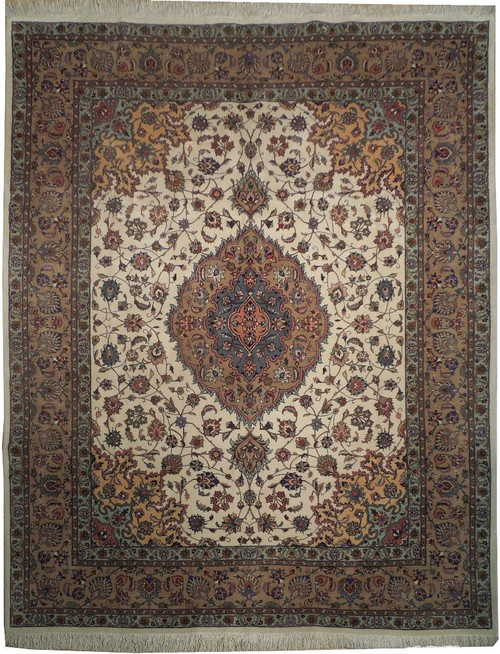
8' x 11'10" Persian Tabriz Rug | Ivory Wool & Silk on Silk Medallion | 500 KPSI, Signed, Never Used
This 8' x 11'10" piece sits at the top of what the Tabriz workshops produce: wool and silk pile knotted on a full silk foundation at roughly 500 knots per square inch, with a woven signature cartouche at one end. It dates to the 1980's and has never been on a floor, so the pile still stands at its original height and the silk highlights throw light the way they did the day the rug came off the loom. Among Persian Tabriz rugs at this scale, a signed silk-foundation example in unused condition is not something that turns up often. Every rug we sell ships with a certificate of authenticity documenting origin, materials and knot count.
Design and Motifs
The center holds a large radiating medallion built in concentric rings: a peach and gold core packed with tiny cruciform rosettes, a band of slate blue and navy cartouches around it, then an outer ring of coral lobed petals tipped with dark navy finials. Two matching coral pendants run out along the vertical axis toward each end, each anchored by a small dark lozenge. The rest of the field is a dense all over vine, thousands of hair-thin scrolling stems carrying pink blossoms, blue palmettes and green leaf clusters, with four corner spandrels drawn in tan and gold that mirror the medallion's architecture. The main border alternates coral cartouches with ivory octagonal panels on an olive ground, framed by narrow navy and ivory guard stripes and a fine reciprocal sawtooth. The drawing stays curvilinear and exact throughout, which is only possible at this knot count.
The Ivory, Coral and Green Palette
The field reads as a warm ivory, closer to unbleached cream than white, and it is the reason the rug feels light rather than formal despite the density of the pattern. Against it the medallion works in muted coral and dusty rose, warming to peach and soft gold at the center, with deep navy and aubergine used only for outlines and small accents so the eye keeps returning to the middle. The vinework brings in sage and grass green on the leaves and two distinct blues on the flowers, a clear cornflower and a deeper slate. The main border shifts the balance, putting olive green under coral cartouches and ivory panels so the frame reads cooler than the field. Where the silk is used, mainly in the highlights and the finer outlines, the color changes as you walk around the rug, going from pale to saturated with the angle of the light.
Tabriz Weaving and the Silk Foundation
Tabriz, in northwest Persia, has been the country's most organized weaving city for centuries, and its best ateliers measure fineness in Raj, the number of knots across a gereh of about 2.75 inches. At roughly 500 knots per square inch this rug sits well above the 60 Raj level that collectors treat as the entry point for serious work, and the silk warp and weft is what makes it possible: silk is thinner and stronger than cotton, so the weaver can pack more knots into the same width and still keep the rug supple. You can see the result on the back, where the knot nodes are small and perfectly even and the kilim ends carry their own woven floral motif. The signature cartouche at the end marks this as a named workshop piece rather than anonymous production, and the depth of the wool and silk pile confirms the rug was never walked on.
8' x 11'10" Persian Tabriz Rug | Ivory Wool & Silk on Silk Medallion | 500 KPSI, Signed, Never Used
Ask about this rug
This piece is the only one of it, so the things worth knowing about it are particular to it. If you want to talk through the size, the colour in your own light, or the weave, speak to someone here first.