Watch the film
| Size in ft: | Width: 6'3" x Length: 9'3" |
| Size in Inch: | Width: 75" x Length: 111" |
| Size in meters: | Length: 2.82 x Width: 1.91 m |
| Colors: | Ivory, Blue, Green, Brown, Camel, Rust |
| Shape: | Rectangular |
| Woven: | 100% Hand-knotted | Handmade |
| Foundation: | Cotton |
| Pile: | Wool and Silk |
| KPSI: | 60 Raj | Approx. 400 |
| Age: | 2000s | Never used |
| Signature: | Signed | Woven cartouche in the camel spandrel |
| Design: | Tabriz Floral Medallion | All-over vine and palmette field |
| Origin: | Persian Tabriz | Made in Persia |
| Condition: | Perfect | Never used |
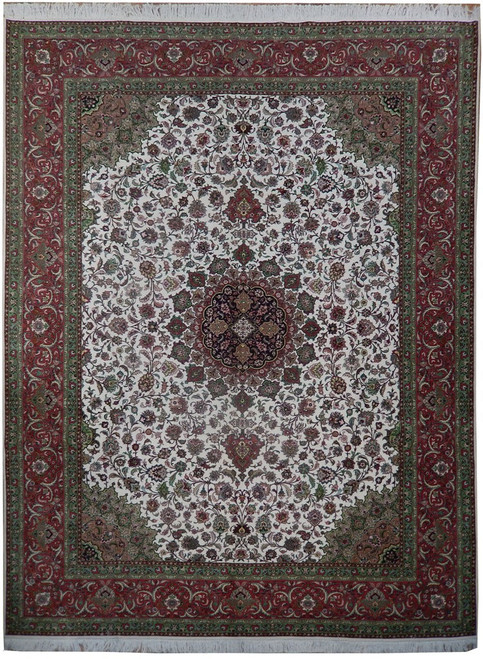
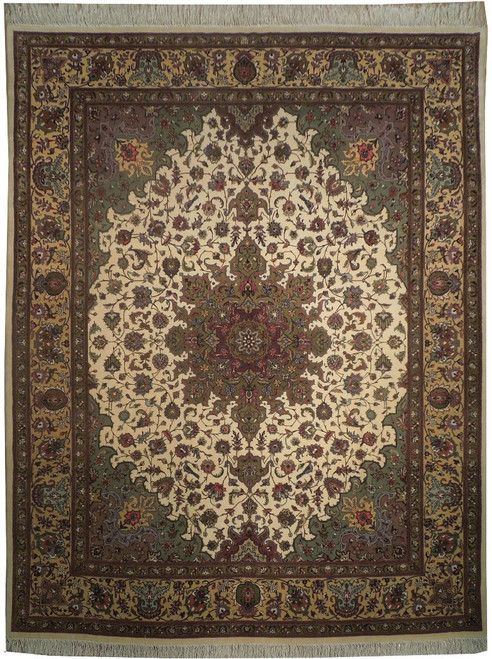
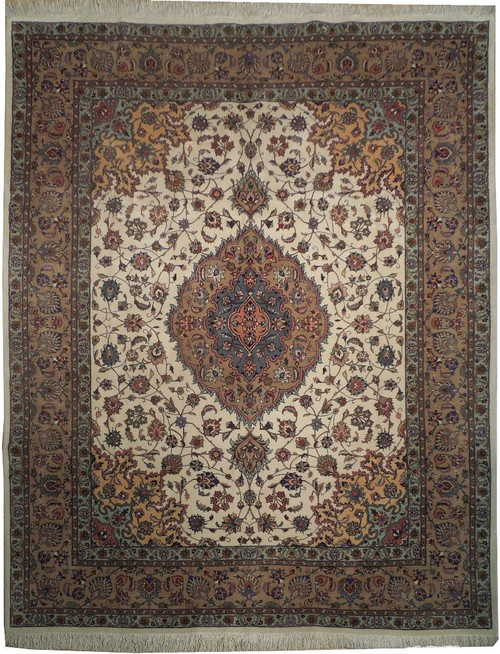
6'3" x 9'3" Persian Tabriz Rug | Ivory Wool and Silk Medallion | 400 KPSI, Signed and Never Used
A signed workshop piece from the 2000s that has never been laid in a room, this rug still carries the crisp pile and full fringe of a weaving that went from the loom into storage. The wool is spun fine and blended with silk in the highlights, which is why the ivory ground catches light differently as you walk past it and why the small leaf tips and tendrils look almost wet in the photographs. At roughly 400 knots per square inch the drawing holds curves that a coarser weave would break into steps, and the weaver signed the work in a cartouche at the top of the field. As one of the more usable 6 x 9 Persian rugs for a seating area or a formal dining setting, it ships with a certificate of authenticity documenting origin, materials and knot count.
Design and Motifs
The field is built around a large lobed medallion with a stepped star at its center, layered outward through pale blue cartouches, small rosettes and curling cloud bands before it breaks into radiating petals. Above and below it, pendant finials reach into the ivory ground, and the spandrels at the 4 corners are filled with camel-brown grounds carrying boteh forms outlined in ivory. Between those anchors the ground is covered with an all-over system of thin vines, split palmettes, serrated lancet leaves and small blossoms, every element mirrored across both axes so the drawing reads as one continuous plan rather than a repeated block. The main border runs a slow procession of palmettes joined by scrolling vine, flanked by narrow guard stripes of reciprocal floral heads, and the signature cartouche sits quietly inside the inner corner where a buyer will find it once the rug is down.
A Palette of Ivory, Sea Green and Soft Brown
The ground is a warm ivory, closer to unbleached cream than white, and it is that softness that lets the rest of the palette stay quiet. The main border is a muted sea green with a blue cast, the single strongest color statement in the piece, and it is filled with palmettes in coral rust, oatmeal, olive and faded rose. The medallion works in dusty brown and mauve with pale aqua tracery and small points of terracotta, while the corner spandrels shift to a camel tan that bridges the ivory field and the green border. Scattered through the field are deeper accents of navy, garnet red and moss, used in small doses on leaf tips and flower centers. Seen from across a room the rug reads as ivory and soft green; standing on it, the browns and rusts come forward, which makes it easy to place with warm wood floors as well as cooler grey and blue interiors.
Tabriz Weaving and the 400 KPSI Standard
Tabriz sits in northwest Persia and has been the country's most organized weaving city for generations, working from full cartoons drawn by professional designers rather than from memory. Fineness there is measured in Raj, the number of knots counted across a gereh of about 2.75 inches, and this rug's 60 Raj translates to roughly 400 knots per square inch, the level where Tabriz workshops move from commercial output into collector work. That density is what allows the curved vine to stay true and the tiny ivory outlines inside the boteh to hold their shape. The cotton foundation is tightly set and the pile is clipped low, both marks of a workshop weaving to a standard rather than to a price, and the silk carried through the highlights is used sparingly where it will do the most for the drawing.
6'3" x 9'3" Persian Tabriz Rug | Ivory Wool and Silk Medallion | 400 KPSI, Signed and Never Used
Ask about this rug
This piece is the only one of it, so the things worth knowing about it are particular to it. If you want to talk through the size, the colour in your own light, or the weave, speak to someone here first.