Watch the film
| Size in ft: | Width: 6'9" x Length: 10' |
| Size in Inch: | Width: 81" x Length: 120" |
| Size in meters: | Length: 3.05 x Width: 2.06 m |
| Colors: | Red, Cream, Beige, Green, Blue, Brown, Pink |
| Shape: | Rectangular |
| Woven: | 100% Hand-knotted | Handmade |
| Foundation: | 100% Cotton |
| Pile: | |
| Age: | 2000's | Never used |
| Design: | Tabriz | Shekargah Hunting Ground | Central Medallion with Pendants |
| Origin: | Persian Tabriz | Made in Persia |
| Condition: | Perfect | Never used |
6'9" x 10' Persian Tabriz Rug | Shekargah Hunting Design, Deer and Birds | 2000s, Never Used
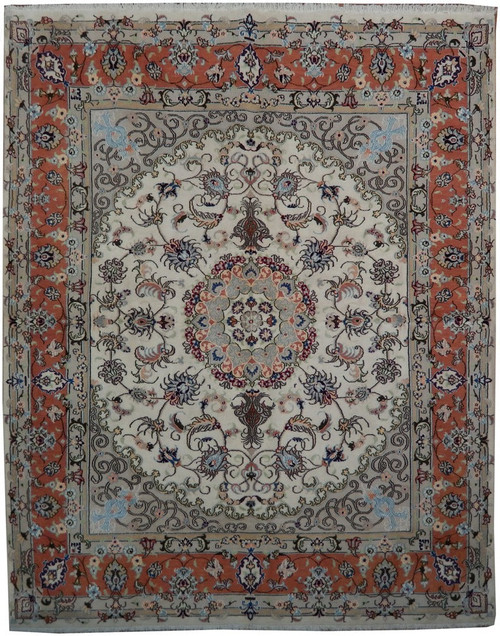
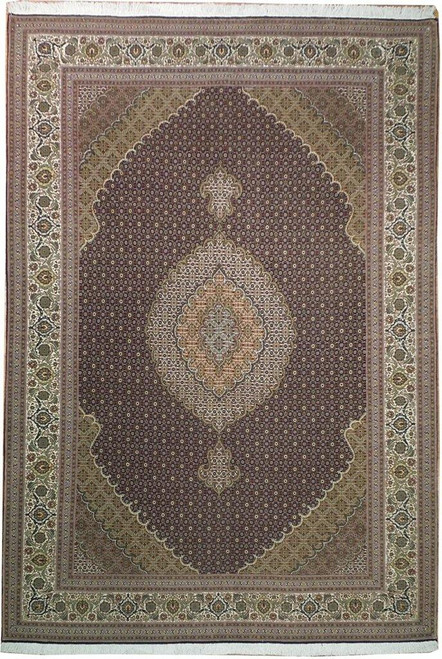
This 6'9" x 10' hand-knotted Tabriz is a shekargah, a hunting ground rug, and it carries the full cast: mounted riders with drawn bows, leaping stags, gazelles, peacocks and small songbirds scattered across a rust red field. A lobed ivory medallion sits at the center with matching pendants above and below, and soft green spandrels open the 4 corners before the design runs out into a wide ivory border of standing figures and blossoming vine. The pile is wool on a cotton foundation, the handle is firm and even, and the pile stands full height because the rug was woven in the 2000s and has never been on a floor. Every rug we ship carries a certificate of authenticity listing origin, materials and measurements.
Design and Motifs
The drawing is what makes this piece worth studying up close. The central medallion is an ivory cartouche-shaped lobe holding a small blue-grey rosette at its heart, ringed by feathered leaves and split palmettes, with a narrow dark outline keeping the curve crisp. Out in the field the weaver has drawn 2 horsemen on each side, one in a green coat with a bow, another riding a dark mount, and around them run deer in mid-leap, a pair of confronting peacocks, cranes, rabbits and small birds perched on flowering stems. Nothing repeats mechanically: the animals are placed individually, facing different directions, some pursued and some grazing. The green spandrels continue the hunt with cypress-like leaf forms and more birds, and the main border alternates standing robed figures with urns of flowers, an unusual and clearly labor-intensive choice compared to the plain vine borders most workshops use. Twin guard stripes of tiny reciprocal blossoms hold the whole composition together.
A Rust Red Field Framed in Soft Green
The field is a warm terracotta red, closer to brick and clay than to a hard crimson, and it reads differently depending on the light: deeper and more saturated in the medallion photograph, lighter and dustier in the full overhead shot. Against it the medallion, pendants and main border are a creamy ivory with beige tones, which is what gives the rug its bright, open look. The spandrels and the inner border ground are a soft pistachio green, an unusual pairing with red and one of the reasons this Tabriz does not look like the standard red and navy formula. Detail colors do the rest of the work: sky blue and deep navy in the small blossoms and bird plumage, chestnut and dark brown in the horses and outlines, olive and moss in the leaves, and touches of pale pink and peach in the flower heads and riders' garments. Nothing has faded, because the rug has never been walked on or sun-exposed.
Tabriz Weaving in Northwest Persia
Tabriz sits in the far northwest of Persia and has been the country's most organized weaving city for centuries, working from full-size cartoons with a designer, a master weaver and a loom crew. Fineness there is measured in Raj, knots per gereh across the width, and figural work like this is only attempted at the higher counts, because a rider's face, a bird's beak or a deer's leg falls apart in a coarse weave. The knotting on this piece is tight and regular, the outlines stay clean at very small scale, and the back shows the even, disciplined grid you expect from a Persian Tabriz rug woven in a proper city workshop rather than a village. Hunting ground compositions trace back to Safavid court carpets, and Tabriz weavers have kept that tradition alive longer and better than anywhere else in Persia.
6'9" x 10' Persian Tabriz Rug | Shekargah Hunting Design, Deer and Birds | 2000s, Never Used
Ask about this rug
This piece is the only one of it, so the things worth knowing about it are particular to it. If you want to talk through the size, the colour in your own light, or the weave, speak to someone here first.