Watch the film
| Size in ft: | Width: 7'11" x Length: 10'2" |
| Size in Inch: | Width: 95" x Length: 122" |
| Size in meters: | Length: 3.10 x Width: 2.41 m |
| Colors: | Black, Ivory, Brown, Olive, Rust |
| Shape: | Rectangular |
| Woven: | 100% Hand-knotted | Handmade |
| Foundation: | Cotton |
| Pile: | Wool and Silk |
| Age: | New |
| Design: | Tabriz Mahi | Herati Fish Pattern | Scalloped Medallion |
| Origin: | Made in India |
| Condition: | Perfect | Never used |
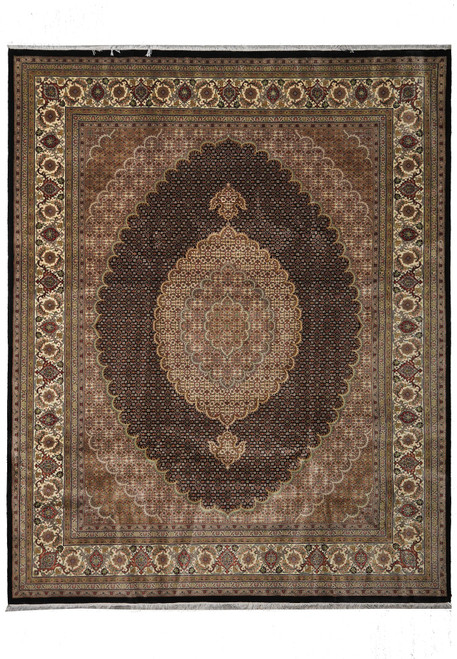
7'11" x 10'2" Tabriz Mahi Rug | Black Herati Field with Ivory Border | Wool and Silk, Never Used
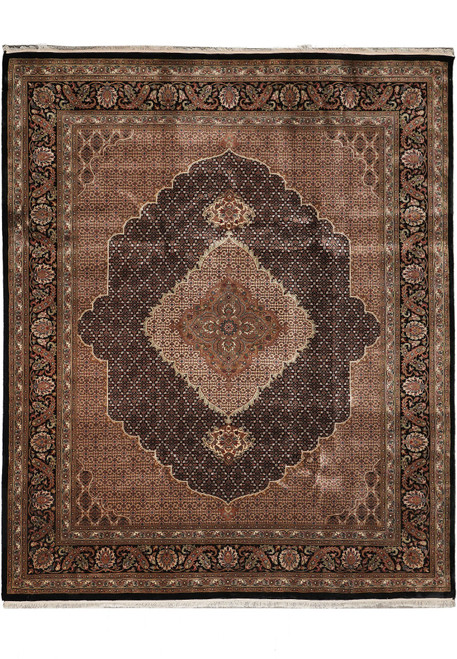
This 7'11" x 10'2" rug is a Mahi, the fish pattern that has been the most copied fine drawing in the rug world for a century, hand-knotted in wool with silk highlights on a cotton foundation. The weave is tight and even, the pile is clipped low so the tiny herati diamonds stay legible, and the silk catches light along the medallion outlines and the vine work in the spandrels. It has never been on a floor: the fringes are uncut and clean, the selvages are firm, and the back tag in the last photograph is the original workshop tag. At this scale it covers a standard seating group or a table for 8, which puts it right in the most requested bracket of 8x10 area rugs. A certificate of authenticity is included with every rug we ship.
Design and Motifs
The whole field is filled with the herati, or mahi, repeat: a small diamond lattice, a rosette at each center, and 4 curved lanceolate leaves turned outward at the corners of every diamond. Those leaves are the fish that give the pattern its name. Over that repeat sits a large lobed medallion built in 3 layers, an inner rosette cartouche, a camel-toned inner field, and a deeply scalloped ivory ring, finished top and bottom with slender cypress-shaped pendants. The 4 corner spandrels answer the medallion with the same scalloped outline, so the eye reads a clean oval floating on the dark ground. The main border runs alternating rust palmettes and olive rosettes on ivory, tied together by a thin meandering vine, and is framed by 6 narrow guard stripes of flowerheads and reciprocal trefoils that keep the edges crisp.
A Black Ground Lit by Ivory, Camel, Olive and Rust
The field ground is a true black rather than a very dark navy, which is what gives this piece its weight and makes the surrounding tones look brighter than they are. Against it the herati lattice is drawn in warm camel, terracotta rust, soft olive green and small ivory highlights, with pinpricks of pale blue and deep garnet scattered through the rosettes. The outer field, beyond the medallion, shifts to a light camel-brown so the corners read soft while the center stays dark. The medallion itself is mostly ivory and sand with a rust and olive core, and the main border is a clear ivory that frames the whole thing. The palette is quiet, warm and neutral-leaning, which is why a black Mahi works under dark wood and with modern furniture as easily as with traditional pieces.
Woven in India to the Tabriz Mahi Standard
India is where most of the world's good contemporary hand-knotted work is now made, and the best Indian workshops weave the Tabriz Mahi drawing at a fineness that holds every element of the lattice without blurring. This piece was knotted there on a cotton warp and weft, with the wool spun fine and blended with silk so the highlight lines sit slightly proud of the pile. That level of drawing is the whole point of a Mahi: at a coarse knot count the fish leaves collapse into blobs, and here they stay sharp across all 4 quadrants. If you are weighing this against other weaving traditions, our guide to what separates an Oriental rug from its neighbors is worth reading, and you can browse the rest of our hand-knotted Oriental rugs alongside it.
7'11" x 10'2" Tabriz Mahi Rug | Black Herati Field with Ivory Border | Wool and Silk, Never Used
Ask about this rug
This piece is the only one of it, so the things worth knowing about it are particular to it. If you want to talk through the size, the colour in your own light, or the weave, speak to someone here first.