| Size in ft: | Width: 10'2" x Length: 13'6" |
| Size in Inch: | Width: 122" x Length: 162" |
| Size in meters: | Length: 4.11 x Width: 3.10 m |
| Colors: | Ivory, Brown, Green, Rust |
| Shape: | Rectangular |
| Woven: | 100% Hand-knotted | Handmade |
| Foundation: | Cotton |
| Pile: | Wool and Silk |
| Age: | New | Never used |
| Design: | Mahi Tabriz | Herati Fish Pattern | Lobed Medallion |
| Origin: | Made in India |
| Condition: | Perfect | Never used |
10'2" x 13'6" Wool and Silk Mahi Tabriz Design Rug | Herati Fish Pattern | Brand New, Never Used
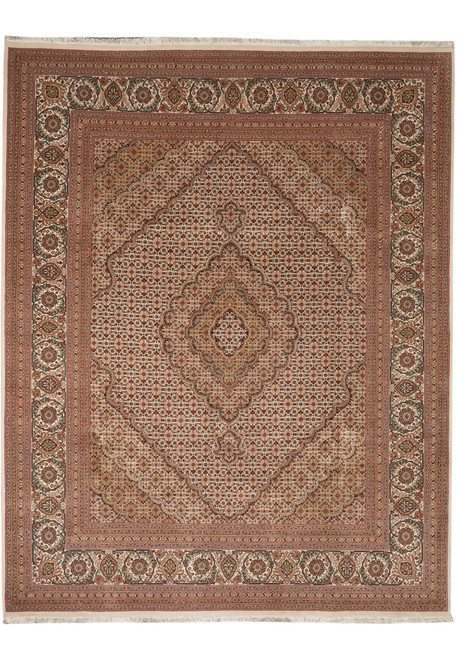
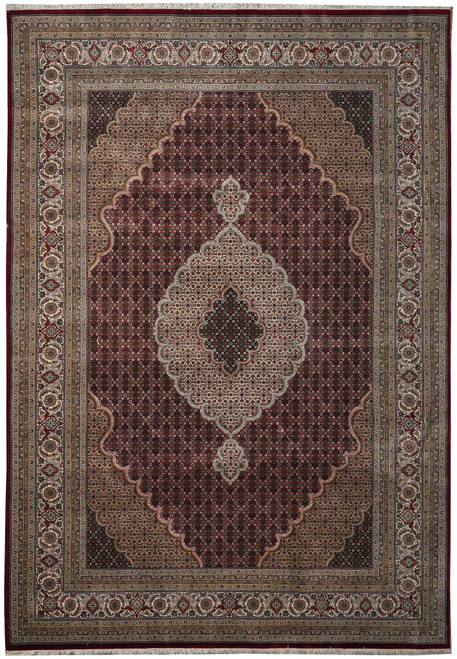
This is a large, finely drawn Mahi Tabriz design rug, hand-knotted in India in wool with silk highlights and never put on a floor. At 10'2" x 13'6" it sits squarely in the 10x14 hand-knotted rug range, the size most people need for a full seating group or a 10 seat dining table with chairs pulled clear. The field is worked in the classic Herati fish repeat, tiny lozenges with rosette centers and curling leaves, carried edge to edge without a break in rhythm, and centered on a scalloped medallion with matching pendants. Silk is used selectively in the medallion outline, the pendant frames and the spandrel tracery, so those lines catch light while the wool ground stays matte. The rug ships with a certificate of authenticity confirming that it is 100% hand-knotted.
Please Note About the Photographs:
The full overview shots were taken under warm gallery lighting, which reads the ground as a deeper tan than it really is. The close-up and corner images show the true color: a clean ivory field with rust, brown, green and slate blue drawing. There is no fading, no wear and no damage anywhere on this rug.
Design and Motifs
Mahi means fish, and the name comes from the pair of curved leaves flanking each small rosette in the lattice, read by weavers as fish circling a pond. Here the repeat is drawn small and consistently, which is what separates a good Mahi from an ordinary one: the diamonds line up across all 13'6" of length without drifting, and the motif keeps its detail even where it runs under the medallion. The medallion itself is an elongated lobed form with a soft outline, filled with a finer version of the same lattice on a darker ground, and it is finished with 2 slender pendants and a pair of side cartouches. Quarter medallions anchor the 4 corners and a delicate lobed cartouche frames the field. The main border is ivory, carrying alternating palmettes and rosettes on a scrolling brown vine, and it is fenced by 6 narrow guard stripes, some with a black and white barber-pole twist, others with a running flower meander on camel and pale green.
A Quiet Ivory Palette with Rust, Brown and Green
The ground is ivory, closer to unbleached cream than to white, and it is what gives this rug its lightness in a room that would be overwhelmed by a red field. Against it the lattice is outlined in brick rust and warm brown, with rosette centers alternating between deep charcoal navy, slate blue, burgundy and a soft camel tan. Small leaves in olive and grass green appear at regular intervals and are the color that keeps the palette from reading flat. The medallion shifts the balance, massing the rust and charcoal more densely so it reads as a darker island against the pale field, with its outline picked out in pale silk that shows almost silver from one direction and ivory from the other. The border repeats the field colors in reverse, with sage green and camel palmettes on ivory. It is a warm, neutral rug overall, easy beside wood, stone, leather and most existing upholstery.
Made in India in the Tabriz Mahi Tradition
This rug was woven in India, where most of the world's best contemporary hand-knotted work is now produced, on cotton warps with a wool pile and silk detailing. Indian workshops adopted the Mahi Tabriz cartoon decades ago and the best of them now execute it with a discipline that stands up to close inspection, which is exactly what the corner and back photographs show: even knotting, straight selvages, a level clipped pile and a crisp reverse where the small lattice reads clearly from behind. The rug is an Oriental rug in the traditional sense, hand-knotted one knot at a time on a vertical loom, and it arrives brand new, never walked on, with full pile height and original fringe intact.
10'2" x 13'6" Wool and Silk Mahi Tabriz Design Rug | Herati Fish Pattern | Brand New, Never Used
Ask about this rug
This piece is the only one of it, so the things worth knowing about it are particular to it. If you want to talk through the size, the colour in your own light, or the weave, speak to someone here first.