Watch the film
| Size in ft: | Width: 8'2" x Length: 10'2" |
| Size in Inch: | Width: 98" x Length: 122" |
| Size in meters: | Length: 3.10 x Width: 2.49 m |
| Colors: | Black, Ivory, Olive Green, Rust |
| Shape: | Rectangular |
| Woven: | 100% Hand-knotted | Handmade |
| Foundation: | Cotton |
| Pile: | Wool and Silk |
| Age: | New |
| Design: | Mahi Tabriz | Herati Fish Pattern | Center Medallion |
| Origin: | Made in India |
| Condition: | Perfect | Brand new |
8'2" x 10'2" Indo-Tabriz Mahi Rug | Black Herati Field, Ivory Medallion | Wool and Silk
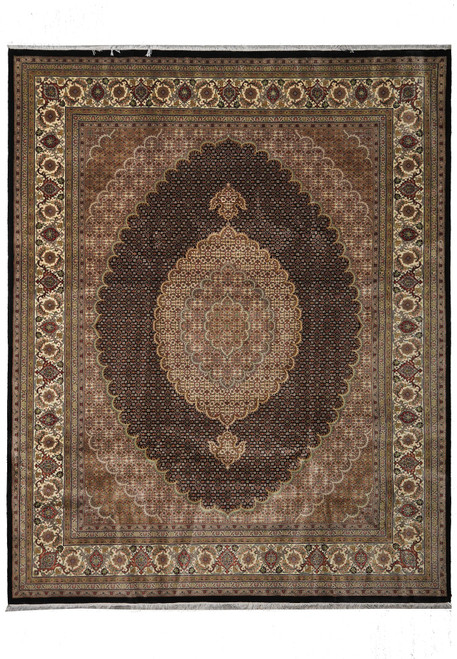
The Mahi, or fish, layout is one of the most demanding drawings in the hand-knotted repertoire, and this 8'2" x 10'2" piece handles it with real discipline: thousands of small diamond cartouches march across a black ground without a single stumble in the rhythm, each one anchored by a rosette and flanked by the pale curved leaves that give the pattern its fish name. It is woven in wool with silk detailing on a cotton foundation, brand new and never laid, with a close even pile that already shows the quiet sheen the silk brings to the lighter motifs. At a true 8x10 hand-knotted rug footprint it settles under a full seating group or a 6 seat dining table without crowding the room. Every rug we sell arrives with a certificate of authenticity documenting its size, materials and origin.
Design and Motifs
The field is a continuous Herati lattice: linked diamonds, a small flowerhead at every intersection, and 4 lanceolate leaves curling around each rosette like fish circling a pond. Sitting on top of it is a lobed ivory medallion with a stepped, scalloped outline, filled with its own miniature version of the same lattice so the eye reads one pattern at two scales. Slender pendants extend from the medallion to the top and bottom of the field, each finished with a small crown finial, and the 4 corner spandrels repeat the lattice in a lighter salmon and camel palette that frames the dark center. The main border carries alternating cusped palmettes and star rosettes on ivory, drawn with curling vines and tiny bud clusters, with 6 narrow guard stripes stepping the design down to the black outer edge and the hand-tied cotton fringe.
A Study in Black, Ivory, Olive and Rust
The ground is a deep, near ink black that photographs almost brown under warm showroom light and reads as true black in daylight, which is exactly why the small motifs pop the way they do. Against it the weavers set rust and terracotta rosettes, soft camel and salmon lattice lines, small clean whites, and a scattering of pale sky blue leaves that act as the cooling note in an otherwise warm field. The medallion and spandrels move into ivory and oatmeal, so the center of the rug glows against the dark ground. Olive green appears throughout the border leaves and guard stripes alongside deep madder red palmettes and touches of violet in the smallest flowerheads. Because the lighter motifs carry the silk, the color shifts as you cross the room: the ivory medallion brightens from one direction and settles into cream from the other.
Made in India: The Mahi Weaving Tradition
This rug was hand-knotted in India, which is where most of the world's finest contemporary hand-knotted work is now produced. The workshops there took the classic Mahi cartoon of Tabriz and kept it honest: the same tight Herati grid, the same stepped medallion outline, the same disciplined guard stripe sequence, executed by weavers who spend years on a single pattern family before they are trusted with a field this dense. What you can see in the photographs of the back and the folded corner is a small, regular knot, a straight black selvedge finished by hand, and a level pile with no dropped rows, which is what separates a workshop piece from ordinary production. If you are weighing this against other origins, our guide on what actually separates an Oriental rug from its neighbors is worth reading before you buy.
8'2" x 10'2" Indo-Tabriz Mahi Rug | Black Herati Field, Ivory Medallion | Wool and Silk
Ask about this rug
This piece is the only one of it, so the things worth knowing about it are particular to it. If you want to talk through the size, the colour in your own light, or the weave, speak to someone here first.