Watch the film
| Size in ft: | Width: 7' x Length: 10' |
| Size in Inch: | Width: 84" x Length: 120" |
| Size in meters: | Length: 3.05 x Width: 2.13 m |
| Colors: | Coral Red, Blue, Green, Ivory |
| Shape: | Rectangular |
| Woven: | 100% Hand-knotted | Handmade |
| Foundation: | Cotton |
| Pile: | 3/8" Wool |
| Age: | 1940's | Semi-Antique |
| Design: | Heriz | All Over Floral Lattice |
| Origin: | Persian Tabriz | Made in Persia |
| Condition: | Excellent |
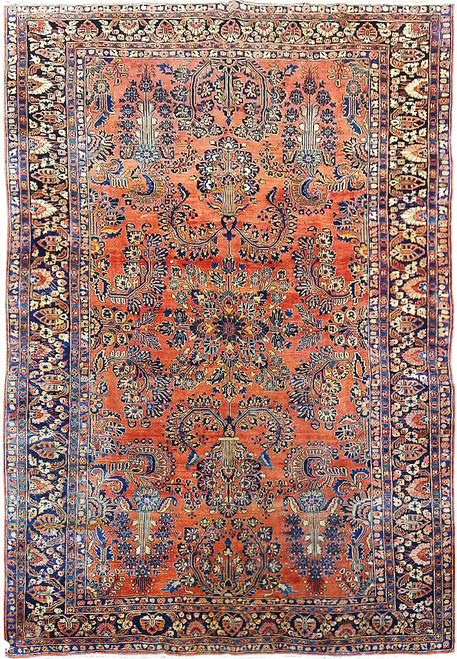
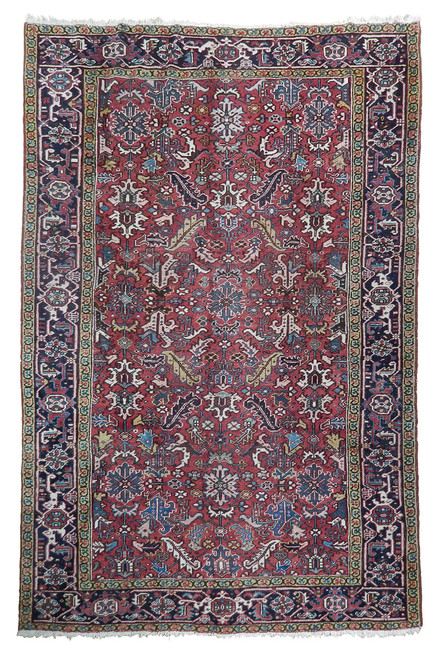
7' x 10' Persian Tabriz Rug | Coral Red Heriz All Over Floral | Semi-Antique 1940s
A semi-antique piece from the 1940s, this 7' x 10' Persian Tabriz reads as a Heriz drawing translated into the finer, more disciplined hand of a Tabriz loom. The coral red field carries an all over floral lattice rather than a single medallion, framed by a deep navy main border and two ivory guard stripes, and the pile is a short 3/8" wool that lets every outline stay crisp. Roughly 80 years on the floor have given the wool a quiet sheen that new weaving cannot imitate, and the rug remains in excellent condition with even pile and straight, secure sides. The proportions land in the most practical part of the range for American rooms, which is why 7 x 10 Persian rugs are the size most buyers come back to. It ships with our certificate of authenticity documenting origin, age, materials and hand-knotted construction.
Please Note About the Photographs:
One image is an extreme macro taken a few inches from the surface, so individual knot heads and flecks of the pale cotton foundation between rows are visible at a magnification no eye sees in a room. This is normal structure in a short-pile semi-antique weave, not wear or damage. Every rug is professionally cleaned, steamed and pressed before it leaves us.
Design and Motifs
The field is built on an interlocking lattice of navy vine work that loops into large open cartouches, each one filled with a palmette, a serrated leaf pair or a small rosette cluster. Between them sit ivory blossoms, sky blue lotus heads and gold eight petal rosettes, with dark green leaves supplying the shadow line that keeps the coral ground from going flat. The drawing is Heriz in vocabulary, angular hooks, stepped spandrel shapes and bold split leaves, but the execution is smoother and more finely articulated than village work, with curves that actually curve. The main border repeats alternating coral and sky blue rosette medallions set in navy, separated by pale scrolling leaf forms, and the ivory guard stripes run a tight meandering vine on all 4 sides. A small woven cartouche at the base of the field reads as the weaver's inscription panel, a detail that rarely survives this legibly.
Coral Red, Navy and Ivory Palette
The ground is a soft coral red with a salmon and terracotta cast, warmer and lighter than the brick reds most people picture, and it shifts gently under changing light the way naturally dyed wool should. Against it the border navy is genuinely deep, close to midnight, and that contrast is what gives the rug its graphic punch from across a room. The secondary colors do the detail work: chalky ivory in the guard bands and blossom outlines, two distinct blues in the florals, a mid sky blue and a paler robin's egg tone, mossy green in the leaves, and small hits of saffron gold and dusty rose in the flower centers. Cream cotton fringe at both ends and a coral overcast selvage tie the edges back to the field. It is a warm palette that sits easily on oak, walnut or parquet flooring and pairs with cream, camel, olive and navy upholstery without competing.
Tabriz Weaving and the Heriz Tradition
Tabriz sits in northwest Persia and has been the country's most technically accomplished weaving city for centuries, working from drawn cartoons on cotton foundations and holding a knot count well above village standards. The Heriz villages lie east of Tabriz beneath Mount Sabalan and gave Persia its famous angular geometry and famously tough wool; Tabriz masters regularly borrowed that vocabulary and rewove it at their own level of finish, which is exactly what happened here. You can see it in the short even pile, the tight ivory guard stripes and the disciplined repeat that holds its rhythm across the full 10 foot length. The 1940s attribution is supported by the wool's patina, the character of the dyes and the structure visible from the back, the same evidence used to date an Oriental rug accurately. Eight decades in and the foundation is still tight, which tells you how much life is left in it.
7' x 10' Persian Tabriz Rug | Coral Red Heriz All Over Floral | Semi-Antique 1940s
Ask about this rug
This piece is the only one of it, so the things worth knowing about it are particular to it. If you want to talk through the size, the colour in your own light, or the weave, speak to someone here first.