Watch the film
| Size in ft: | Width: 10'2" x Length: 13'2" |
| Size in Inch: | Width: 122" x Length: 158" |
| Size in meters: | Length: 4.01 x Width: 3.10 m |
| Colors: | Red, Ivory, Blue, Green |
| Shape: | Rectangular |
| Woven: | 100% Hand-knotted | Handmade |
| Foundation: | Cotton |
| Pile: | |
| Age: | Circa 1960s | Semi-antique |
| Design: | All-over floral | Palmettes & rosettes | Ivory main border |
| Origin: | Persian Tabriz | Made in Persia |
| Condition: | Excellent |
10'2" x 13'2" Persian Tabriz Rug | All-Over Floral Design | Circa 1960s Semi-Antique
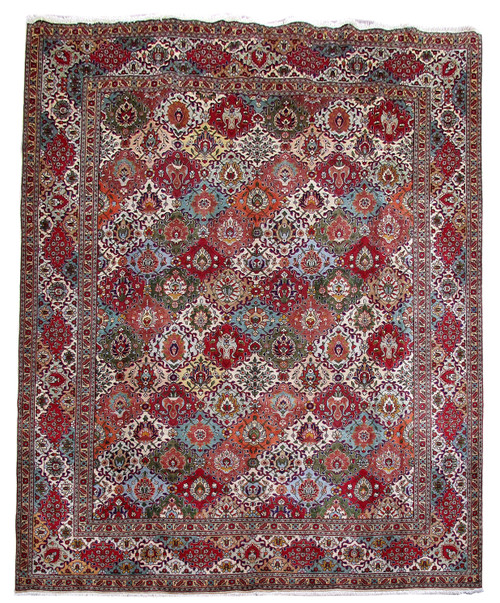
This is a room-size Tabriz from the 1960s, woven in northwest Persia on a cotton foundation with a clipped 3/8" wool pile that still stands full and even across all 13 feet of length. There is no central medallion here: the weaver committed the entire red field to a repeating lattice of palmettes, rosettes and thin ivory vine scroll, which is the harder drawing job and the reason the rug reads as one continuous carpet rather than a framed panel. At 10'2" x 13'2" it sits squarely in the 10 x 13 Persian rug range, large enough to carry a full seating group with the furniture legs on the wool. Condition is excellent, with intact selvages, original ends and clean cotton fringe. A certificate of authenticity is included with every rug we ship.
Please Note About the Photographs:
The first overhead photograph was shot under bright studio light and reads warmer and lighter than the rug actually is. The truer tone is the deeper brick red and cooler ivory you see in the floor photographs and the close-up of the pile. Please judge the color from those images.
Design and Motifs
The field is an all-over floral design built on a diagonal lattice of slender ivory vines. Each intersection carries a motif: round 8 petal rosettes, split-leaf arabesques, small cypress-shaped sprays and broad palmettes drawn in profile, with tiny paired leaves filling the gaps so almost no red is left bare. The close-up shows how the weaver alternated the color of adjacent rosettes, blue against ivory against soft gold, so the repeat never reads mechanically even though the drawing is strictly symmetrical. The ivory main border runs a heavy scrolling vine with turtle palmettes and rosettes, flanked on both sides by blue guard stripes of small stemmed flowerheads, and a narrow red outer stripe closes the frame. The corners resolve cleanly, which on a rug this large is a fair test of the cartoon and of the weaver following it.
A Deep Brick Red Field Framed in Ivory
The ground is a warm brick red that pulls slightly toward tomato in direct light and settles into a deeper madder tone away from the window. Against it, the vine work is a creamy undyed ivory, and the flowerheads carry three distinct blues: a dark indigo in the palmette centers, a medium slate blue in the larger rosettes, and a soft powder blue in the border guard stripes. Sage and olive greens appear in the small leaves and in a few rosette petals, warm gold and apricot in the smaller blossoms, and a touch of near-black in the tightest outlines, which is what gives the pattern its definition from standing height. The ivory main border is the same cream as the field vines, so the frame reads as an extension of the drawing rather than a separate band. Overall the palette is a classic red and ivory Persian scheme, warm enough for a wood floor and calm enough to live with daily.
Tabriz Weaving and the Quality of This Piece
Tabriz, in the northwest of Persia, is the city where the commercial workshop rug was effectively invented, and its weavers work from a full cartoon with the Turkish knot on a cotton warp, measuring fineness in Raj across the width. This piece is a solid mid-century workshop weave rather than a 60 Raj collector rug: the back photograph shows tidy, regular rows and clear definition of each motif, which is exactly what you want in a carpet meant to be walked on rather than hung. The wool is well spun and has kept its luster after six decades, and the pile depth is still uniform edge to edge. If you want to understand where a piece like this sits on the timeline, our guide to how to date an Oriental rug walks through the same clues we used here: dye behavior, fringe and selvage treatment, and the handle of the foundation.
10'2" x 13'2" Persian Tabriz Rug | All-Over Floral Design | Circa 1960s Semi-Antique
Ask about this rug
This piece is the only one of it, so the things worth knowing about it are particular to it. If you want to talk through the size, the colour in your own light, or the weave, speak to someone here first.