Watch the film
| Size in ft: | Width: 10'2" x Length: 13'2" |
| Size in Inch: | Width: 122" x Length: 158" |
| Size in meters: | Length: 4.01 x Width: 3.10 m |
| Colors: | Multi Color, Ivory, Red, Coral, Sky Blue, Olive Green, Navy, Gold, Pink |
| Shape: | Rectangular |
| Woven: | 100% Hand-knotted | Handmade |
| Foundation: | Cotton |
| Pile: | |
| Design: | Tabriz | All Over Floral Lattice | Triple Border |
| Origin: | Persian Tabriz | Made in Persia |
| Condition: | Excellent | Even pile throughout |
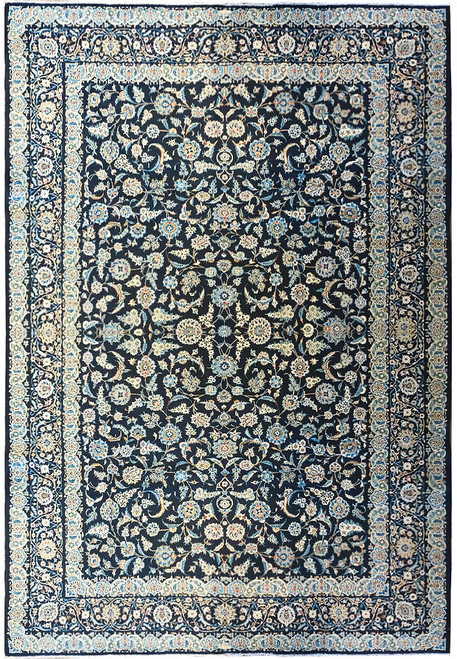
10'2" x 13'2" Persian Tabriz Rug | All Over Floral Lattice | Multi Color on Ivory | Excellent Condition
This is a room-size Persian Tabriz woven on a cotton foundation with a fine wool pile, and it belongs to the group of Tabriz pieces that skip the central medallion in favour of an all over floral design that runs from border to border. At 10'2" x 13'2" it covers a large formal room properly, with enough field showing past a sofa group or a 10 seat table to keep the drawing readable rather than buried. The pile is even from end to end with no low spots, the selvedges are intact and the ivory ends still carry their original fringe, which is what puts it in excellent condition rather than merely good. The close back photograph shows a tight, disciplined knot structure with clean rows and no repairs, the mark of a proper town workshop rather than village work. Every rug we sell ships with a certificate of authenticity confirming origin, materials and hand-knotted construction, and this one sits squarely in the practical band of 10x13 Persian rugs that buyers look for when a 9x12 falls short.
Design and Motifs
The field is built from a diagonal lattice of diamond compartments, each one filled with its own small rosette or star medallion and framed by curling aubergine vine work that never quite repeats the way you expect. Inside the compartments the drawing alternates between 8 petal and 12 petal rosettes, upright palmettes, serrated leaves and small vases sprouting tulips and carnations, with tiny detached blossoms scattered in the gaps so almost no ground is left empty. The close detail photograph shows how much information is packed into a single compartment: a pale blue cartouche holding a red bud, a cream palmette outlined in navy, a yellow and red pinwheel rosette no wider than a thumbnail. The system is held together by a triple border. The wide ivory main border carries alternating red and pale blue cartouches with rosettes and cypress-like sprays, and it is fenced on both sides by narrow navy guard stripes with a reciprocal trefoil and running vine. All 4 corners resolve cleanly, which on an all over lattice of this density is the part that separates a well drawn cartoon from a careless one.
A True Multi Color Palette on an Ivory Ground
The ground is ivory to soft cream, and it is the ivory that does the work here, holding the whole crowded field open and bright. Over it the weaver ran a genuinely polychrome palette: deep madder red and a cooler raspberry in the larger compartments, a warm coral salmon that reads almost terracotta in raking light, and a pale sky blue that turns faintly celadon where it meets green. Olive and sage green fill the leaves and many of the palmettes, navy and inky aubergine outline the vines and hold the border stripes, and gold, mustard, peach and shell pink appear in the small rosettes and single blossoms. The effect is not a scattered rainbow but a balanced multi color surface, because the same handful of tones repeat on a strict rhythm across every diagonal row. Note how the angle of the light changes the reading: photographed flat the field looks red-dominant, while the low-angle photographs bring the coral, blue and green forward and the rug reads much lighter. That flexibility is why a rug like this settles into both warm and cool rooms.
Tabriz Origin and Weaving Quality
Tabriz sits in the far northwest of Persia and has been the country's most organised weaving city for centuries, the place where cartoon-driven workshop production, fine wool sorting and the Raj counting system were refined into a repeatable standard. Raj measures the number of knots across a gereh, about 2.75 in of width, and it is the yardstick Tabriz masters use instead of guesswork: 40 Raj is commercial, 50 Raj is fine, and 60 Raj and above is collector territory. This piece is not marked with a Raj count, so we will not assign one, but the back tells you plenty on its own. The knot rows are straight and closely packed, the wefts are firmly beaten, and the pile is clipped low enough that the smallest blossoms and the navy outlines stay crisp, all of which reflects town workshop practice rather than nomadic weaving. The wool is the tough, slightly lustrous Azerbaijan fleece that Tabriz is known for, which is precisely why these rugs hold their drawing and their surface under decades of real use. If you are comparing pieces, it is worth browsing other Persian Tabriz rugs to see how unusual a fully polychrome all over field of this size really is.
10'2" x 13'2" Persian Tabriz Rug | All Over Floral Lattice | Multi Color on Ivory | Excellent Condition
Ask about this rug
This piece is the only one of it, so the things worth knowing about it are particular to it. If you want to talk through the size, the colour in your own light, or the weave, speak to someone here first.