Watch the film
| Size in ft: | Width: 8' x Length: 10'6" |
| Size in Inch: | Width: 96" x Length: 126" |
| Size in meters: | Length: 3.20 x Width: 2.44 m |
| Colors: | Navy Blue, Red, Ivory |
| Shape: | Rectangular |
| Woven: | 100% Hand-knotted | Handmade |
| Foundation: | Cotton |
| Pile: | |
| Age: | Semi-Antique |
| Design: | Tabriz Floral Medallion | Curvilinear Vine Scroll |
| Origin: | Persian Tabriz | Made in Persia |
| Condition: | Excellent |
8' x 10'6" Persian Tabriz Rug | Navy Floral Medallion | Semi-Antique, Excellent Condition
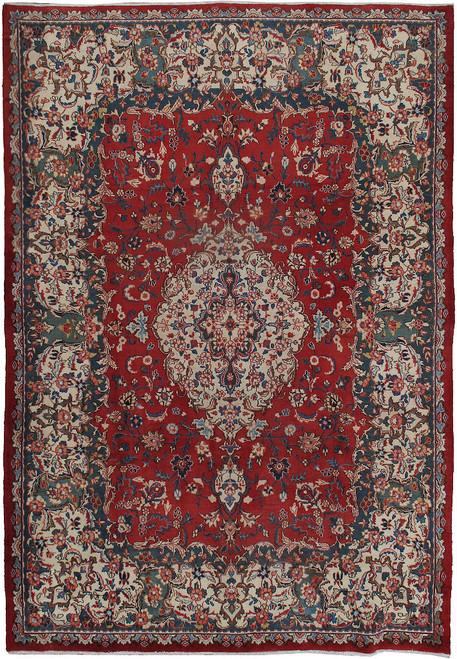
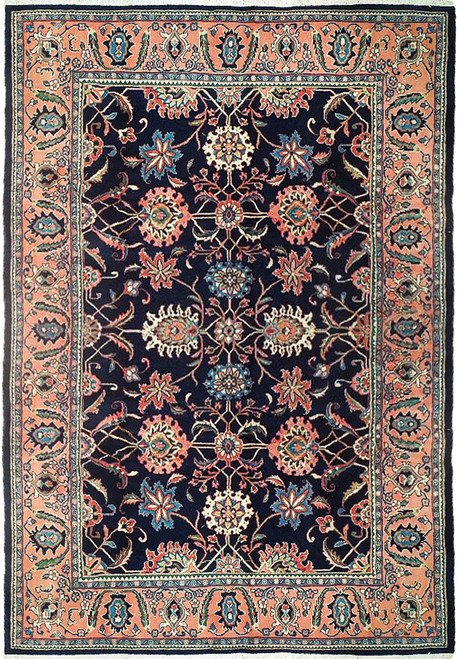
This is a semi-antique Persian Tabriz measuring 8' x 10'6", hand-knotted in wool on a cotton foundation with a 3/8" pile that still stands firm and even across the whole field. It is a classic town-workshop piece: a single red lobed medallion floating on a deep navy ground, ivory corner spandrels, and a wide red main border framed by blue-green guard stripes. The drawing is curvilinear throughout, with no breaks in the vine work and clean, symmetrical corner resolution, which is the mark of a weaver following a properly drafted cartoon. It sits in the sweet spot of 8x11 Persian rugs, large enough to anchor a full seating group yet still manageable in a standard room. Condition is excellent, with full pile, straight sides and sound cotton fringes, and the rug ships with a certificate of authenticity.
Design and Motifs
The center medallion is a stepped, lobed diamond in tomato red, built around a small ivory rosette with a 4 petal core and flanked by two pale cartouche-like finials. Out of its points run slender pendant tips that dissolve into the field rather than ending abruptly. Around the medallion the ground carries a dense all-over floral drawing of split palmettes, serrated saz leaves, multi-petal rosettes and long curling arabesque scrolls, all outlined in a thin rose-pink line that lifts them off the dark ground. The 4 corner spandrels are drawn in ivory with a large blue-centered palmette apiece, giving the composition its breathing room. The main border repeats an alternating palmette and rosette chain linked by a continuous vine, and the inner and outer guard stripes carry a small repeating 4 leaf motif in blue on ivory, a steady rhythm that keeps the busy field contained.
Color Palette
The field is a deep navy blue that carries a plum, almost aubergine undertone in raking light, a shade that comes from well-aged indigo over the local wool and is a large part of this rug's character. Against it the medallion and border read as a warm tomato red with a slight brick cast, softer and more muted than a modern dye would give. Ivory appears in three weights: a creamy white in the spandrels and large border palmettes, a cooler chalk tone in the guard stripes, and a thin pink-ivory outline that traces every vine and leaf. Secondary notes include teal and petrol blue in the rosette centers, a dusty rose in the smaller flowerheads, olive green in the leaf tips and a warm camel in a few palmette crowns. The overall effect belongs with the darker navy blue Persian rugs, rich and formal under lamplight, and forgiving of traffic in a busy room.
Tabriz Origin and Weave
Tabriz sits in northwest Persia and has been the country's most organized weaving city for centuries, the place where master designers draft cartoons on graph paper and workshops weave to the Raj system rather than from memory. That discipline is visible here in the exact mirroring of the field across both axes and in the way the border turns each of the 4 corners without crowding the pattern. The handle is typical Tabriz: a tight, somewhat stiff cotton foundation, a short clipped pile that holds detail, and a back with clear, orderly knot rows, as the ruler shot shows. Age is semi-antique rather than new, and the softened reds and the slight patina across the navy are exactly the signs described in our guide on how to date an Oriental rug. A piece like this has already proved it will last, and with normal household use it has generations left in it.
8' x 10'6" Persian Tabriz Rug | Navy Floral Medallion | Semi-Antique, Excellent Condition
Ask about this rug
This piece is the only one of it, so the things worth knowing about it are particular to it. If you want to talk through the size, the colour in your own light, or the weave, speak to someone here first.