Watch the film
| Size in ft: | Width: 8' x Length: 11' |
| Size in Inch: | Width: 96" x Length: 132" |
| Size in meters: | Length: 3.35 x Width: 2.44 m |
| Colors: | Blue, Faded Cranberry Red, Ivory |
| Shape: | Rectangular |
| Woven: | 100% Hand-knotted | Handmade |
| Foundation: | Cotton |
| Pile: | |
| Age: | 1960's | Vintage |
| Design: | Tabriz | All Over Floral |
| Origin: | |
| Condition: | Vintage | Even Low Pile |
8' x 11' Persian Tabriz Rug | Vintage 1960s All Over Floral | Blue & Faded Cranberry | Low Pile
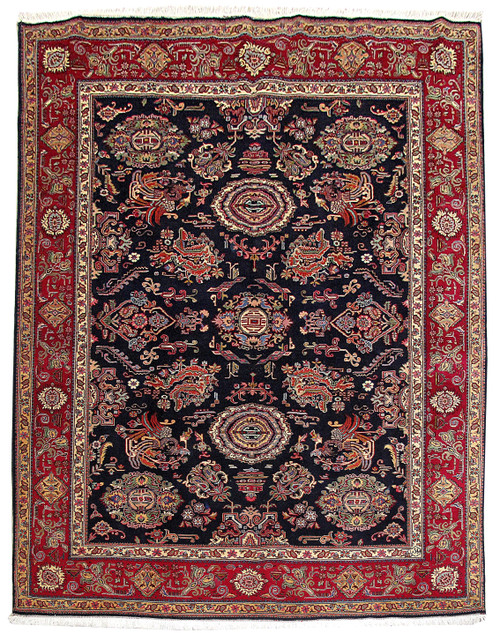
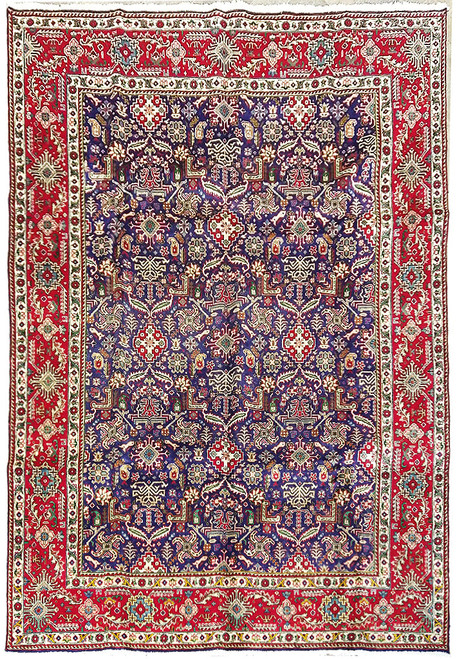
This 8' x 11' Persian Tabriz rug dates to the 1960's and has aged into exactly the kind of piece decorators hunt for and rarely find: a blue all over floral field, a wide faded cranberry border, and a wool pile worn low and perfectly even from one end to the other. Nothing about it is reproduced or chemically washed to look old. Six decades of light and use did the work, softening the madder reds toward dusty rose and opening the indigo field so the ivory vine lattice reads almost like drawing on paper. It lies flat and quiet, which is why it works under furniture in rooms where a thick new pile would look heavy. Every rug we ship carries a certificate of authenticity confirming it as a genuine hand-knotted piece, and for buyers shopping the harder 8x11 Persian rugs format, a vintage example in honest even condition at this size is an uncommon find.
Please Note About the Photographs:
The first image reads brighter and cooler than the rug does in person. The showroom photographs taken on the stone floor are the accurate ones, so judge the color from those. The straight diagonal lines crossing the pile in several shots are fold marks and shadow from pallet storage. They are not wear, not fade and not damage, they relax once the rug is laid flat, and every rug is professionally steamed and pressed before it ships.
Design and Motifs
The field runs as a continuous all over composition rather than a single medallion, built on a broad ivory vine lattice that loops into ogival compartments and fills each one with large serrated palmettes and split leaves. At the center two star cartouches sit back to back inside a ring of salmon and rose blossoms, a quiet anchor point rather than a dominant medallion. Look closely at the field and small narrative motifs appear: crenellated castle forms like miniature battlements, slender urns, and pairs of long tailed birds facing each other beak to beak above the lower vine. The 4 corners of the field are filled with squared panels of the same drawing, a device that makes the blue ground read as an inset carpeted room within the rug. The main border carries alternating rosettes and shield palmettes on a reciprocal vine, flanked by narrow guard stripes of upright bar and dot motifs that march the full perimeter. Both ends finish with the same drawing, so the rug reads correctly from either direction.
A Faded Palette of Blue, Cranberry and Ivory
The field is a mid indigo that shifts across the width, deeper and almost teal where the pile sits a touch higher, lighter and more denim where the light catches it, with patches of soft olive brown where the original dark outlines have abraded down toward the knot base. Against that ground the lattice and leaves are ivory, bone and pale wheat, while the blossoms carry faded cranberry red, salmon and a powdery pink that was once a stronger madder rose. The border is the most changed area of all, a wide cranberry and rose ground gone chalky and uneven in the best way, printed with ivory rosettes and small blue accents that keep the perimeter from going flat. There is no harsh contrast anywhere in the rug, which is why it sits so easily beside linen, oak and warm plaster walls. If you are working a cool scheme, it belongs with the softer blue Persian rugs rather than the saturated navies.
Tabriz Weaving in Northwest Persia
Tabriz sits in the northwest corner of Persia and has been the commercial engine of Persian weaving for centuries, the city where workshop drawing, cartoon design and the Raj counting system were refined to a standard that village looms could not match. The curved vine work and the balanced repeat seen here are typical of that tradition: a designer set the cartoon, and the weavers followed it closely enough that both halves of the field mirror cleanly across the long axis. The wool is local highland fleece on a cotton foundation, spun firm, which is why a pile worn this low still covers the warps evenly with no bald ground showing. Age shows in the right places, in the oxidized dark outlines and the softened reds rather than in holes or repairs, and if you want to understand how those clues are read, our guide on how to date an Oriental rug walks through the same signals we used on this piece. For a 1960's rug that has clearly lived in a home, it has come through remarkably level.
8' x 11' Persian Tabriz Rug | Vintage 1960s All Over Floral | Blue & Faded Cranberry | Low Pile
Ask about this rug
This piece is the only one of it, so the things worth knowing about it are particular to it. If you want to talk through the size, the colour in your own light, or the weave, speak to someone here first.