| Size in ft: | Width: 10' x Length: 12'10" |
| Size in Inch: | Width: 120" x Length: 154" |
| Size in meters: | Length: 3.91 x Width: 3.05 m |
| Colors: | Faded Coral, Beige, Blue |
| Shape: | Rectangular |
| Woven: | 100% Hand-knotted | Handmade |
| Foundation: | Cotton |
| Pile: | |
| Age: | 1970's | Vintage |
| Design: | Kerman Floral Medallion | Curvilinear |
| Origin: | Persian Kerman | Made in Persia |
| Condition: | Good and Stable | Low even pile |
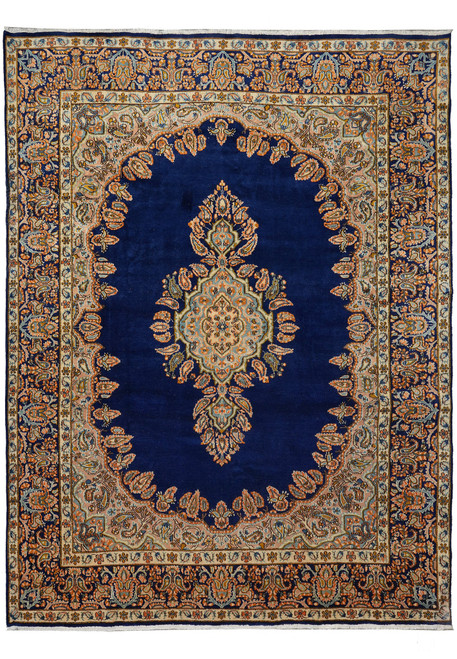
10' x 12'10" Persian Kerman Rug | Faded Coral Floral Medallion | 1970s Vintage Low Pile
This 10' x 12'10" Kerman was knotted in Persia in the 1970s and has aged the way buyers hope a Kerman will age. The madder field has dropped from full red to a dusty, faded coral, the wool has burnished down to a low and completely even pile, and the formal court drawing now reads soft and almost washed. The weave underneath is good and stable, with tight sides, honest low nap and no repair work to explain away. At just under 13 feet long it covers a true room without going oversize, which puts it in the most requested of all 10x13 Persian rugs proportions. It ships with a certificate of authenticity confirming it as a hand-knotted Persian Kerman.
Please Note About the Photographs:
The close-up photographs show the low pile and the soft striations of abrash running through the coral field. That shading is natural variation in the hand-dyed wool combined with 50 years of gentle, even use, not staining, holes or repair. This is a deliberately low-pile vintage piece, and it is professionally steamed and pressed before it leaves our warehouse.
Design and Motifs
The center holds a tall lobed medallion on a deep blue ground, filled with ivory palmettes, curled acanthus leaves and small paired birds, with a single coral rosette set exactly at the middle. Slender pendants run off the top and bottom of the medallion into the open field, and the field itself is left largely bare so that detached floral sprays, bud clusters and thin leafy stems can float across it in ivory, pale blue and soft green. Four corner spandrels in ivory and powder blue answer the medallion with dense scrolling vinework and cypress-like leaf forms. The main border is deep blue and reads like a garden in procession, alternating palmettes, urn shapes and curved boteh separated by trellis panels of tiny blossoms, exactly the pictorial garden border treatment that Kerman workshops are known for. Narrow ivory guard bands carry a meandering vine on both sides of it, and the finish runs out to a coral selvage.
The Faded Coral, Blue and Ivory Palette
Color is the whole argument for this rug. The field sits somewhere between faded coral, salmon and dusty rose, warmer toward the center and cooler along the edges, with gentle horizontal abrash bands where the dye lots shifted on the loom. Against it the medallion and main border read as a smoky blue, closer to slate teal than true navy in daylight, dark enough to anchor the composition without turning heavy. Between the two sits a wide range of neutrals: chalky ivory in the spandrels and guard borders, warm beige in the palmettes and leaf outlines, and a pale eau de nil green in the smaller blossoms. The floral sprays carry drops of powder blue that pick the border color back up into the field, and small clean touches of blush pink appear in the border urns and in the outer vine. The overall effect is muted and slightly sun-washed, which is why this palette works under both antique wood and modern upholstery instead of dictating the room.
Kerman Weaving in Southeast Persia
Kerman sits in the southeast of Persia, a desert city with a weaving industry old enough and organized enough that its workshops have supplied Western drawing rooms for well over a century. The city's weavers work the asymmetric knot on a cotton foundation and build their designs from cartoons drawn by professional designers, which is why a Kerman curves where a village rug would go angular: the vine turns, the palmette opens, the medallion outline flows rather than steps. Local wool from the surrounding highlands is soft and takes dye with a particular clarity, and Kerman dyers historically favored the pinks, corals and light blues that this rug wears so well after five decades. Pieces from the 1970s like this one were woven for export in room sizes, and the combination of low even pile, stable handle and faded palette is precisely the profile collectors and decorators now hunt for. If you want to understand how a weave, a palette and a back tell you an age, our guide on how to date an Oriental rug walks through the same clues we used here.
10' x 12'10" Persian Kerman Rug | Faded Coral Floral Medallion | 1970s Vintage Low Pile
Ask about this rug
This piece is the only one of it, so the things worth knowing about it are particular to it. If you want to talk through the size, the colour in your own light, or the weave, speak to someone here first.