Watch the film
| Size in ft: | Width: 9'2" x Length: 11'6" |
| Size in Inch: | Width: 110" x Length: 138" |
| Size in meters: | Length: 3.51 x Width: 2.79 m |
| Colors: | Beige, Champagne, Blue, Navy, Ivory, Soft Gold |
| Shape: | Rectangular |
| Woven: | 100% Hand-knotted | Handmade |
| Foundation: | Cotton |
| Pile: | |
| Age: | Circa 1930s | Antique |
| Design: | Art Deco | Peking Style | Vase and Flowering Branch Motifs | Open Field |
| Origin: | Chinese Peking | Made in China |
| Condition: | Excellent | Full even pile |
9'2" x 11'6" Antique Chinese Art Deco Rug | Peking Vase & Floral Design | Circa 1930s
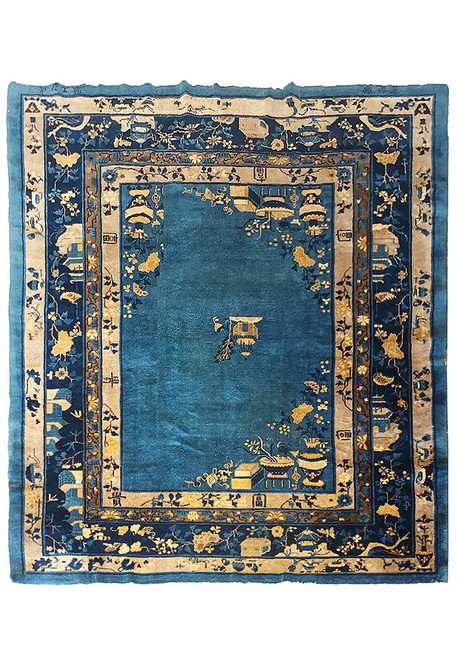
This is a genuine antique from the 1930s, hand-knotted in China in the Peking tradition and drawn with the restraint that collectors of the Art Deco period look for. The field is left almost entirely open in a warm champagne beige, with a single flowering vase at the center and a scattering of small urns, planters and blossoming sprigs placed like objects on a scroll. It is a room-size piece at 9'2" x 11'6", which puts it squarely in the most usable of all 9x12 Oriental rugs, and as an Oriental rug of this age it carries close to a century of patina in the wool. The pile is soft, full and evenly worn across the whole surface, the sides and ends are intact, and the piece ships with a certificate of authenticity confirming age, origin and hand-knotted construction.
Please Note About the Photographs:
The soft diagonal lines you see across the open field in several photos are fold marks and shadows from pallet storage. They are not wear, not fading and not damage. Because the field is one large area of light color, storage creases read strongly in photographs and disappear once the rug is laid flat. Every rug leaves us professionally steamed and pressed before shipping.
Design and Motifs
The composition is built on emptiness, which is the hardest thing for a weaver to carry off. At the center sits a tall blue and gold baluster vase with a second smaller urn beside it, both sprouting blossoming branches, peony heads and dark leaf forms. Four smaller vessels mark the quarters of the field, and 4 more low planters and censers fill the spaces toward the ends, each one drawn small and left to float on the bare ground. A narrow inner guard band in mid blue runs a thin flowering vine, and the main border widens into a deep navy ground carrying ivory cartouches filled with the traditional repertoire: standing vases, potted plants, cloud scrolls, perched birds and butterflies, all outlined in near black and filled with soft gold. A solid indigo outer band frames the whole piece and gives the light field its edge. There is no medallion and no all-over repeat, which is exactly why this drawing reads as modern in a contemporary room.
Color: Champagne Field, Indigo and Sky Blue Drawing
The field is a champagne beige that shifts between pale sand and a warmer camel tone depending on how the light falls, with gentle abrash banding that comes from small-lot dyeing and is a mark of age, not a flaw. Against that ground the palette is almost entirely blue and works in 3 clear registers: a near black indigo for outlines, branch work and the solid outer band, a rich saturated navy for the main border field, and a soft powder or sky blue used inside the vases, the guard band and the flower heads. Ivory cream fills the border cartouches, and small touches of apricot and soft gold appear in the blossoms and in the border leaf forms, warming the whole scheme so it never turns cold. The result is a quiet beige and blue rug that reads as neutral from across the room and only shows its detail up close.
Origin and Weaving Quality: Peking, China, 1930s
Rugs of this type were woven in and around Peking during the decades when Chinese workshops were producing for Western drawing rooms, and the 1930s is the high point of that output: classical Chinese motifs, vases, birds and precious objects, arranged with the open spacing and flattened drawing that the Art Deco market wanted. The back shown here is a clean, even hand-knotted cotton foundation with straight rows and no repairs visible, and the wool is the soft, lustrous local fleece that gives these pieces their plush hand and their slight sheen under light. Chinese city work of this period was never knotted for maximum fineness the way the fine urban ateliers of Persia were; the value sits in the wool quality, the natural dyes and the confidence of the drawing. If you want to understand how pieces like this are placed in time, our guide on how to date an Oriental rug walks through the same clues we used here: dye behavior, wear pattern, back structure and motif vocabulary.
9'2" x 11'6" Antique Chinese Art Deco Rug | Peking Vase & Floral Design | Circa 1930s
Ask about this rug
This piece is the only one of it, so the things worth knowing about it are particular to it. If you want to talk through the size, the colour in your own light, or the weave, speak to someone here first.