Watch the film
| Size in ft: | Width: 9'7" x Length: 12'8" |
| Size in Inch: | Width: 115" x Length: 152" |
| Size in meters: | Length: 3.86 x Width: 2.92 m |
| Colors: | Red, Navy Blue, Ivory, Green |
| Shape: | Rectangular |
| Woven: | 100% Hand-knotted | Handmade |
| Foundation: | Cotton |
| Pile: | |
| Design: | Tabriz | Octagonal Medallion | Ivory Corner Spandrels |
| Origin: | Persian Tabriz | Made in Persia |
| Condition: | Excellent |
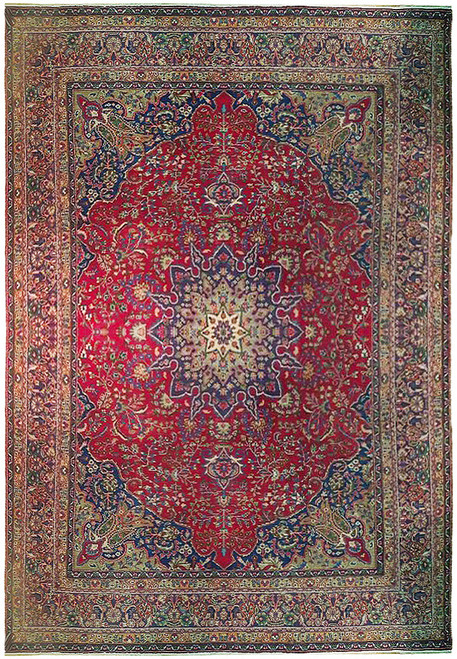
9'7" x 12'8" Persian Tabriz Rug | Green Octagonal Medallion on Red Field | Semi-Antique, Excellent Condition
This is a semi-antique Persian Tabriz in the classic room size, 9'7" x 12'8", with a 3/8" wool pile that still stands full and even from selvage to selvage. The field is a deep true red, carrying a deep green octagonal medallion with an ivory heart, and the four corners are filled with ivory spandrels that pull light into the room. It has seen floor time and wears it well: the pile has settled into that slightly silky surface that only comes with age, with no bare spots, no repairs and clean original ends and sides. At 9'7" x 12'8" it sits squarely in the bracket most buyers shop when they search 10x13 Persian rugs, large enough to carry a full seating group or a 8 to 10 seat dining table. Every rug we ship leaves with a certificate of authenticity recording origin, materials and construction.
Design and Motifs
The drawing is a medallion and corner layout, the backbone of Tabriz weaving, but handled here with a village firmness rather than a curvilinear workshop line. The center is a stepped octagonal medallion outlined in deep green, framed by a thin ivory and coral band, holding an ivory panel with a cruciform rosette and small hooked palmettes at the cardinal points. Two serrated pendants run off the medallion along the long axis, each ending in a small diamond. The red field around it is anything but empty: blue-grey rosette discs, paired leaf sprays, cypress shapes, angular cruciform blossoms and small stepped forms are set out in strict mirror symmetry, so the top half of the rug answers the bottom half almost motif for motif. The 4 ivory corner spandrels are filled with linked octagon cartouches, each carrying its own small rosette, with dark green leafy clusters tucked against the inner edge. The navy main border runs a steady alternation of hooked star diamonds and upright vase forms, flanked by guard stripes of reciprocal trefoils and running vine, which keeps the whole composition contained.
A Red Field Read Against Green, Navy and Ivory
The dominant color is a saturated madder red, warm rather than orange, that shifts slightly with the nap and reads a touch lighter when viewed from the fringe end. Against it the designer set two dark anchors: a bottle green in the medallion outline and the leaf clusters, and a deep indigo navy across the main border, so the eye travels from the bright center outward and stops cleanly at the frame. Ivory does the lifting work, in the medallion core, in the 4 spandrels and in the thin outline bands, and it has mellowed to a soft cream with faint camel and buff tones through the octagon cartouches. Secondary accents are worth noting up close: dusty coral and salmon in the rosettes, a chalky blue-grey in the round discs scattered over the field, and small touches of pale green and gold in the border rosettes. Buyers shopping red and burgundy Persian rugs will find this one unusually easy to place, because the green and ivory keep the red from flattening a room.
Tabriz Weaving in Northwest Persia
Tabriz sits in the far northwest of Persia and has been the commercial and technical capital of Persian weaving for centuries, the city where the Turkish knot, the hook and the Raj counting system were standardized and then exported to the surrounding towns. Fineness in Tabriz is measured in Raj, the number of knots across a gereh of about 2.75 inches, and large room-size pieces like this one are typically woven in the mid range, built for strength and daily service rather than for a collector's loupe. The construction here shows it: a cotton foundation under a hand-knotted wool pile, tightly packed wefts, and a back with crisp, legible knot rows, as the ruler shot confirms. That combination is why Tabriz room sizes survive decades of traffic and come to market in this condition. The wool is good local fleece with natural lanolin still in it, which is what gives the surface its slight sheen and lets the red hold depth instead of going chalky with age.
9'7" x 12'8" Persian Tabriz Rug | Green Octagonal Medallion on Red Field | Semi-Antique, Excellent Condition
Ask about this rug
This piece is the only one of it, so the things worth knowing about it are particular to it. If you want to talk through the size, the colour in your own light, or the weave, speak to someone here first.