Watch the film
| Size in ft: | Width: 9'9" x Length: 13' |
| Size in Inch: | Width: 117" x Length: 156" |
| Size in meters: | Length: 3.96 x Width: 2.97 m |
| Colors: | Berry Red, Champagne, Green, Blue |
| Shape: | Rectangular |
| Woven: | 100% Hand-knotted | Handmade |
| Foundation: | 100% Cotton |
| Pile: | |
| Age: | Vintage |
| Design: | All Over Floral | Tabriz |
| Origin: | Persian Tabriz | Made in Persia |
| Condition: | Excellent |
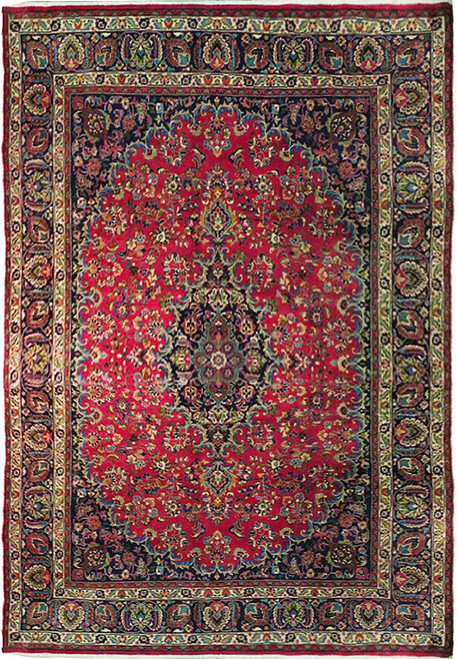
9'9" x 13' Persian Tabriz Rug | All Over Floral Design | Vintage Berry Red Field
A vintage Tabriz in a true room size, this rug covers a 9'9" x 13' footprint with a single continuous floral composition instead of a central medallion, which is the harder of the two layouts to draw well. The pile is hand-knotted wool at roughly 3/8" on a cotton foundation, dense enough to sit flat and take furniture without crushing, and the wool has aged into the soft sheen you only get from decades of settling. Corners, borders and vine work all resolve cleanly, and the field reads as one design from any angle rather than a repeat that stops at the edges. It falls naturally into the 10x13 Persian rug range that most formal living and dining rooms need. Every rug we sell ships with a certificate of authenticity documenting origin, materials and construction.
Please Note About the Photographs:
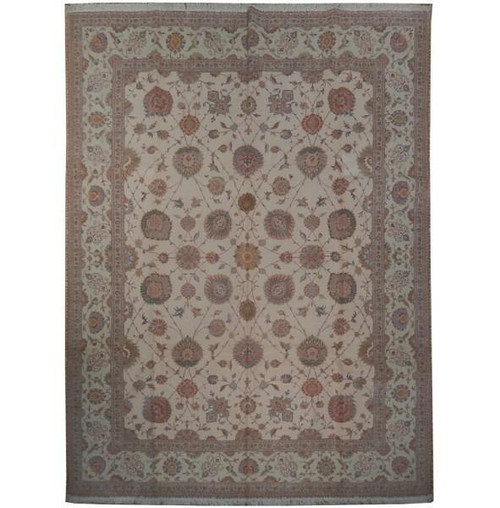
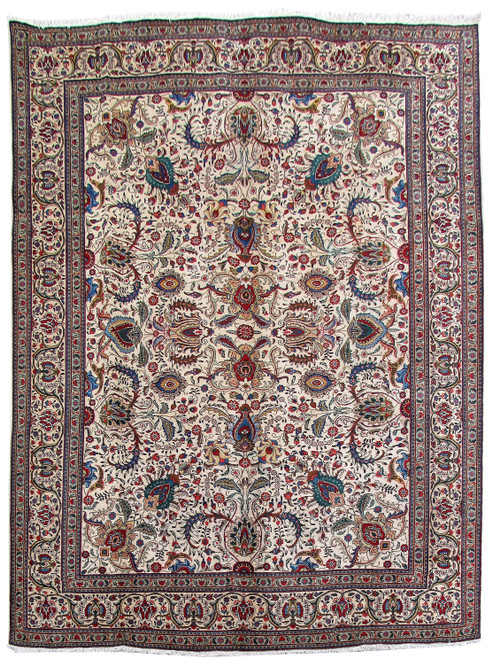
The first image is a studio photograph, where the field reads slightly brighter and pinker than it does in person. The floor photographs taken under warehouse lighting show the truer berry red and the warmer champagne tone of the border. Nothing in the rug has faded or changed; this is lighting only.
Design and Motifs
The field is an all over floral design built on a lattice of thin arabesque vines that arc, cross and double back across the whole 13' length. Along those vines sit large palmettes, open lotus blossoms and multi-petal rosettes, each one drawn at a different scale and shaded differently, so no two neighboring flowers repeat exactly. Serrated saz leaves in green and deep navy cut diagonally between the blossoms and give the field its movement. Three larger shaded cartouche-style flower heads run up the center line, standing in for a medallion without interrupting the pattern. The main border carries a procession of flowering vases and broad palmettes separated by slender leaf sprays, framed on both sides by narrow guard stripes with a running vine of small florets. The corners are properly turned, the border drawing meeting and resolving at all 4 corners rather than being cut off, which is the detail that separates workshop drawing from village improvisation.
Berry Red, Champagne and the Supporting Palette
The ground is a berry red that leans cool rather than orange, closer to a ripe raspberry than to brick, and it holds an even tone from selvage to selvage with only the gentle variation good hand-dyed wool always shows. Against it, the border runs a soft champagne gold, pale enough to function almost as an ivory frame but warm enough to keep the whole rug from looking stark. Inside the field the blossoms are worked in apricot, salmon, buttery gold, cream and pale ecru, with a few flower heads shaded from dark to light across a single petal ring. The leaves supply the cooler notes: olive and sage green, a deep spruce, and a dark navy that reads nearly black at a distance and provides the outline strength the pattern needs. Small touches of powder blue appear in the border stems and in the guard stripes, and the champagne border picks up rust and terracotta in the vases. The overall effect is warm and deeply saturated, red-dominant but not heavy, and it sits comfortably with both antique wood and modern upholstery.
Tabriz: Northwest Persia's Weaving Capital
Tabriz sits in the northwest of Persia and has been the country's most organized weaving city for centuries, working from paper cartoons prepared by professional designers rather than from memory. Fineness there is counted in Raj, the number of knots across a gereh of about 2.75 in, and Tabriz workshops built their reputation on curvilinear drawing that only holds together at a serious knot count. You can see the discipline on the back of this piece, where the knotting is regular row to row, the cotton warps are evenly spaced, and the outlines stay crisp even in the smallest florets. The 3/8" wool pile is typical of a good mid-century Tabriz commission: short enough to keep every line legible, long enough to wear for generations under real traffic. For collectors who want to place a piece like this in its period, our guide on how to date an Oriental rug walks through the wear, dye and construction clues that matter.
9'9" x 13' Persian Tabriz Rug | All Over Floral Design | Vintage Berry Red Field
Ask about this rug
This piece is the only one of it, so the things worth knowing about it are particular to it. If you want to talk through the size, the colour in your own light, or the weave, speak to someone here first.