Watch the film
| Size in ft: | Width: 9' x Length: 12'1" |
| Size in Inch: | Width: 108" x Length: 145" |
| Size in meters: | Length: 3.68 x Width: 2.74 m |
| Colors: | Blue, Olive, Apricot |
| Shape: | Rectangular |
| Woven: | 100% Hand-knotted | Handmade |
| Foundation: | Cotton |
| Pile: | |
| Age: | New | Never used |
| Design: | Zigler Chobi | All Over Palmette | Multi-Border |
| Origin: | Peshawar | Made in Pakistan |
| Condition: | Perfect | Never used |
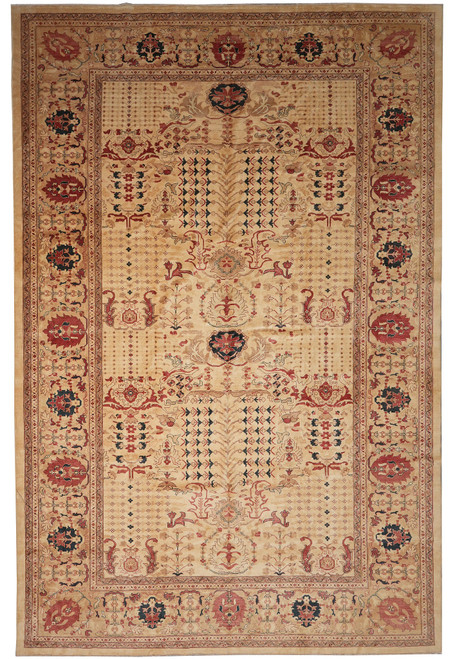
9' x 12'1" Zigler Chobi Oriental Rug | Blue, Olive & Apricot All Over Palmette Design | Brand New
A brand new, never used Zigler Chobi woven in Peshawar, Pakistan, hand-knotted entirely in hand-spun wool on a cotton foundation and given the soft antique wash these workshops are known for. At 9' x 12'1" it lands squarely in the most useful room size there is, which is why 9x12 area rugs move faster than any other dimension we carry. The pile is clipped low and even, the handle is supple rather than stiff, and the wool still carries its natural lanolin sheen, visible in the raking light of the close-up photographs. The colors are deliberately quiet: a faded sky blue field, apricot and cream palmettes, olive accents, with a teal selvage finishing all 4 sides. It arrives with a certificate of authenticity confirming the hand-knotted construction, materials and origin.
Design and Motifs
There is no central medallion here. Instead the weaver filled the field with a true all over design: large lobed palmettes arranged in offset rows, each one outlined and anchored on a scrolling vine that links the whole field into an ogival lattice. Between the big palmettes sit smaller cypress forms, split-leaf arabesques, 8 petal rosettes and tiny paired blossoms, so the eye never finds an empty patch. The drawing is slightly softened and village-like rather than perfectly mechanical, which is exactly the look this design group aims for. The field is framed by 5 bands: a wide main border of alternating apricot palmettes and olive vinework on blue, flanked by narrow reciprocal vine guards in cream, then outer stripes of small flowering sprigs. Corners are resolved cleanly on all 4 sides, and the pattern repeats without interruption from end to end.
A Faded Blue, Apricot and Olive Palette
The dominant color is a pale, slightly greyed sky blue, and it is not flat: subtle abrash runs across the field where one dye lot of hand-spun wool gave way to the next, lightening toward the center and deepening to a teal cast along the edges and the selvage. Over that blue the palmettes read in two values, a dark charcoal grey-brown that photographs almost black in the overhead shots, and a warm apricot that ranges from peach to cream depending on the light. Olive and sage green fill the leaves and smaller rosettes, with occasional slate blue dots in the border flowers. The cream and apricot guard stripes lift the whole composition and keep it from going cold. Against the grey tile in the studio photographs the effect is calm and almost bleached, which is why this coloring suits pale oak, limestone, white walls and brass or black metal without fighting any of them.
Peshawar Weaving and the Zigler Tradition
The Zigler name goes back to a Swiss trading house that commissioned large decorative rugs in the Sultanabad tradition for Western rooms in the 1880s, with generous drawing, open spacing and muted dyes. Today the best interpretations of that style come out of the workshops around Peshawar, where weavers card and spin the wool by hand, dye it in small lots with vegetable and natural dyestuffs, and wash the finished piece to settle the colors into that antique tonality. The construction here is honest workshop work: a firm cotton warp, tight rows of wool knots visible in the folded-back corner photograph, straight sides, flat lay and a hand that rolls easily. If you are weighing how this kind of piece compares with a village or city weave from elsewhere, our guide on what separates one Oriental rug group from another is worth 5 minutes before you buy.
9' x 12'1" Zigler Chobi Oriental Rug | Blue, Olive & Apricot All Over Palmette Design | Brand New
Ask about this rug
This piece is the only one of it, so the things worth knowing about it are particular to it. If you want to talk through the size, the colour in your own light, or the weave, speak to someone here first.