| Size in ft: | Width: 10'1" x Length: 17'6" |
| Size in Inch: | Width: 121" x Length: 210" |
| Size in meters: | Length: 5.33 x Width: 3.07 m |
| Colors: | Burgundy, Blue, Navy, Turquoise, Saffron Gold, Ivory, Orange |
| Shape: | Rectangular |
| Woven: | 100% Hand-knotted | Handmade |
| Foundation: | Cotton |
| Pile: | |
| Age: | 1930's | Antique |
| Design: | Sarouk | All-Over Detached Floral Sprays | Navy Palmette Border |
| Origin: | Persian Sarough | Made in Persia |
| Condition: | Excellent | Full even pile for its age |
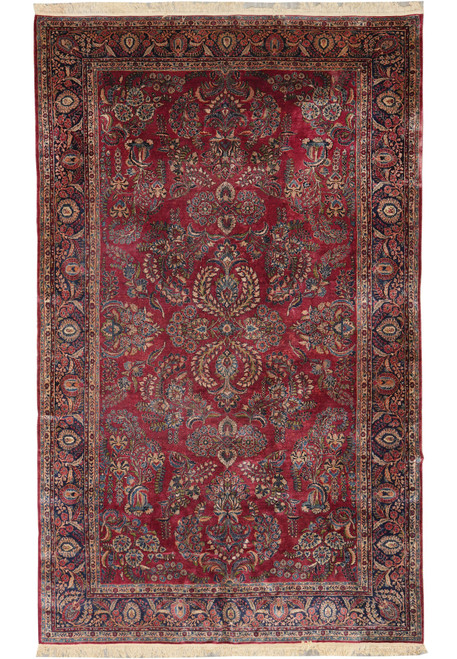
10'1" x 17'6" Persian Sarough Rug | 1930s Antique Palace Size | Burgundy Field, All-Over Floral Sprays
This is a genuine pre-war Sarough, woven in Persia in the 1930s and still carrying its original cloth back tag and dealer number 6908. At 10'1" x 17'6" it belongs to the small group of oversize Persian rugs that were commissioned for long formal rooms rather than cut down from standard looms, and the drawing runs true from end to end with no crowding or shortened repeats. The pile is fine wool on a cotton foundation, still full and evenly standing after roughly 90 years, with clean selvages and original cream fringe. Every piece ships with a certificate of authenticity stating origin, age, materials and measurements.
Please Note About the Photographs:
The first overhead photograph was shot flat under bright studio light and reads lighter and pinker than the rug actually is. The close-up and angled photographs are the accurate reference: the field is a deep burgundy red with strong navy and turquoise drawing.
Design and Motifs
The field follows the classic Sarough formula of detached floral sprays, each bouquet drawn as an individual unit and floated on open ground rather than tied into a continuous vine. Look closely and the vocabulary is broad: 8 petal rosettes with orange centers, serrated saffron leaves, curling boteh shaped palmettes, small cypress-like flowering stems and clustered blossom heads that repeat in offset rows so no two adjacent bouquets sit in the same position. A larger flowering cluster anchors the center of each half of the field, giving the long format a visual rhythm without ever resolving into a formal medallion. The main border carries a navy ground with alternating palmettes and leafy stems in gold, coral and turquoise, framed by ivory guard stripes that keep the burgundy field from bleeding into the room. The corners resolve cleanly, a good sign of a drawn cartoon rather than improvised village work.
Burgundy Field and Antique Blue Palette
The ground is a deep burgundy red with a cochineal warmth to it, and because the wool is glossy the tone shifts with the light, reading close to wine under lamplight and brighter crimson in daylight. Against it the blues do the heavy lifting: inky indigo outlines, a mid cornflower blue in the rosettes and a clear turquoise in the leaves, three separate blue values used deliberately rather than one. Saffron gold and butter yellow carry the leafwork, with small hits of soft orange and apricot in the flower centers and ivory used sparingly for highlights and the guard stripes. The abrash across the field is gentle and even, the natural variation of hand-dyed yarn lots that gives an antique its depth. Buyers searching red and burgundy Persian rugs for a large formal room will find this one anchors dark wood, brass and cream upholstery without fighting them.
Sarough Weaving and the 1930s Period
Sarough is a weaving town in the Arak region of west central Persia, and by the 1920s and 1930s its looms were producing the heaviest, most tightly packed floral rugs in the country, built with a thick wool pile on a stout cotton foundation so the rug could take decades of traffic in an American dining room and still stand up. That density is visible on the folded corner here, where the back shows a compact, regular knot and straight rows with no slack. Period pieces of this size are getting genuinely scarce, since most were woven in room sizes up to 9x12 and anything past 17 feet required a purpose-built loom. If you want to understand how these pieces are attributed and dated, our guide to Persian Sarough rugs covers construction and workshop history, and our article on how to date an Oriental rug explains the wear, dye and back-tag evidence behind the 1930s reading on this one.
10'1" x 17'6" Persian Sarough Rug | 1930s Antique Palace Size | Burgundy Field, All-Over Floral Sprays
Ask about this rug
This piece is the only one of it, so the things worth knowing about it are particular to it. If you want to talk through the size, the colour in your own light, or the weave, speak to someone here first.