Watch the film
| Size in ft: | Width: 10'10" x Length: 14'3" |
| Size in Inch: | Width: 130" x Length: 171" |
| Size in meters: | Length: 4.34 x Width: 3.30 m |
| Colors: | Red, Blue, Ivory |
| Shape: | Rectangular |
| Woven: | 100% Hand-knotted | Handmade |
| Foundation: | Cotton |
| Pile: | |
| Age: | 1970s | Semi-antique |
| Design: | Esfahan | Floral Medallion |
| Origin: | Persian Isfahan | Made in Persia |
| Condition: | Excellent |
10'10" x 14'3" Persian Isfahan Najafabad Rug | Red Floral Medallion | 1970s Fine Wool
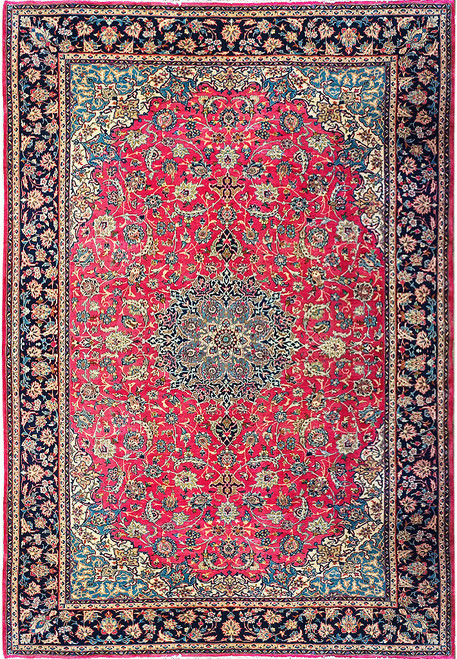
A 1970s workshop piece in the classic Isfahan idiom, woven in the Najafabad group west of the city on a cotton foundation with a tightly clipped wool pile. The drawing is the reason to own it: a 16 point star medallion floats over a madder red field packed with scrolling vine, palmettes and small rosette lattices, and nothing in the layout is rushed or simplified. At 10'10" x 14'3" this covers a full formal room and sits comfortably in the family of 10x14 Persian rugs that anchor a large seating group without crowding the walls. The pile is even and full across the whole surface, the ivory fringe is original and hand finished, and the red selvage is intact. Every rug ships with a certificate of authenticity confirming origin, materials and hand-knotted construction. Read more in our complete guide to Isfahan rugs.
Design and Motifs
The center holds a navy star medallion with 8 points resolved into 16, its core a sky blue rosette ringed by ivory and saffron petals. Above and below it run slender pendants that end in small navy cartouches, and the field between them carries a continuous system of curved vine, split leaves, cypress-like sprays and open blossoms. Four ivory spandrels close the corners, each filled with a pale blue trellis of tiny 8 petal rosettes and a pair of large blue and gold flowering vases with arched leaves, the same vase motif that repeats along the main border. The border scheme is a wide indigo band of salmon rosette clusters and weeping willow trees, framed by ivory guard stripes of connected vine and by narrow red outlines. Look at the close photographs and the outlines stay crisp, one knot wide in places, which is what separates true Isfahan workshop drawing from a village copy of it.
A Madder Red Field Framed in Indigo and Ivory
The field is a warm madder red, deep and slightly tomato-leaning under daylight rather than cool or purple, and it reads as a single even tone from edge to edge with no abrash breaking it up. Against that red the border sets a strong indigo blue, darker at the pile tips and brighter where the light rakes across it in the angled photographs. Ivory does the structural work: the corner spandrels, the two guard stripes and the outlining of most flower heads are all in a soft cream that has warmed with age rather than gone chalky. Inside those three main colors sit the secondary notes that make the rug feel alive, a pale sky blue used throughout the vine work and the medallion core, salmon pink in the border rosettes, saffron gold in the vase stems and leaf tips, and small touches of green and near-black in the leaves. The fringe is natural ivory and the selvage is bound in red.
Isfahan Drawing, Najafabad Weaving
Isfahan in central Persia has been a court weaving center since the Safavid workshops of the 16th century, and its reputation rests on drawing rather than decoration: the curved line, the flowing vine, the precision of a repeat, all of which only hold together at a high knot count. Najafabad, a short distance west, weaves to those cartoons and supplies much of the larger format work in the Isfahan style, which is why room-size pieces like this one exist at all when the city workshops concentrate on smaller formats. This example was made in the 1970s, a strong period for the region, with the fine cotton warps and short clipped wool pile visible in the fold photograph and a back that shows clear, regular knot rows. If you are curious how weavers, dyes and construction are used to place a piece in time, our guide on how to date an Oriental rug walks through the same evidence.
10'10" x 14'3" Persian Isfahan Najafabad Rug | Red Floral Medallion | 1970s Fine Wool
Ask about this rug
This piece is the only one of it, so the things worth knowing about it are particular to it. If you want to talk through the size, the colour in your own light, or the weave, speak to someone here first.