Watch the film
| Size in ft: | Width: 10'2" x Length: 12'5" |
| Size in Inch: | Width: 122" x Length: 149" |
| Size in meters: | Length: 3.78 x Width: 3.10 m |
| Colors: | Rust, Navy Blue, Orange |
| Shape: | Rectangular |
| Woven: | Hand-Knotted |
| Pile: | 3/8" Wool |
| Origin: | Persia |
| Design: | Bakhtiari |
| Condition: | Excellent |
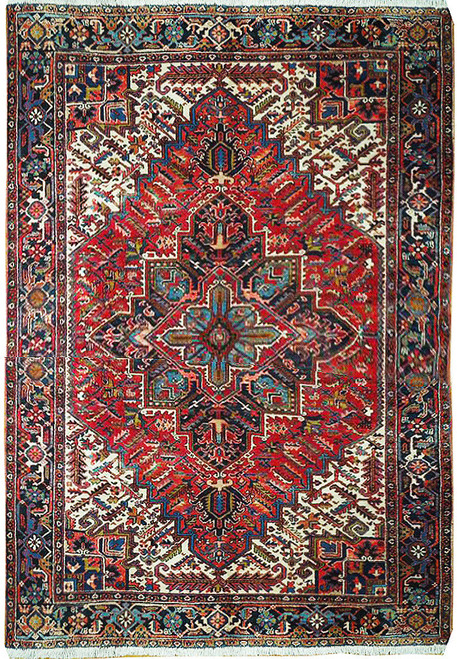
10'2" x 12'5" Persian Bakhtiari Rug | Navy Star Medallion on Rust Field | Semi-Antique Village Weave
This is a proper room-size village piece, 10'2" x 12'5" of hand-knotted wool on a cotton foundation, woven in the Bakhtiari tradition of the western Zagros. The drawing is confident rather than fussy: a broad navy field carrying a rust star medallion, rust spandrels pushing in from the 4 corners, and an ivory vine that traces every outline so the whole layout reads clearly from across a room. The 3/8" pile is full and even, the handle is heavy and substantial the way good village weaving should be, and the wool has the faint sheen that comes from mountain flocks. Among the Persian Bakhtiari rugs we import, this one sits in the practical sweet spot: big enough to anchor a 10 by 12 seating plan, tough enough to take daily traffic. It ships with a certificate of authenticity documenting origin, materials and construction.
Please Note About the Photographs:
The first studio image reads brighter and pinker than the rug does in person. The floor photographs taken on hardwood, and the close-ups of the medallion and corner, are the truer record of the color: a deeper brick rust against a dark navy ground. Screens and lighting vary, so judge the tone from the floor shots.
Design and Motifs
The center holds an 8 pointed star medallion built up in layers: a small diamond core in wine, an apricot cartouche around it, then a ring of lance-shaped petals in ivory, salmon and teal, and finally a serrated rust outline that steps out into the navy field. Above and below the medallion, twin pendants finish the vertical axis. The field itself is not empty for a moment. Angular palmettes, hooked leaves, tulip heads, small rosettes and squared-off vine tendrils fill every inch, with ivory reserved for the outlines so the motifs sit forward against the dark ground. The spandrels in the 4 corners repeat the rust of the medallion and carry their own cluster of blossoms and cypress-like sprigs. Framing all of it is a wide rust main border of alternating oval rosettes and floral sprays, flanked by narrow ivory guard stripes of reciprocal squares and a fine outer meander. The drawing is geometric in its skeleton and floral in its detail, which is exactly what separates a Bakhtiari from the curvilinear city workshops.
A Rust and Navy Blue Palette with Apricot Lights
Two colors do the structural work here. The ground is a deep inky navy, close to midnight where the pile lies flat, and against it the rust runs from a soft brick through to a warmer terracotta depending on how the light falls. That variation is natural abrash from hand-dyed wool and it gives the field a living, uneven glow rather than a printed flatness. Inside the medallion and scattered through the border you get the orange notes the spec calls out, reading as apricot and salmon on the petals and rosette centers, with small hits of teal green on the leaves and a rich aubergine on a few of the smaller blossoms. Ivory does the outlining everywhere, tracing the vine, the medallion petals and the guard stripes, and it is what keeps a densely drawn rug legible. The overall effect is warm and grounded: navy anchors the room, rust supplies the warmth, and the apricot and teal accents keep it from ever feeling heavy.
Bakhtiari Weaving in the Chahar Mahal Villages
The Bakhtiari are a large tribal confederation of the western Zagros, and the rugs that carry their name are woven in the settled villages of Chahar Mahal southwest of Isfahan, places like Shahr Kord, Saman, Chalshotor, Boldaji and Farsan. Those villages sit high, the winters are hard, and the fleece off mountain sheep is correspondingly long-stapled and resilient, which is why Bakhtiari rugs have a reputation for outlasting the households that buy them. The weave here is the classic village construction: a strong cotton warp and weft beaten down firmly, a symmetrical knot, and a pile left at a full 3/8" so the rug has weight and body underfoot. Most people know Bakhtiari work through the compartmented garden panel, so a single-medallion field like this one is the less common format and shows the weaver working an Isfahan-area medallion idea in a frankly tribal, angular hand. As one of our large Persian rugs, it was made to be walked on, and the construction backs that up.
10'2" x 12'5" Persian Bakhtiari Rug | Navy Star Medallion on Rust Field | Semi-Antique Village Weave
Ask about this rug
This piece is the only one of it, so the things worth knowing about it are particular to it. If you want to talk through the size, the colour in your own light, or the weave, speak to someone here first.