Watch the film
| Size in ft: | Width: 10'2" x Length: 14'3" |
| Size in Inch: | Width: 122" x Length: 171" |
| Size in meters: | Length: 4.34 x Width: 3.10 m |
| Colors: | Antique red, beige, golden tan, navy blue, green, apricot |
| Shape: | Rectangular |
| Woven: | 100% Hand-knotted | Handmade |
| Foundation: | Cotton |
| Pile: | |
| Age: | 1960's |
| Design: | Kashan | All-over floral | Golden tan border |
| Origin: | Jaipur | Made in India |
| Condition: | Perfect | Pre-owned |
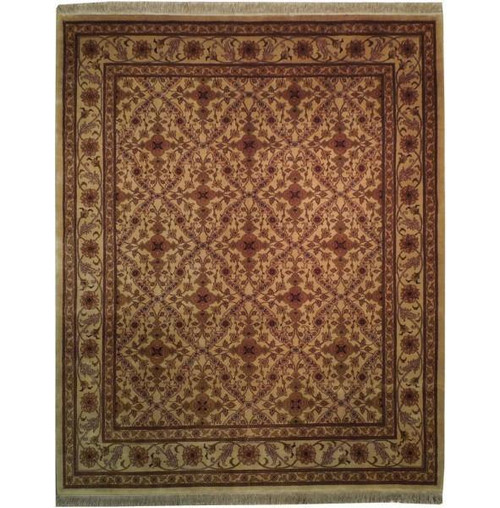
10'2" x 14'3" Indian Jaipur Rug | Kashan All-Over Floral Design | 1960s Wool Pile
This 10'2" x 14'3" room-size piece was knotted in Jaipur in the 1960's, and it is the kind of weaving that explains why India became the first stop for buyers who want classical drawing at an honest price. The field is a deep antique red carrying an all-over floral system in beige and golden tan, the wool pile still has body and sheen in the raking light, and the ivory fringe sits full and even at both ends. Six decades on it is clean, supple and undamaged, which is why the condition reads perfect rather than merely good, and it falls squarely in the most useful of all the 10x14 rugs we stock for large rooms. Every rug we ship, including a vintage Oriental rug of this age, leaves Freeport with a certificate of authenticity recording its size, materials, age and origin.
Design and Motifs
The layout is a Kashan all-over floral, drawn without a central medallion so the pattern reads as one continuous garden across the full 14'3" length. Thin vines sweep in long arcs from the bottom border to the top, tying together large 8 and 10 petal rosettes, split palmettes, serrated acanthus leaves and small 5 petal blossoms. At the heart of each vertical repeat sits a navy teardrop palmette filled with fanned green and apricot leaflets, one of which is caught in full detail in the close-up photograph. The main border is a broad golden tan band with a meandering vine, open red cartouche-like blossoms and dark green leaf clusters, framed inside by a narrow sage guard stripe of alternating leaves and 4 point stars, and outside by a red guard carrying a leaf and bar motif that runs right out to the selvage. The corners are resolved cleanly, with the border vine turning the angle instead of being cut off, which is a sign the weaver followed a properly drawn cartoon rather than improvising.
A Study in Antique Red and Golden Tan
The field colour is the first thing you notice: a soft antique red that shifts from brick to tomato as the pile turns, with gentle horizontal striation through the ground that gives the surface movement rather than a flat printed look. Against it the flowers are worked in beige, cream and golden tan, with apricot and salmon shading on the petals so each blossom has depth instead of a single tone. Leaves and vine work run through sage, olive and a deeper bottle green, and almost every motif is outlined in a dark navy blue that holds the drawing crisp at a distance. The main border lifts the whole piece into a warmer key, a honey to golden tan ground that photographs almost apricot in low light, edged by the navy guards and the red outer stripe. It is a warm, candlelit palette that sits comfortably on wood, stone or pale tile, and it belongs to the family of red and burgundy rugs that anchor a formal room without going cold.
Jaipur Weaving and the Quality of the Knot
Jaipur, in Rajasthan, has been a serious weaving centre for generations, and by the 1960's its workshops were interpreting the classical city designs of central Asia with real discipline, Kashan drawing among them. This rug is hand-knotted on a cotton foundation with a wool pile, and the folded corner photograph shows a tight, even back with straight rows and no slack, which is what keeps a rug this wide flat on the floor for decades. The wool is the other half of the story: well spun, lanolin-rich and left at a medium pile height, so it has taken a light sheen with use instead of going dry or fuzzy. India is now where most of the world's best contemporary hand-knotted work is made, and pieces like this from the 1960's are the reason that reputation exists. If you are comparing it with other hand-knotted Oriental rugs in this size, note the resolved corners, the consistent border width and the full original fringe, all marks of a workshop piece rather than a quick village copy.
10'2" x 14'3" Indian Jaipur Rug | Kashan All-Over Floral Design | 1960s Wool Pile
Ask about this rug
This piece is the only one of it, so the things worth knowing about it are particular to it. If you want to talk through the size, the colour in your own light, or the weave, speak to someone here first.