Watch the film
| Size in ft: | Width: 10'3" x Length: 14' |
| Size in Inch: | Width: 123" x Length: 168" |
| Size in meters: | Length: 4.27 x Width: 3.12 m |
| Colors: | Red, Navy, Green, Beige, And Gold. |
| Shape: | Rectangular |
| Woven: | Hand-Knotted |
| Pile: | Full Wool Pile |
| Origin: | Persia |
| Design: | Antique |
| Age: | 1930's |
| Condition: | Perfect Like New- No Sign Of Usage |
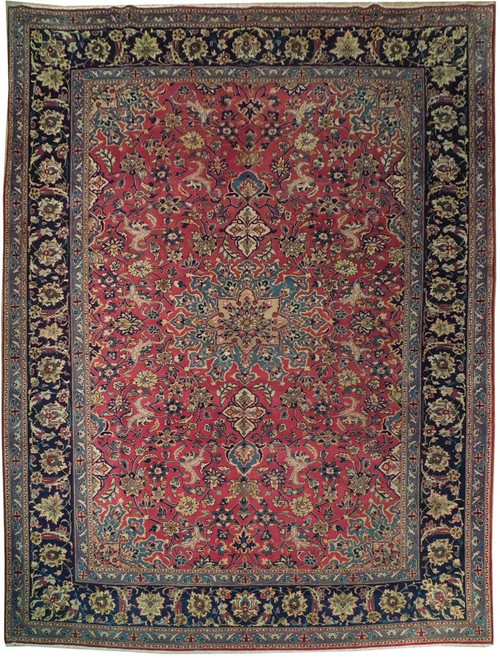
10'3" x 14' Antique Persian Tehran Rug | Signed Poetry Border | 1930s, Never Used
Tehran rugs are the scarcest of the Persian city weaves, and a 1930s example of this scale that has never been walked on is rarer still. This piece measures 10'3" x 14', carries a full wool pile on a cotton foundation, and runs a band of woven poetry cartouches around all 4 sides of the border, the kind of commission detail that only appears on workshop pieces made to order. The drawing is fine and fully curvilinear, the wool has kept its sheen after roughly 90 years, and the pile depth in the fold shots shows a rug that was stored rather than used. It ships with a certificate of authenticity, and at this footprint it sits comfortably in the same planning bracket as our 10 x 14 Persian rugs.
Please Note About the Photographs:
The field of this rug is a raspberry-toned red. The full overhead studio photograph renders it deeper and closer to burgundy, while the showroom floor shots and close-ups read lighter and pinker. The true color sits between the two. None of that variation is wear, fade or damage; the pile is full and even across the whole rug, and every piece is professionally steamed and pressed before it ships.
Design and Motifs
A small lobed medallion sits at the center, an ivory rosette wrapped in indigo and red petals floating inside a soft blue-green cloud of vinework, and around it the field never repeats itself in a mechanical way. Flowering stems climb the full length of the rug, carrying open blossoms, palmettes and serrated leaves, and threaded through them are gazelles, crouching big cats, and small birds perched on the vines. Six ivory reserves shaped like lobed cartouches break the field at regular intervals, each one filled with its own miniature animal and scroll composition. At both ends a large footed vase spills a flowering tree into the field, anchoring the composition the way a court cartoon would. The border is the signature element: a deep navy main band alternating rose-red cartouches of woven script with 8 petal rosettes in ivory and sage, framed inside and out by beige guard stripes of pink and blue flower heads, and closed by a barber-pole minor stripe.
A Raspberry Red Field Against Indigo and Ivory
The ground is a madder red that has softened toward raspberry and rose with age, warm rather than orange, and it reads differently from each end of the room as the pile direction changes. Against it the palette is unusually broad for a Persian city rug: deep indigo navy in the medallion, the main border and the flower centers; a chalky sage and soft moss green in the leaves and in several of the vases; ivory and cream in the field reserves, the animals and the guard borders; and a gold to camel tone in the vine outlines and the smaller blossoms. Cherry pink, rust and a dark aubergine appear in the flower heads, and the script in the cartouches is worked in near-black navy so it stands clear of the rose panels behind it. Every color here is a natural, vegetable-dyed tone, which is why the greens sit quietly next to the red instead of fighting it, and why the ivory has aged to a warm parchment rather than staying bright white.
Tehran Weaving and the Quality of the Knot
Tehran produced very few rugs, and it produced them for a short window: a handful of city workshops weaving for the capital's own households in the decades around the 1930s, with master drawing borrowed from the classical Persian repertoire and executed at a knot count fine enough to carry curved line, script and animal figures at this scale. Output was never commercial, which is why genuine Tehran pieces surface so rarely and why so many are misattributed to other cities. The construction here is textbook for the group: a cotton warp and weft, a tightly packed all-wool pile clipped low so the drawing stays crisp, flat-lying selvedges and even, regular knotting visible on the reverse in the fold photographs. The inscribed border, the low even pile and the depth of the dyes all point the same direction, and if you want to understand how those markers are read, our guide on how to date an oriental rug walks through the same evidence a dealer uses in the hand.
10'3" x 14' Antique Persian Tehran Rug | Signed Poetry Border | 1930s, Never Used
Ask about this rug
This piece is the only one of it, so the things worth knowing about it are particular to it. If you want to talk through the size, the colour in your own light, or the weave, speak to someone here first.