Watch the film
| Size in ft: | Width: 10'8" x Length: 12'4" |
| Size in Inch: | Width: 128" x Length: 148" |
| Size in meters: | Length: 3.76 x Width: 3.25 m |
| Colors: | Rustic Burgundy, Deep Red, Ivory, Navy Blue, Black, Beige, Rust |
| Shape: | Rectangular |
| Woven: | 100% Hand-knotted | Handmade |
| Foundation: | Cotton |
| Pile: | |
| Age: | 1970's | Approx. 50 years old |
| Design: | Garden Panel | Khesti Compartment Field | Tribal |
| Origin: | Persian Bakhtiar | Made in Persia |
| Condition: | Excellent | Ready for daily use |
10'8" x 12'4" Persian Bakhtiar Rug | Tribal Garden Panel Design | 1970s Wool
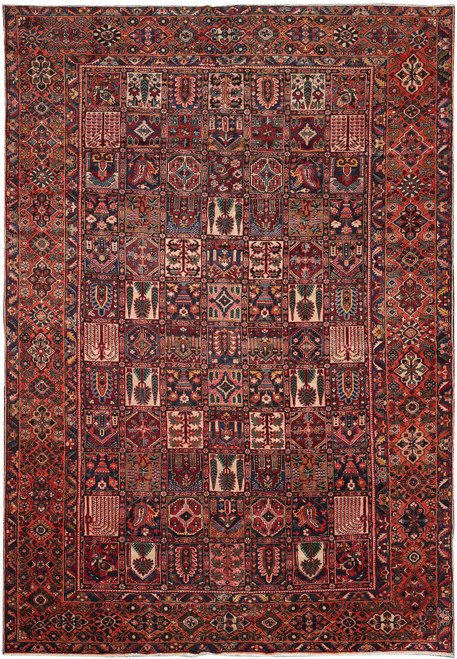
This is a 1970s Persian Bakhtiar in the classic garden format, hand-knotted in wool on a cotton foundation and measuring 10'8" x 12'4". The field is divided into a grid of roughly 70 small compartments, each one drawn as its own small garden plot, and the whole thing is framed by a wide burgundy border of ivory vines and palmettes. It is a true room-size piece that sits comfortably among large Persian rugs, with a heavy, thickly packed handle you can feel the moment you walk on it. Condition is excellent, the pile is full and even across the whole surface, the ends and sides are sound, and the rug ships with our certificate of authenticity.
Design and Motifs
The khesti, or brick, layout is the signature Bakhtiar drawing: a lattice of small squares, each outlined by a black and ivory barber-pole stripe, each filled with a different motif. Working across the field you find weeping willows and cypress trees on ivory grounds, flowering tree of life panels on aubergine black, diamond medallions with serrated leaf hooks on camel beige, vases of blossom, angular birds, and rosette sprays on navy and rose grounds. No two adjacent compartments repeat, which is what makes the rug reward close looking. The border is a different vocabulary altogether, a curvilinear run of ivory arabesque vines, pink and navy palmettes and eight petal rosettes, with a taupe grey guard band separating the formal border from the tribal Persian geometry of the field.
A Burgundy Field Lit by Ivory, Navy and Rust
The dominant reading is rustic burgundy: a deep madder red that carries the border and most of the compartment grounds, shifting toward a cooler wine tone where the wool takes the dye differently. Against it, the ivory panels act as light wells, spaced so the eye moves diagonally across the field rather than sitting on any one square. Navy blue and near-black aubergine anchor the darker panels, with camel beige and soft rust warming the middle of the rug and clear orange, rose pink and pale peach appearing as small accents in the blossoms and rosettes. The ivory outlines of the border vines and the cream cotton fringe keep the palette from going heavy, and under lamplight the wool has a low, waxy sheen that reads red in the evening and more brick toned in daylight.
Bakhtiar Weaving in the Chahar Mahal Villages
Bakhtiar rugs come from the villages of the Chahar Mahal district in western Persia, south of Isfahan, woven by settled Bakhtiari families around Shahr Kord and Saman. The weave is village work rather than workshop work: a stout cotton warp, heavy wefts beaten down hard, and a thick wool pile clipped medium high, which is exactly why these rugs survive decades of traffic without thinning. Local mountain wool is greasy and resilient, so the pile springs back and the colors mellow instead of fading flat. Roughly 50 years old, this piece has the depth of tone that only comes with age, and if you want to understand how weavers, wool and wear give a rug its date, our guide on how to date an Oriental rug covers the same signals we used here. Among Persian Bakhtiar garden rugs, a clean example in this size is the one collectors hold onto.
10'8" x 12'4" Persian Bakhtiar Rug | Tribal Garden Panel Design | 1970s Wool
Ask about this rug
This piece is the only one of it, so the things worth knowing about it are particular to it. If you want to talk through the size, the colour in your own light, or the weave, speak to someone here first.