Watch the film
| Size in ft: | Width: 10' x Length: 13'2" |
| Size in Inch: | Width: 120" x Length: 158" |
| Size in meters: | Length: 4.01 x Width: 3.05 m |
| Colors: | Deep Pomegranate Red, Green, Blue, Ivory |
| Shape: | Rectangular |
| Woven: | 100% Hand-knotted | Handmade |
| Foundation: | Cotton |
| Pile: | |
| Age: | 1950's |
| Design: | Kerman Floral Medallion | Open Field | Shah Abbasi Blossoms |
| Origin: | Persian Kerman | Made in Persia |
| Condition: | Excellent | Full even pile |
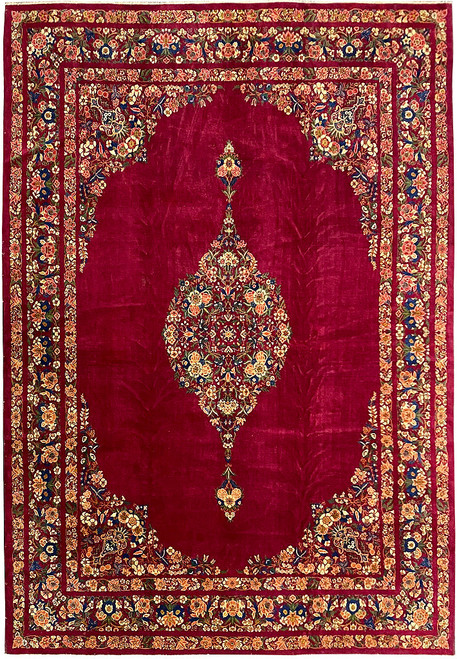
10' x 13'2" Persian Kerman Rug | Shah Abbasi Floral Medallion | 1950s Pomegranate Red Field
A room-filling Kerman from the 1950s, hand-knotted in wool on a cotton foundation and still carrying a full, even pile after seven decades. The drawing is classic city work: a lobed navy medallion with ivory pendants floating on an open pomegranate red ground, with flowering sprays crowding in from all 4 sides and a wide ivory and navy border of carnations and curling acanthus. At 10' x 13'2" it covers a full seating group or a 10 seat dining table, and it sits comfortably among our 10x13 Persian rugs. Every rug we sell ships with a certificate of authenticity.
Please Note About the Photographs:
The field is a deep pomegranate red. Under direct light the plush pile catches the sun and several close-up photos read brighter, almost magenta, while the overhead shots read darker and cooler. That is the nap of the wool reflecting light, not a difference in dye or a faded area, and the rug reads as one continuous red in a normally lit room.
Design and Motifs
The composition is built around a single lobed medallion on a navy ground, filled with rose and sky blue blossoms around an ivory cartouche whose core holds a small 8 petal rosette in red and blue. From its tips run slender gold stems ending in two leaf shaped pendants, each a miniature version of the medallion itself. The rest of the field is deliberately left open, so the eye travels across bare red before reaching the flowering thicket that rings the border: bouquets of Shah Abbasi palmettes, carnations, forget-me-nots and serrated leaves that lean inward as if planted along the edge of a garden bed. The 4 corners carry pale green spandrels drawn as cartouches of their own, packed with roses and gold scrollwork. The main border reverses the scheme, setting ivory floral panels against navy, with a narrow red guard stripe and green inner line holding everything together. It is a drawing full of incident that never feels crowded, because the empty red field gives it room to breathe.
The Pomegranate Red, Navy, Green and Ivory Palette
The ground is a saturated pomegranate red with a cool, slightly wine-toned depth, the kind of red that turns almost velvet where the pile lies one way and glows where it lies the other. Against it, the medallion and border grounds are a near-black navy that reads deep indigo up close. The flowers work across a wide range: sky blue and steel blue blossoms, rose pink and raspberry carnations, soft old ivory, and a warm straw gold used for the vine scrolls and the outlines of the pendants. Pale celadon green appears in the corner spandrels and the inner guard stripe, and it is the color that keeps the red and navy from feeling heavy. A few blossoms carry brown and apricot shading, and the ivory fringe at both ends is clean and bright. In a room with warm wood, brass and cream walls the red dominates; against gray or charcoal upholstery the navy and green come forward instead.
Kerman Weaving in Southeast Persia
Kerman sits in the high desert of southeast Persia and has been a weaving center for centuries, known for finely spun local wool and for designers who drew flowers the way a botanical illustrator would, in curved line rather than village angles. The pictorial garden border is the signature of the town, and this rug shows it clearly in the ranks of bouquets circling the field. Workshop pieces of this period were woven on cotton warps with a tightly packed wool pile, which is why the surface here is still dense and level with no thin areas or repairs. A mid-century date fits everything visible in the weave, from the depth of the dyes to the handle of the wool, and if you want to understand the evidence yourself, our guide on how to date an Oriental rug walks through it. You can see how this piece compares with other Persian Kerman rugs in our inventory.
10' x 13'2" Persian Kerman Rug | Shah Abbasi Floral Medallion | 1950s Pomegranate Red Field
Ask about this rug
This piece is the only one of it, so the things worth knowing about it are particular to it. If you want to talk through the size, the colour in your own light, or the weave, speak to someone here first.